The Mafia’s Favorite President? Richard Nixon and the Politics of Enemies: The Huston Plan
There was a moment in the summer of 1970 when the machinery of the American government came dangerously close to being turned against Americans at home.
The country was already coming apart at the seams. Vietnam had become a war fought overseas and argued about everywhere. College campuses were boiling with protest. Demonstrations spilled into the streets. The shooting of students at Kent State in May had shocked the nation, while the administration was struggling to deal with a growing sense that political unrest, violence and radicalism were becoming intertwined.
Inside the White House, Richard Nixon wanted information.
He wanted to know who was organizing the demonstrations, who was financing them, whether foreign powers were influencing American dissidents and what the intelligence agencies knew about the growing protest movement. What emerged from those concerns was a secret proposal that would become known as the Huston Plan.
Its recommendations reached far beyond ordinary intelligence gathering.
The plan proposed relaxing restrictions on domestic surveillance, expanding the use of student informants, increasing electronic surveillance, monitoring mail and permitting surreptitious entries. Some of the proposed techniques were acknowledged within the government to raise serious legal problems. Nixon approved the recommendations in July 1970, but within days withdrew his approval after objections from FBI Director J. Edgar Hoover and Attorney General John Mitchell.
The plan was never fully implemented as written. That distinction is important.
But the story does not end there. Some of the intelligence practices associated with the plan continued or expanded in other forms, and the effort exposed a much larger struggle inside the Nixon administration over how far the federal government could go when it believed America was under attack from its own citizens.
The Huston Plan was a blueprint. For a few days, the White House had the blueprint in its hands.
America in the Summer of 1970
The Huston Plan did not appear out of nowhere. By the summer of 1970, the Nixon administration was dealing with a country experiencing extraordinary political and social unrest. The Vietnam War had produced a protest movement that reached deeply into American universities and communities. Violent radical groups were attracting federal attention, while demonstrations sometimes ended in confrontations with police and National Guard units.
The invasion of Cambodia announced by Nixon in April intensified the crisis. At Kent State University, National Guard troops fired on protesters on May 4, killing four students and wounding nine others. Eleven days later, two students were killed at Jackson State College in Mississippi. The Nixon Library notes that hundreds of colleges and universities experienced strikes or shutdowns during the period.
For the White House, the events were not simply political demonstrations. They were increasingly viewed through the language of national security.
On June 5, 1970, Nixon met with FBI Director J. Edgar Hoover, CIA Director Richard Helms and senior military intelligence officials. The Senate Intelligence Committee later reported that Nixon charged the intelligence chiefs with obtaining better information on domestic dissenters and determining whether foreign influence was involved.
The question was simple enough. Who was behind the unrest? The answers the White House wanted were anything but simple.
Tom Huston Gets the Assignment
Tom Charles Huston was a young White House staff member who found himself in the middle of an extraordinary assignment. He was not the director of the FBI. He did not command the CIA. He was not running a federal intelligence agency. His significance came from his position inside the White House and his role as a liaison to the intelligence community.
The administration wanted the agencies to cooperate more closely. That was easier said than done.
The FBI, CIA, National Security Agency and military intelligence organizations had different missions, different bureaucratic cultures and different restrictions on domestic intelligence. The CIA was particularly constrained from operating domestically, while the FBI had its own policies governing surveillance and informants.
The committee created to examine the problem included Hoover’s FBI, Helms’s CIA, the Defense Intelligence Agency and the NSA. Huston worked with the group and helped turn its recommendations into a set of proposals for the president.
The resulting document eventually acquired Huston’s name. The Huston Plan was born.
The Plan Behind the Name
The title sounds almost harmless. It wasn’t.
The plan envisioned a significant expansion of domestic intelligence collection directed at groups considered threats to national security. Among the proposed measures were expanded surveillance of campus groups, increased use of student informants and changes to restrictions governing intelligence collection.
The Senate’s later investigation found that Huston’s recommendations included relaxing restrictions on the recruitment of campus sources, including the FBI’s existing restriction against recruiting informants among students under twenty-one. The purpose was to obtain more information about protest and demonstration activity on college campuses.
That was only one part of the package.
The proposals also involved electronic surveillance, mail coverage and surreptitious entries. The National Security Archive’s collection of declassified Huston Plan documents describes proposed joint intelligence operations involving electronic and physical surveillance, so-called “black bag” jobs and monitoring of domestic dissident groups.
In other words, the plan was not simply a request for more agents or better filing systems.
It contemplated methods that could involve breaking into places, monitoring communications and penetrating organizations from the inside. The government was contemplating turning the country into an intelligence map.
The Mail
There is something particularly unsettling about the mail component of the plan. The mailbox is one of the most ordinary objects in American life. Letters arrive in it. Bills arrive in it. Birthday cards arrive in it. Personal correspondence travels through it under the assumption that the government is not casually reading what citizens send one another.
The Huston Plan proposed relaxing restrictions surrounding mail surveillance.
The Senate Intelligence Committee later described the proposal as part of a broader effort to remove restraints on domestic intelligence collection. Earlier FBI and intelligence programs had already demonstrated that government agencies possessed the technical and organizational ability to monitor communications and inspect correspondence.
The issue was not whether the government could gather information. It was whether it should be allowed to do so without the ordinary legal restraints that protected Americans from arbitrary surveillance.
That distinction would become one of the central questions of the intelligence scandals that followed Watergate.
The College Campus as a Battlefield
The Nixon administration viewed some college campuses as more than places of protest. They were seen as potential recruiting grounds for radical movements.
That perception drove one of the most controversial aspects of the plan: expanding the government’s ability to gather intelligence through student informants.
The Senate investigation later examined the recommendation in detail. FBI officials acknowledged that the proposed change would allow greater recruitment of student sources, including younger students, so that the Bureau could obtain information concerning demonstrations and campus organizations.
The concern about foreign influence was real in the minds of intelligence officials. So was the concern about violence. But the danger came when the government began treating political dissent, radical politics and criminal activity as overlapping categories rather than distinct ones.
A student could be protesting the war. Another could be organizing a demonstration. Another could belong to a violent organization. The intelligence apparatus had to decide where the line was.
The Huston Plan proposed moving that line.
The Black Bag
Then there was the phrase that sounds like it belongs in a gangster’s vocabulary rather than a government memorandum.
Black bag job.
The term referred to covert entry operations in which intelligence officers or agents secretly entered premises to obtain information or conduct surveillance. The Huston Plan contemplated relaxing restrictions on such activity.
That is where the proposal moved into especially dangerous territory.
The Senate investigation concluded that the plan recommended presidential authorization for certain intelligence techniques that violated federal statutes or constitutional protections. The later Senate report described the plan as including proposals for illegal intelligence operations and expanded domestic intelligence collection. The government had entered territory normally associated with espionage.
Except this time, the potential targets were inside the United States.
Nixon Says Yes
In July 1970, the proposals reached the president. Nixon approved them.
The Senate Intelligence Committee later documented that the president’s approval was communicated through White House channels and that a decision memorandum was prepared for distribution to the FBI, CIA, NSA and Defense Intelligence Agency.
For the people working on the plan, this was the green light. The White House had approved the relaxation of restrictions. But one man was not prepared to accept it.
- Edgar Hoover.
The longtime FBI director had spent decades building the Bureau into a powerful institution. He understood domestic intelligence better than almost anyone in Washington, and he also understood the political risks of allowing the White House to dictate intelligence operations too directly.
Hoover objected.
And when Hoover objected, the plan encountered something more powerful than bureaucracy. It encountered a man who knew where the bodies were buried.
Hoover Draws the Line
Hoover’s opposition was not necessarily a rejection of domestic intelligence gathering itself. The FBI was already deeply involved in monitoring political organizations and dissident groups.
His objection was more complicated.
Some of the proposed methods were considered too dangerous, legally questionable or operationally unsound. Hoover also resisted the expansion of certain intelligence relationships and restrictions that the White House wanted removed.
Attorney General John Mitchell backed Hoover’s objections.
The pressure moved back toward Nixon. Five days after approving the Huston Plan, Nixon rescinded his approval. The Senate Intelligence Committee later described the plan as having been approved and then revoked within five days at Hoover’s insistence.
The blueprint was officially dead. But Washington was not finished with it.
Dead on Paper
This is where the story becomes murky.
The Huston Plan was never implemented in its entirety as originally approved. The State Department’s historical record, for example, describes the plan itself as not implemented and notes that an Interagency Evaluation Committee was subsequently established in December 1970 to coordinate domestic intelligence assessments.
That would make the story easy. Nixon approved an extraordinary plan. Hoover objected. Nixon backed down. End of story.
Except it wasn’t.
The Senate’s later investigation found that some recommendations associated with the plan were subsequently implemented by the FBI in modified or separate forms. The Bureau lowered its age restriction for certain student informants from twenty-one to eighteen and resumed legal mail-cover activities. The committee also found that the FBI dramatically intensified domestic intelligence investigations during the fall of 1970, even while avoiding some of the clearly illegal techniques contemplated by the plan.
The plan had been killed. Some of the ideas survived. That was the real story.
| The Mafia’s Favorite President? Richard Nixon and the Politics of Enemies: The ‘Enemies List’ and the IRS |
The Intelligence War Continued
The Huston Plan also revealed a larger problem. The intelligence agencies were already gathering enormous amounts of information about American political activity.
The Senate investigation found that the FBI, CIA, NSA and military intelligence agencies possessed overlapping information concerning domestic dissent. The CIA’s mail-opening and CHAOS programs and NSA collection could feed information into broader intelligence efforts, while the FBI remained the dominant source of domestic intelligence information.
The government’s concern about domestic unrest therefore did not disappear when Nixon rescinded the plan.
If anything, the pressure intensified.
The fall of 1970 saw expanded FBI investigations of Black nationalist and New Left organizations. The Senate later reported that thousands of new investigations were opened, including investigations of Black student groups regardless of whether they had been involved in disturbances and investigations of New Left campus organizations that were not necessarily known to be violent.
The intelligence net was spreading. The Huston Plan had shown what the White House wanted. The agencies were already showing what they were capable of doing.
A Warning About Presidential Power
The most disturbing part of the Huston Plan is not any single surveillance technique. It is the theory behind the proposal.
The president and his advisers were confronted with domestic unrest and believed that national security required stronger intelligence capabilities. That concern was not invented out of thin air. The country had experienced riots, bombings, violent political organizations and widespread protests.
But national security is a powerful phrase. Once attached to an activity, it can make extraordinary measures sound ordinary.
A telephone becomes an intelligence source. A college student becomes an informant. A letter becomes a piece of evidence. A locked office becomes a target. A political organization becomes a potential security threat. The danger lies in how quickly the categories can expand.
The Huston Plan put that danger on paper.
| The Mafia’s Favorite President? Richard Nixon and the Politics of Enemies: Daniel Ellsberg and the Pentagon Papers |
The Secret Plan That Became Evidence
The public did not learn the full story immediately. The Huston Plan remained buried in the files of the Nixon administration until the Watergate investigations began tearing open the government’s internal records.
When investigators discovered the document, it became something more than a forgotten memorandum.
It became evidence. Evidence of what the administration had considered. Evidence of what the president had approved. Evidence of the struggle between the White House and the intelligence agencies.
And evidence that the machinery of domestic surveillance had been expanding during a period when the government was increasingly preoccupied with political enemies and dissent.
The Senate Watergate investigation later examined the plan in considerable detail, while the Church Committee’s investigation into intelligence abuses would return to it as part of a much larger examination of domestic surveillance.
The document that had once been secret became part of the historical record.
| How ’bout a Perdon, Mr. President? |
From Huston to the Plumbers
The Huston Plan belongs in the same story as the Pentagon Papers and the White House Plumbers, but the connection needs to be handled carefully. The plan was not the Plumbers.
It did not cause the Watergate break-in. And it was not a single continuous operation stretching from 1970 into 1972. What connects them is something less tidy and more revealing: a growing White House interest in intelligence about domestic political opponents, leaks and dissent.
The Pentagon Papers intensified the administration’s fear of leaks. The Plumbers responded with covert investigations. The Fielding burglary demonstrated how far some of those efforts could go.
Watergate eventually showed what happened when similar attitudes toward secrecy and political intelligence collided with an election campaign.
The names changed. The targets changed. The appetite for information remained.
The White House Underground
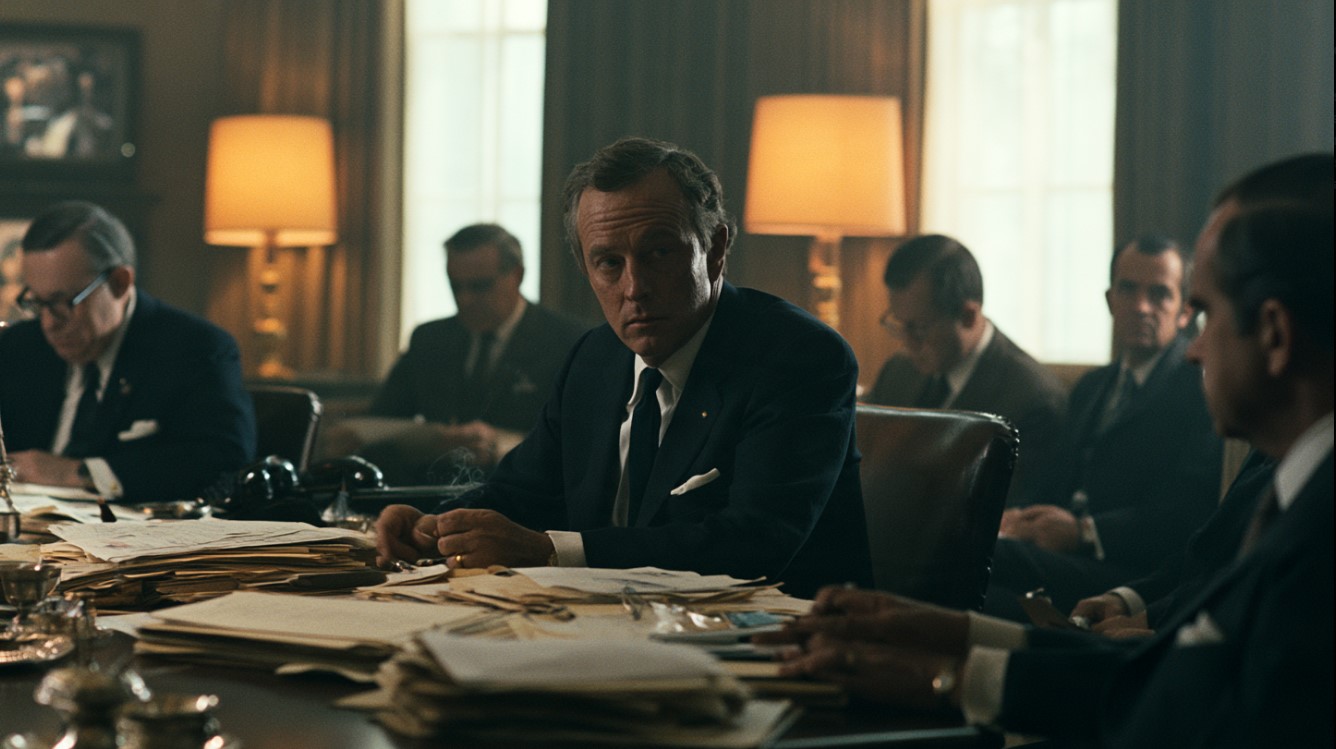
There is an almost cinematic quality to the Huston Plan. Imagine the White House in the summer of 1970: television images of burning buildings and angry demonstrations, Vietnam maps spread across desks, intelligence reports moving through government offices, college campuses in turmoil and the president demanding better information.
Then the doors close. The telephones become quieter. A White House aide begins assembling recommendations. The intelligence chiefs sit around tables.
Words such as surveillance, informants, mail, wiretaps and entries begin appearing on paper.
The government is building a plan for watching its own citizens. And somewhere in the chain of command, the president says yes.
For five days, the Huston Plan existed with presidential approval.
Then Hoover objected. Nixon reversed course. But the document remained. And so did the question it raised.
The Final File
The Huston Plan was never fully carried out as written, and that fact should not be lost beneath the darker parts of the story. The proposal was rescinded, and some of its most controversial recommendations were not implemented under the plan itself. The historical record is clear on that point.
But the plan remains important precisely because it showed what senior officials were willing to contemplate during a period of national crisis.
It also exposed the limits of the idea that presidential approval automatically makes an intelligence operation legitimate. The Constitution did not disappear when the streets became violent. The law did not stop applying because a protest became frightening.
And the government could not simply transform political dissent into a national-security category and assume that every surveillance method was therefore justified.
The Huston Plan was a blueprint for a government looking inward. It was never fully built. But the blueprint survived.
Years later, investigators would find it in the files and hold it up as evidence of how the Nixon administration approached domestic intelligence. By then, the story had become much larger than Tom Charles Huston or a memorandum written in the summer of 1970.
It had become part of the story of Watergate.
And that story had a familiar lesson from the underworld: once an organization starts operating in the shadows, it becomes increasingly difficult to control what happens there. The Huston Plan was supposed to help the White House see its enemies.
Instead, it left behind a paper trail that allowed history to see the White House.
References:
- U.S. Senate Select Committee to Study Governmental Operations with Respect to Intelligence Activities. Intelligence Activities and the Rights of Americans: Book II. 94th Cong., 2d sess., 1976. Senate Government Printing Office.
- U.S. Senate Select Committee to Study Governmental Operations with Respect to Intelligence Activities. National Security, Civil Liberties, and the Collection of Intelligence: The Huston Plan. Book III. 94th Cong., 2d sess., 1976.
- National Archives and Records Administration. Records of the Watergate Special Prosecution Force, Record Group 460. Washington, D.C.
- National Archives and Records Administration. Watergate Exhibit: Memorandum for Sharon Fawcett, Assistant Archivist, Office of Presidential Libraries. National Archives, Washington, D.C.
- Richard Nixon Presidential Library and Museum. Presidential Daily Diary, 1970. National Archives and Records Administration, Yorba Linda, California.
- Richard Nixon Presidential Library and Museum. H. R. Haldeman Diaries, 1970. National Archives and Records Administration, Yorba Linda, California.
- National Security Archive, George Washington University. “Spying on Americans: Infamous 1970s White House Plan for Protest Surveillance Released.” June 25, 2020.
- U.S. Department of State, Office of the Historian. Foreign Relations of the United States, 1969–1976, Volume XXXVIII, Part 2: Intelligence Community Documents. Historical Document 19.
- U.S. Senate. “The Senate Creates the Select Committee on Intelligence.” Senate Historical Office.
- Nixon Presidential Library and Museum. “Free Speech and Civic Engagement in an American Democracy.” Richard Nixon Presidential Library and Museum.