The Executioner’s Complaint: Albert Anastasia and the Enemies He Created
Article 6 in the Series: “The Blame Game: Mobsters Who Could Never Admit They Were the Problem”
The executioner spent years making enemies and was shocked when they finally compared notes.
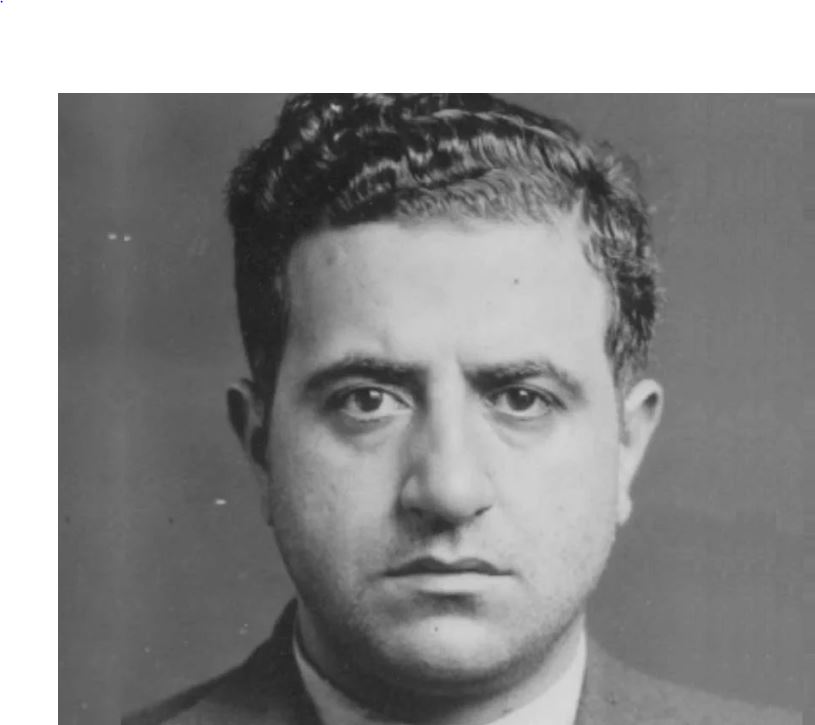
On the morning of October 25, 1957, Albert Anastasia walked into the barber shop at the Park Sheraton Hotel in Manhattan. It was the kind of ordinary ritual that seemed almost absurdly peaceful for a man whose career had been built around violence. Anastasia settled into a barber chair, expecting a haircut. Instead, two masked gunmen entered and opened fire.
Within seconds, the man once associated with Murder, Inc. and feared throughout the New York underworld was dead.
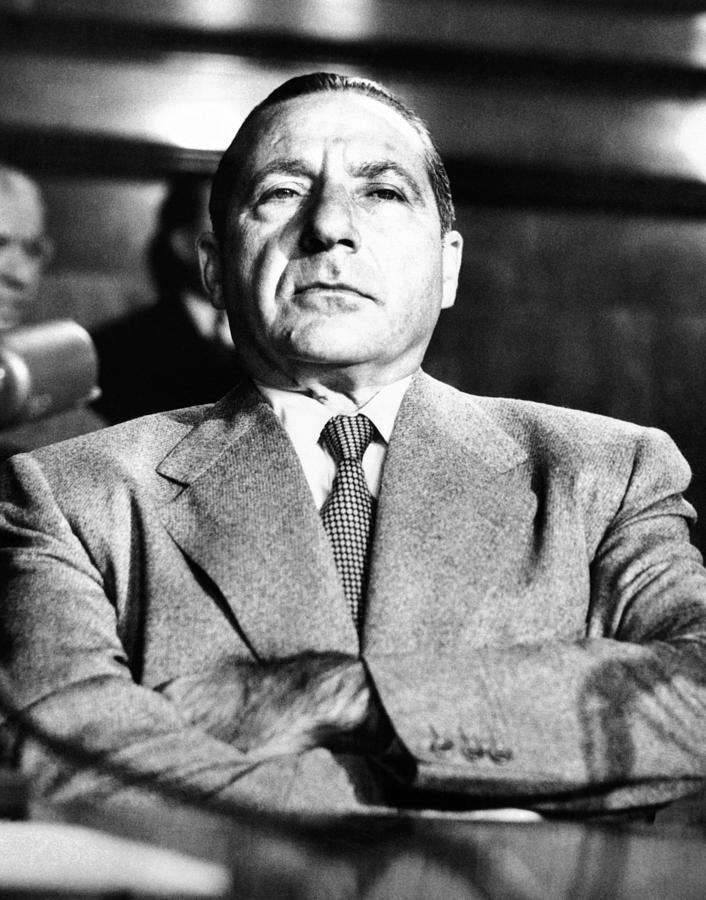
The photograph of Anastasia’s body, still surrounded by the wreckage of the barber shop, became one of the most enduring images of Mafia history. The assassination looked like the ultimate act of betrayal—a powerful boss suddenly cut down by men whose identities were never conclusively established in court.
But there was another way to view the story. Albert Anastasia had spent decades creating enemies.
He frightened subordinates, alienated fellow Mafia leaders, ignored the interests of powerful allies, and developed a reputation for violence that made even other criminals uncomfortable. By the mid-1950s, opposition to him was no longer confined to one rival or one faction. His enemies had multiplied.
Anastasia had spent years believing that fear was power. Eventually, the people who feared him discovered that they had a common interest.
The Making of a Mafia Executioner
Albert Anastasia’s reputation for violence was established long before he became boss of one of New York’s major crime families. He was closely associated with the organization later known as Murder, Inc., the enforcement arm of the New York underworld during the 1930s and early 1940s. The Library of Congress later described him as an underworld overlord and reputed chief executioner of Murder, Inc.
His reputation served a purpose.
In organized crime, a man known to be willing to kill could command obedience without constantly having to demonstrate it. Violence became Anastasia’s calling card. He was not simply another gangster trying to make money. He was a man other gangsters understood could become extremely dangerous when crossed.
But fear has a hidden cost. A subordinate who respects a boss may remain loyal. A subordinate who fears a boss may remain loyal only until another option appears.
Anastasia increasingly confused the two.
Taking Control Through Violence
In 1951, Anastasia’s relationship with Vincent Mangano, the boss of the crime family he would eventually control, deteriorated dramatically. Mangano disappeared, while his brother Philip was found murdered. Anastasia was never indicted for either killing, but he was widely suspected of involvement. Following the disappearance of Mangano, Anastasia assumed control of the organization.
His elevation demonstrated both the power and danger of his reputation. Anastasia had the muscle to seize control, but running a Mafia family required something beyond muscle. A boss had to balance competing personalities, maintain relationships with other families, and understand when aggression created more problems than it solved.
Anastasia was not particularly good at that part of the job. He had spent his career developing a reputation as an enforcer. Now he was expected to behave like a statesman.
The distinction mattered. A Mafia boss could survive being feared. What became dangerous was being feared and unpredictable.
The Schuster Murder and the Cost of Recklessness
One of Anastasia’s most consequential decisions involved Arnold Schuster, a Brooklyn clothing salesman who had helped identify bank robber Willie Sutton. Schuster’s murder in 1952 generated enormous public attention and outrage. The killing was viewed by many in the Mafia as an unnecessary act that created precisely the kind of law-enforcement and public pressure organized crime preferred to avoid.
For Anastasia, the message was simple: those who cooperated with authorities could pay a terrible price. For other Mafia leaders, however, the lesson was different. Anastasia was becoming a liability.
The traditional Mafia philosophy depended heavily on discretion. Violence was supposed to serve a purpose. A killing that generated headlines, public outrage, and intensified government attention could damage an entire organization.
Anastasia’s violent instincts were therefore no longer simply a weapon. They were becoming a political problem.
When Fear Turned Into Opposition
By the mid-1950s, Anastasia had accumulated enemies throughout the underworld. His relationship with Frank Costello provided him with powerful protection, while Vito Genovese viewed him as an obstacle to his own ambitions. At the same time, Carlo Gambino—Anastasia’s own underboss—was quietly positioning himself for greater power.
Anastasia, however, continued behaving as though his reputation guaranteed his security.
That was the mistake.
He had become accustomed to solving problems through intimidation. When someone challenged him, he responded aggressively. When another boss disagreed with him, he treated the disagreement as a threat. When subordinates became difficult, fear remained his preferred management tool.
What he failed to recognize was that his enemies did not have to defeat him individually. They only had to agree that they would be better off without him. That distinction would prove fatal.
The Boss Who Blamed Everyone Else
Anastasia’s growing problems were easy to explain if he wanted to avoid personal responsibility.
Genovese was ambitious. Gambino was disloyal. Meyer Lansky was opposed to him. Other bosses were jealous. Law enforcement was persecuting him.
Each explanation contained some element of truth. Genovese certainly wanted greater power. Gambino certainly had ambitions of his own. Powerful Mafia figures had competing financial interests. Federal authorities were certainly interested in Anastasia.
But none of those facts erased Anastasia’s responsibility for the situation. His own behavior had helped make cooperation among his enemies possible.
He had frightened the people beneath him and antagonized people above him. He had demonstrated that he was willing to use violence in ways that could create enormous public attention. He had developed an image so extreme that other bosses could plausibly portray him as a danger to the entire organization.
The executioner had become politically inconvenient.
| Joseph Colombo and the War He Started Against Reality |
Genovese Sees an Opportunity
Vito Genovese understood something Anastasia apparently did not. You did not have to beat Albert Anastasia at his own game. You simply had to convince enough people that removing him was in their interests.
Genovese was already maneuvering against Frank Costello. Anastasia was one of Costello’s strongest allies, making him a significant obstacle. According to accounts based in part on testimony from former Mafia member Joe Valachi, Genovese worked to undermine Anastasia and eventually secured the cooperation of Carlo Gambino.
The strategy was brutally simple. Remove Costello’s support. Remove Anastasia. Replace Anastasia with Gambino. And change the balance of power in New York.
When Genovese’s campaign against Costello succeeded in 1957, Costello survived an assassination attempt and subsequently relinquished control. Anastasia was suddenly exposed.
The man who had spent years relying on powerful allies had fewer places to turn.
| Carmine Galante and the Empire He Destroyed Himself |
Carlo Gambino and the Ultimate Betrayal
Perhaps the most revealing part of Anastasia’s downfall was the role of Carlo Gambino.
Gambino was not some distant rival who suddenly appeared on the scene. He was Anastasia’s own underboss. He understood the organization from the inside. He knew its weaknesses. More importantly, he knew Anastasia himself.
Gambino had watched the boss alienate people. He had watched Anastasia make dangerous decisions. He had watched the fear surrounding the organization. And he had his own ambitions. The Mob Museum identifies the 1957 murder as a plot involving Genovese and Gambino, with Gambino subsequently taking control of Anastasia’s family.
That is the central irony of Anastasia’s story.
The man who had built his career around identifying threats failed to recognize the most dangerous threat sitting close to him. His own underboss had a reason to see him removed.
| Joe Bonanno: The Boss Who Blamed Everyone |
The Barber Chair
On October 25, 1957, Anastasia entered the barber shop at the Park Sheraton Hotel. His bodyguard reportedly left the area after parking the boss’s car, leaving Anastasia exposed. Two masked gunmen entered the shop and opened fire. Anastasia was killed at the scene. The Library of Congress preserves a photograph taken that day showing police at the entrance to the barber shop.
The assassination became legendary partly because of its setting.
A barber chair. A quiet Manhattan morning. A man accustomed to commanding death suddenly unable to command anything.
The identity of the actual gunmen has remained a matter of historical debate. The assassination was never successfully prosecuted, and different accounts have pointed to different participants and motives. Some contemporary and later accounts have connected the killing to Genovese and Gambino, while other theories have implicated Joseph “Crazy Joe” Gallo or other underworld figures.
What is considerably less controversial is the political result. Anastasia was dead. Carlo Gambino became the boss.
And the balance of power in New York’s Mafia had changed permanently.
The Executioner Becomes the Victim
The image of Anastasia’s death contains a dark irony.
For decades, he had represented the threat of violence. His name was associated with Murder, Inc., executions, intimidation, and the enforcement of Mafia discipline. He had built authority by making other men fear what might happen if they crossed him.
Yet when the end came, his reputation could not protect him. In fact, it may have helped destroy him.
The more frightening Anastasia became, the more reasonable his removal appeared to men who believed he had become a threat. His violence had created fear, but fear eventually became resentment. Resentment created alliances. Alliances created opportunity.
And opportunity produced the barber shop.
The Enemies He Created
Anastasia’s story is sometimes reduced to a simple Mafia conspiracy: Vito Genovese wanted him dead, Carlo Gambino wanted his position, and therefore the two men arranged his assassination.
That explanation is incomplete. A conspiracy may explain who benefited from Anastasia’s death, but it does not explain why so many people were willing to see him removed.
That required years. Years of violence. Years of intimidation. Years of political miscalculation. Years of treating allies as potential enemies and enemies as problems that could be solved through fear. Anastasia’s downfall was therefore not simply an assassination.
It was an accumulation of consequences.
The Blame Game
That is why Albert Anastasia belongs in The Blame Game: Mobsters Who Could Never Admit They Were the Problem.
He lived in a world where blaming others was almost second nature. Rival bosses were plotting. Associates were disloyal. Government officials were enemies. Every setback could be explained as someone else’s betrayal.
But Anastasia’s greatest problem was not that he had enemies. It was that he had created so many.
He operated as though violence could permanently solve problems. He believed fear created loyalty. He treated opposition as something to crush rather than something to understand. He failed to recognize that a frightened subordinate with an opportunity to become boss might eventually decide that fear was no longer enough.
By the time Anastasia sat down in that barber chair, the political decision to remove him may already have been made.
The gunmen pulled the triggers. But the conditions that made his assassination possible had been developing for years. The executioner spent his life making other people afraid of him. In the end, he discovered that fear cuts both ways.
And the men he had frightened for years had finally compared notes.
| Albert Anastasia |
References:
Davis, John H. Mafia Dynasty: The Rise and Fall of the Gambino Crime Family. New York: HarperCollins, 1993.
Maas, Peter. The Valachi Papers. New York: G. P. Putnam’s Sons, 1968.
Raab, Selwyn. Five Families: The Rise, Decline, and Resurgence of America’s Most Powerful Mafia Empires. New York: St. Martin’s Press, 2005.
Sifakis, Carl. The Mafia Encyclopedia. 3rd ed. New York: Facts On File, 2005.
The Mob Museum. “Albert Anastasia.” The Mob Museum. Accessed August 20, 2026.
The Mob Museum. “Albert Anastasia Killed.” The Mob Museum, October 25, 1957. Accessed August 20, 2026.
United States Library of Congress. “Where Shooting Occurred: A Policeman Guards Entrance to Barber Shop in Midtown New York Hotel Where Albert Anastasia Was Shot to Death by Two Masked Men, Oct. 25.” Prints and Photographs Online Catalog. October 25, 1957.
United States Senate, Permanent Subcommittee on Investigations. Organized Crime and Illicit Traffic in Narcotics. Washington, D.C.: U.S. Government Printing Office, 1959.