Paul Castellano: The Quiet King Behind the Concrete Mansion
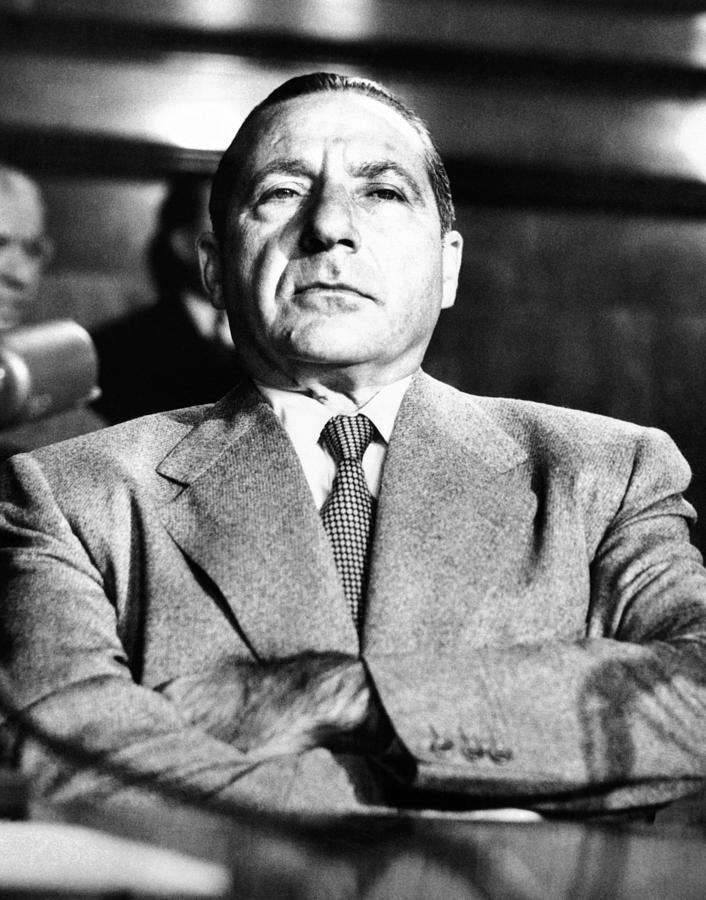
Paul Castellano did not look like the kind of gangster who needed to order a murder.
He looked like a businessman.
Behind the expensive suits, the Staten Island mansion, and the polished image was one of the most powerful men in the American Mafia. As boss of the Gambino crime family, Castellano presided over an organization that stretched from the streets of New York into labor unions, construction, trucking, food distribution, gambling, and legitimate businesses. He inherited the throne of one of America’s most powerful crime families and transformed it into something increasingly corporate. But Castellano’s greatest strength eventually became his greatest weakness.
He believed the future of organized crime belonged to businessmen rather than street soldiers. He wanted money to move quietly through legitimate industries, away from the bloodshed that attracted police and newspaper reporters. His vision was sophisticated, profitable, and increasingly detached from the men who carried out the violence on the streets.
That disconnect would eventually cost him his life.
A Brooklyn Beginning
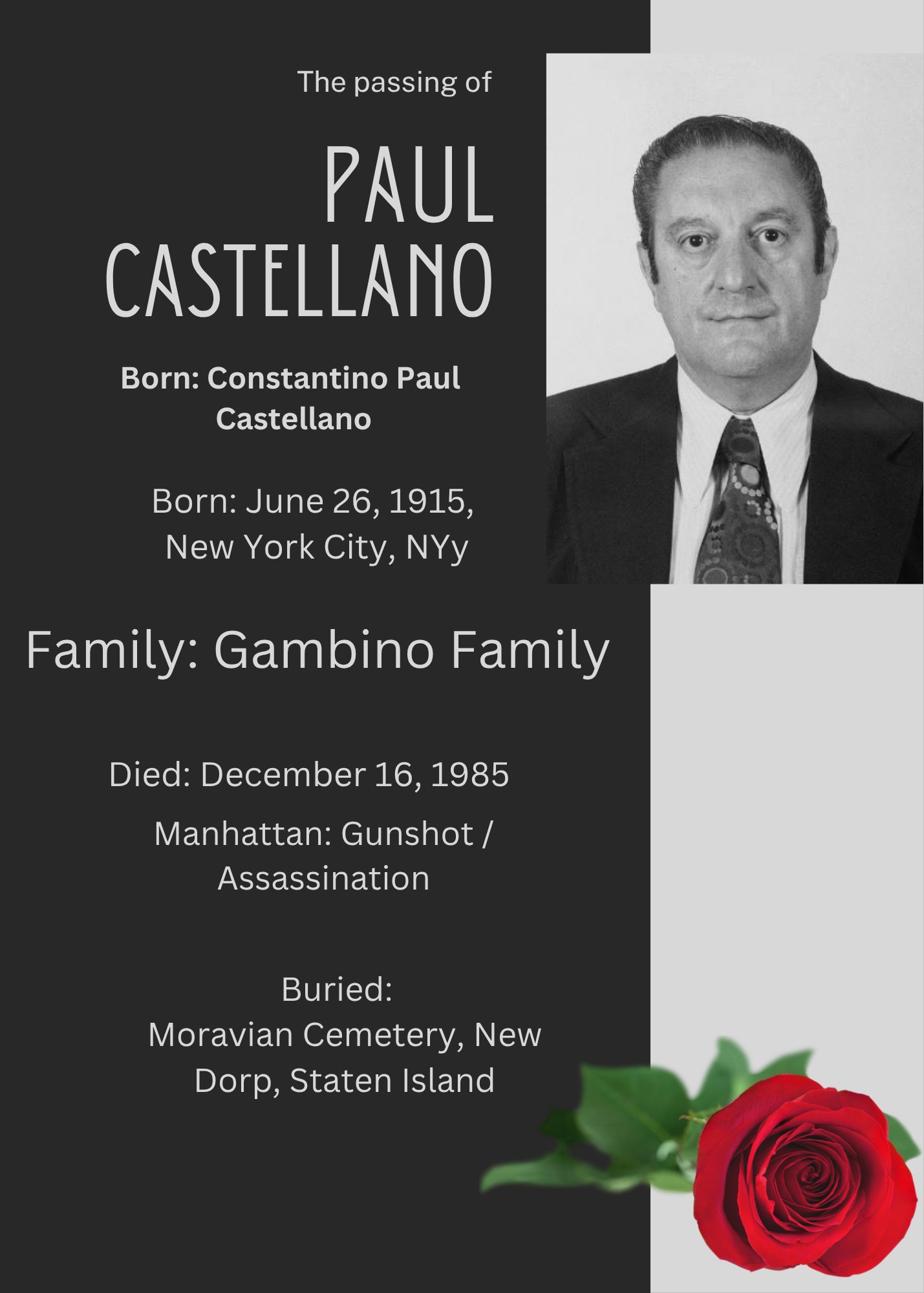
Paul Castellano was born Constantino Paul Castellano on June 26, 1915, in Brooklyn, New York. His parents were Italian immigrants, and his father worked as a butcher while also maintaining connections to the local underworld. Castellano grew up in an environment where organized crime was already becoming deeply embedded in Brooklyn neighborhoods.
He left school as a teenager and entered the world of crime, initially becoming involved in gambling and other street-level operations. His early criminal career did not immediately suggest that he would one day become the boss of the Gambino family. He was not the kind of young gangster who constantly sought attention or built a reputation through reckless violence.
Instead, Castellano demonstrated something more valuable to the Mafia: an ability to make money.
He also understood the importance of family and alliances. His sister married Carlo Gambino, a relationship that would eventually place Castellano close to the man who would become one of the most influential Mafia bosses in American history.
Under Carlo Gambino
Carlo Gambino recognized Castellano’s potential and gradually brought him deeper into the family’s operations.
Gambino was a master of discretion. He rarely sought publicity and avoided the kind of flamboyant behavior that made men like Al Capone famous. His philosophy was simple: make money, maintain control, and keep law enforcement guessing. Castellano absorbed those lessons.
He became involved in construction, food distribution, and other legitimate-looking businesses that provided opportunities for organized crime to generate enormous profits. His growing wealth allowed him to move beyond the traditional image of a street gangster.
By the 1960s and early 1970s, Castellano had become one of Gambino’s most trusted lieutenants.
When Gambino died in 1976, the succession appeared almost inevitable. Castellano became boss.
The New Gambino Boss
Taking control of the Gambino family placed Castellano at the top of one of the most powerful criminal organizations in the country. He inherited a vast network of rackets and associates, but he also inherited a problem that would eventually define his reign.
The street soldiers wanted a boss who understood the streets. Castellano wanted to run a corporation.
From his massive home on Staten Island, he increasingly managed the family like a business enterprise. He was interested in construction contracts, labor influence, trucking operations, food companies, and other ventures capable of generating substantial income without constant violence.
The mansion became almost legendary. To federal agents, it was a symbol of Mafia wealth. To street gangsters, it represented something else: a boss who appeared increasingly separated from the men who made his power possible.
Castellano’s lifestyle also created resentment. He lived behind gates and security while soldiers and capos were expected to risk prison or death carrying out orders.
The old Mafia was changing. Castellano wanted to change with it. Not everyone agreed.
The Construction Empire
Construction became one of Castellano’s most important sources of power.
New York’s construction industry was enormous, and organized crime had long understood that controlling labor unions, contractors, and supply chains could generate far more money than traditional street rackets. Castellano developed relationships that allowed the Gambino family to profit from this system while maintaining the appearance of legitimate business activity.
His approach was sophisticated.
Instead of demanding money from every business on the street, Castellano could influence much larger transactions. A construction project worth millions could produce enormous profits through bid-rigging, labor manipulation, kickbacks, and other schemes.
The Mafia was no longer merely shaking down neighborhood stores. It was positioning itself inside the machinery of the American economy. Castellano saw that future clearly.
The Growing Problem of John Gotti
While Castellano was building his corporate-style empire, another Gambino figure was becoming increasingly famous on the streets. His name was John Gotti.
Gotti represented almost everything Castellano disliked about the new generation of gangster. He was outspoken, charismatic, aggressive, and comfortable with publicity. He cultivated relationships with reporters and enjoyed the attention that came from being recognized as a Mafia celebrity. Castellano wanted none of it.
The relationship between the two men became increasingly strained. Gotti believed Castellano was out of touch with the street soldiers who created the family’s power. Castellano, meanwhile, viewed Gotti’s behavior as dangerous and reckless.
There was another problem. Gotti had developed his own powerful following. The Gambino family was becoming divided between the old boss and the men who believed the organization needed a different kind of leadership.
The Donnie Brasco Disaster
The Mafia’s vulnerability to undercover law enforcement became painfully obvious during the 1970s and early 1980s.
An FBI agent named Joseph D. Pistone infiltrated the Bonanno crime family by posing as a jewel thief named Donnie Brasco. His operation exposed the vulnerabilities created when criminals trusted outsiders. The operation had consequences far beyond the Bonanno family.
Castellano and other Mafia leaders understood that informants and undercover agents could penetrate organizations that had previously relied upon secrecy and intimidation. The federal government was no longer simply reacting to Mafia crimes.
It was entering the Mafia’s world from the inside.
The RICO Era
The passage and aggressive use of the Racketeer Influenced and Corrupt Organizations Act transformed the government’s battle against organized crime. Instead of prosecuting gangsters only for individual crimes, federal prosecutors could target the criminal organization itself. Leaders could be held responsible for broader patterns of racketeering and criminal activity.
Castellano increasingly found himself under federal scrutiny. In 1984, he was indicted on charges involving racketeering and related criminal activities. The pressure intensified over the following years as prosecutors assembled evidence against the Mafia’s leadership.
For Castellano, the greatest danger was no longer a rival gangster with a gun. It was a federal prosecutor with a wiretap.
The Commission Trial
The most devastating blow came with the federal government’s prosecution of the Mafia Commission. The case targeted the leadership of New York’s major Mafia families and accused them of operating a nationwide criminal enterprise. Castellano was among the defendants.
The trial represented a turning point in American organized crime history. Prosecutors demonstrated that the Mafia was not simply a collection of independent street gangs. It possessed a system of governance through which major families could coordinate criminal activities, resolve disputes, and protect their interests.
Castellano was convicted. He faced a lengthy prison sentence, and the future of the Gambino family suddenly appeared uncertain. But Castellano remained boss.
And outside the courtroom, John Gotti was watching.
The Final Break
By 1985, the relationship between Castellano and Gotti had deteriorated beyond repair. Castellano’s decision to elevate more business-oriented figures and distance himself from street operations angered Gotti and his allies. The government’s prosecution also created fears that the family could lose its leadership if Castellano were imprisoned.
Then came an event that changed everything. On December 16, 1985, Paul Castellano and his underboss, Thomas Bilotti, arrived at Sparks Steak House in Manhattan. They never made it inside.
Gunmen opened fire as the two men approached the restaurant. Castellano was struck repeatedly and died on the sidewalk outside the restaurant. Bilotti was killed alongside him.
The assassination was not a random Mafia shooting. It was a coup.
John Gotti had ordered the killing, according to prosecutors and later evidence, and within months he would become the new boss of the Gambino family.
The Death of the Old Mafia
Castellano’s murder became one of the most notorious Mafia assassinations in American history.
The location was almost symbolic. A powerful boss, dressed for dinner, had been executed in one of Manhattan’s most recognizable public settings. The old Mafia tradition of settling disputes behind closed doors had suddenly spilled into the street.
Gotti’s rise also represented a dramatic change in the Gambino family.
The quiet businessman had been replaced by a boss who embraced publicity. Gotti became a media sensation, earning the nickname “the Teflon Don” after several early courtroom victories.
But the victory was temporary. Federal prosecutors would eventually dismantle Gotti’s regime as well.
The Legacy of Paul Castellano
Paul Castellano remains one of the most complicated figures in American organized crime history.
He was not the classic Mafia boss portrayed in movies. He was not a street brawler looking for trouble on every corner. His ambition was larger and, in many ways, more modern. Castellano wanted organized crime to become less visible, more profitable, and more deeply integrated into legitimate industries.
That vision made him extraordinarily powerful. It also separated him from the men beneath him.
Castellano underestimated the importance of personal loyalty among street soldiers. He believed money and structure could hold the Gambino family together, but Gotti understood that fear, respect, and relationships mattered just as much.
In the end, the boss who wanted to run the Mafia like a corporation was murdered by men who believed he had forgotten what the Mafia was. His death marked the end of one era and the beginning of another.
In noir terms, Paul Castellano was the man behind the mansion gates, surrounded by money, power, and armed protection, watching an old world disappear outside his window. He had built his empire around the idea that organized crime could become cleaner, quieter, and more sophisticated.
But the streets had their own ideas. And on a cold December evening outside Sparks Steak House, the old rules came crashing through the windshield.
Buried at: Moravian Cemetery, New Dorp, Staten Island