Louis “Lepke” Buchalter: The Killer in the Tailored Coat
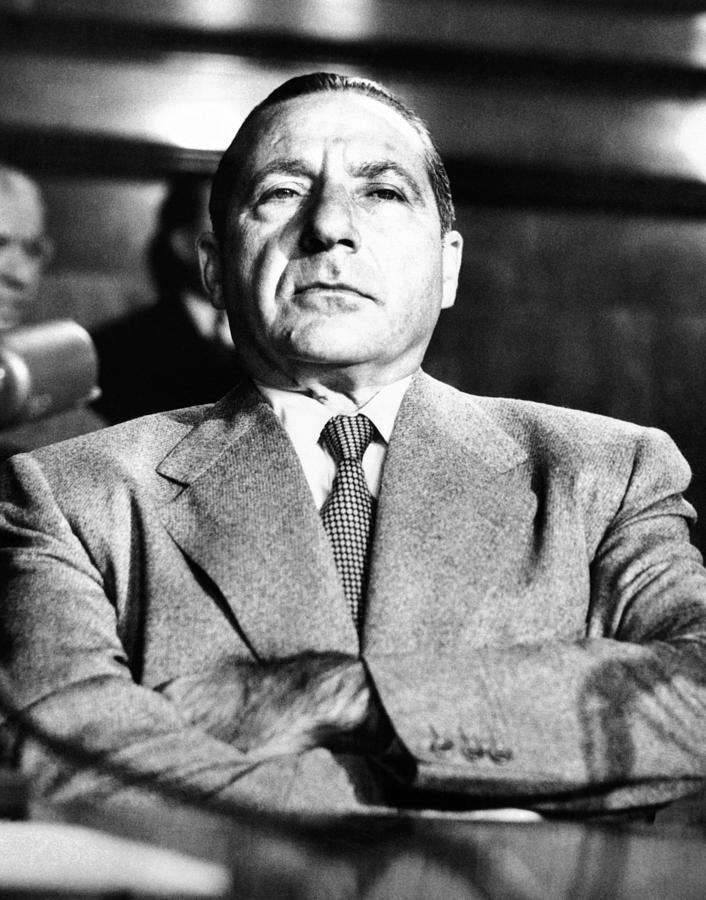
Louis “Lepke” Buchalter did not look like death. That was part of the problem.
He dressed neatly, spoke softly, and often carried himself more like a businessman than one of the most feared
criminals in America. He lacked the theatrical swagger of Al Capone or the celebrity aura of John Gotti. Lepke preferred the background. He understood that the men who survived longest in organized crime were often the ones who attracted the least public attention.
Yet behind the quiet image stood a manfederal authorities considered one of the most dangerous organized crime
figures of the twentieth century.
Buchalter controlled labor rackets, extortion schemes, garment industry corruption, narcotics operations, and one
of the deadliest murder networks in American underworld history. Law enforcement linked him directly to Murder, Inc., the infamous enforcement arm associated with national organized crime during the 1930s and 1940s.
Where some gangsters used violence impulsively, Lepke treated it like administration.
Murder became paperwork.
From the Lower East Side to the Streets
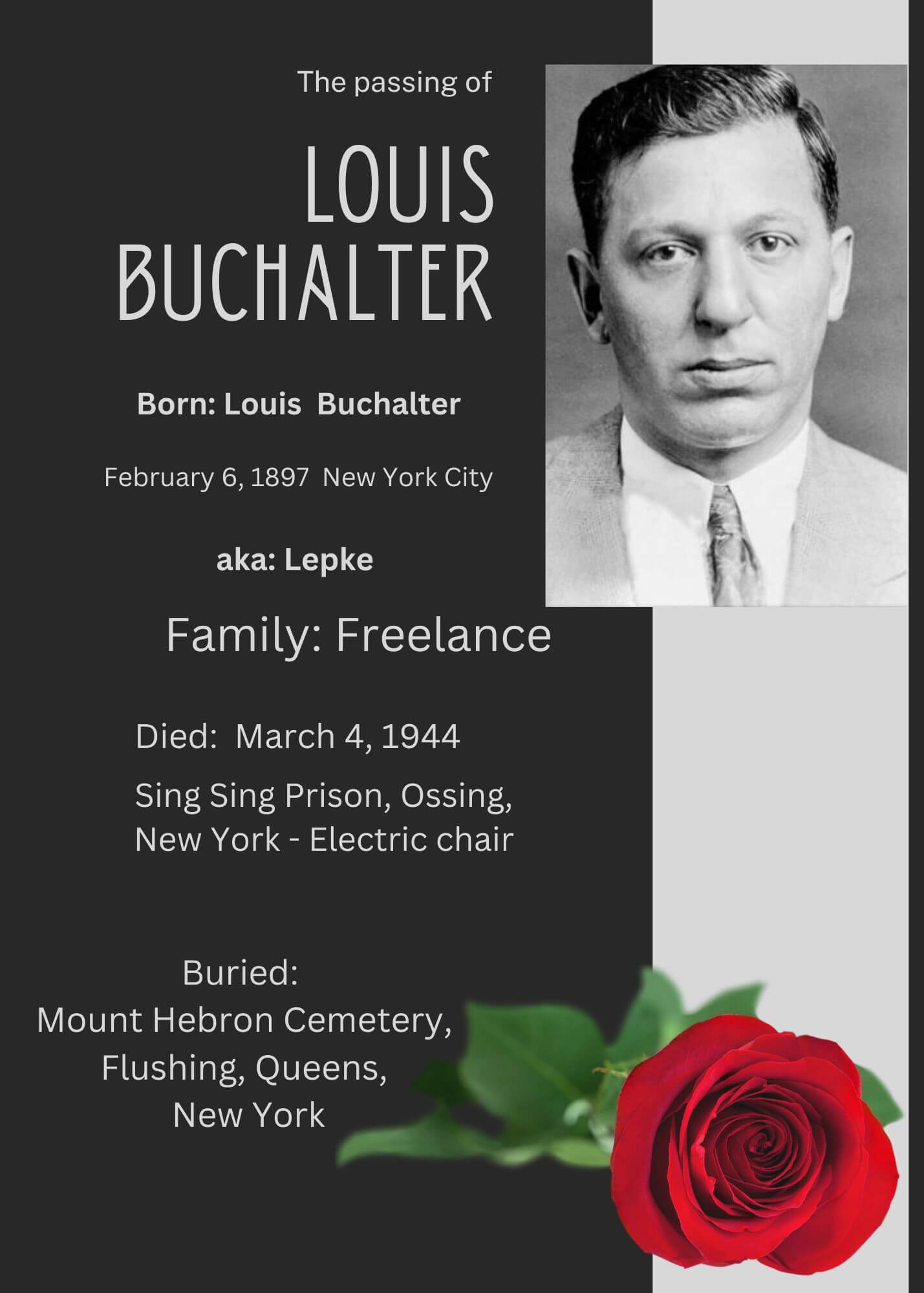
Louis Buchalter was born in Manhattan in 1897 to Jewish immigrant parents from Eastern Europe. His childhood unfolded inside the crowded and unforgiving neighborhoods of the Lower East Side, where poverty, gangs, and ethnic conflict shaped everyday survival.
His nickname “Lepke” came from the Yiddish word Leybkele, meaning “little lion,” a childhood name given by
his mother.
The tenderness of the nickname contrasted sharply with the man he became.
Buchalter’s early life was unstable. His father died young, and his mother reportedly spent long periods away from home, leaving him drifting through reform schools, petty crime, and street gangs. By adolescence, he was already involved in theft and burglary.
The streets hardened him quickly.
Unlike flamboyant gangsters who enjoyed attention, Lepke learned to operate quietly. He built connections
carefully and cultivated loyalty through business opportunities rather than personality alone.
One of the most important relationships of his early criminal life was with fellow gangster Jacob Shapiro, known as Gurrah Shapiro. Together, the two men built powerful labor extortion operations throughout New York’s garment industry.
The profits became enormous.
Labor Racketeering and Industrial Corruption
By the 1920s and 1930s, Buchalter had become one of the most powerful labor racketeers in America. He understood something many gangsters overlooked: controlling industries could be more profitable than robbing them.
The garment district offered perfect opportunities. Factories, trucking operations, unions, and manufacturers all
depended on stability. Buchalter and Shapiro inserted themselves directly into that system through intimidation and corruption.
Businesses paid for “labor peace.” Union leaders accepted bribes. Strikes appeared or disappeared depending on
organized crime interests. Truck routes, factory access, and shipping operations became controlled through fear and extortion.
Lepke’s genius was organizational. He built systems rather than temporary scams. Entire industries quietly adapted themselves around organized crime pressure because resistance often resulted in sabotage, violence, or financial destruction.
His operations expanded beyond garments into bakeries, trucking, restaurants, and labor unions across New
York. By the height of his power, Buchalter had become one of the underworld’s most successful hidden executives. And yet most ordinary Americans barely recognized his face.
Murder, Inc.
If labor racketeering made Lepke wealthy, Murder, Inc. made him infamous.
During the 1930s, national organized crime increasingly required centralized enforcement. Informants, disloyal
gangsters, independent operators, and troublesome rivals needed to disappear efficiently. According to investigators, Murder, Inc. evolved into the syndicate’s unofficial execution squad, carrying out killings across multiple states. Buchalter became one of its central figures.
The organization allegedly included killers such as Albert Anastasia, Abe Reles, and other feared enforcers
connected to Brooklyn organized crime. Victims were shot in alleys, strangled in apartments, stabbed in warehouses, and buried anonymously. Some simply vanished.
The efficiency shocked investigators. Murder became industrialized.
Lepke reportedly approved executions calmly, often while dressed impeccably in expensive suits and conducting
ordinary business elsewhere. Associates described him as emotionally detached from violence itself.
To Buchalter, murder was strategic maintenance. Not personal rage. That distinction made him especially
frightening.
The Luciano Era and National Syndicate Connections
Buchalter operated during the same transformative era that produced figures like Charles “Lucky” Luciano
and Meyer Lansky.
The American underworld was evolving away from fragmented street gangs into coordinated national syndicates. Mafia bosses, Jewish gangsters, labor racketeers, gamblers, and corrupt politicians increasingly collaborated across ethnic and geographic lines.
Lepke fit perfectly into the new system because he specialized in infrastructure.
He controlled unions. He controlled trucking. He controlled labor peace. And he controlled killers.
While Luciano reorganized the Mafia structurally, Buchalter became one of the hidden operators ensuring discipline and enforcement behind the scenes.
Yet the very efficiency that built his empire eventually attracted federal attention.
The Hunt for Lepke
By the late 1930s, law enforcement agencies had become obsessed with capturing Buchalter.
Unlike many gangsters arrested repeatedly for street-level crimes, Lepke insulated himself carefully through
layers of intermediaries and corrupt relationships. Prosecutors struggled to tie him directly to murders or extortion schemes. Still, pressure mounted relentlessly.
Federal authorities pursued him for narcotics charges, labor racketeering, and homicide conspiracies. Newspapers
increasingly portrayed him as Public Enemy Number One after the decline of more famous gangsters like Capone.
Then came the betrayal that changed everything.
Abe Reles Turns Informant
Abe Reles, one of Murder Inc.’s key killers, became a government informant after arrest.
The consequences were catastrophic.
Reles provided investigators with detailed information about organized crime murders, enforcement structures, and Buchalter’s leadership role inside Murder, Inc. For the first time, prosecutors possessed insider testimony connecting the syndicate directly to organized killings.
The code of silence had cracked. Reles described murders with horrifying precision, naming participants, methods, and orders. His testimony exposed the machinery beneath organized crime’s public image.
Buchalter understood the danger immediately.
In a highly unusual moment for a major gangster, Lepke surrendered voluntarily in 1939 after negotiations involving federal authorities and underworld intermediaries.
Even then, he hoped to avoid execution. He failed.
Trial, Conviction, and Execution
Initially convicted on narcotics charges, Buchalter later faced murder indictments based heavily on informant
testimony. The trials fascinated America.
For years, organized crime leaders had seemed untouchable. Now prosecutors argued that Lepke oversaw a national murder enterprise functioning like a corporate death squad.
The jury convicted him. In 1944, Louis Buchalter was executed in the electric chair at Sing Sing prison.
He remains the only major American Mafia-era crime boss executed by the federal government.
The symbolism mattered enormously. The government wanted America to see that organized crime leadership could face not merely imprisonment, but death itself.
The Legacy of Lepke Buchalter
Louis Lepke Buchalter represented organized crime at its coldest and most systematic.
He lacked the celebrity glamour of Bugsy Siegel or the political polish of Frank Costello. Instead, Lepke embodied something darker: Administrative violence. He understood industries, logistics,
labor systems, and intimidation structures with terrifying clarity. Under his influence, organized crime evolved beyond neighborhood gangs into interconnected business operations capable of influencing major sectors of
American industry.
And when those operations required violence, Murder, Inc. delivered it efficiently.
Buchalter’s downfall also marked a turning point. Informants, coordinated prosecutions, and federal investigations increasingly threatened the secrecy that organized crime depended upon. The mythology of invincible gangsters began cracking under legal pressure.
Still, Lepke’s legacy endured in the shadows of labor corruption, racketeering systems, and organized enforcement networks that survived long after his execution.
He never sought the spotlight.
But for years, Louis Lepke Buchalter stood behind some of the darkest machinery in the American
underworld—soft-spoken, carefully dressed, and quietly deciding who would live
and who would disappear.
Click the links below to see where he is buried. “