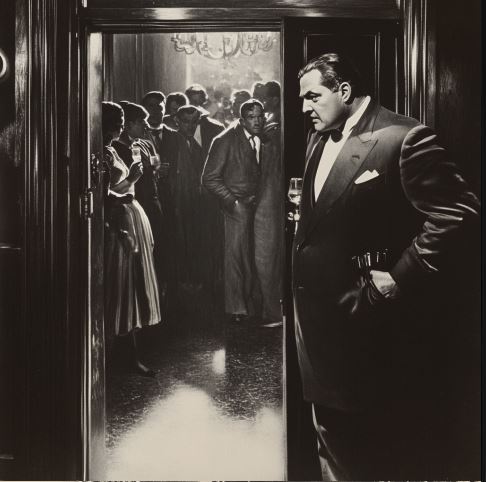
The door was unmarked. No sign, no flicker of neon, no hint of life behind the brick or timber. Maybe it was a butcher shop, maybe a tailor’s back room where suits never seemed to sell. Some nights, it was just a silent doorway in a row of silent buildings. But if you knew the knock—or knew the man who knew the knock—the door opened to another America. Smoke hung thick in the air, jazz slid through the room like liquid silk, and glasses clinked with a rhythm that was steady, deliberate, and very, very dangerous. Deals were whispered between sips of gin, fortunes exchanged under the hum of a muted piano.
During Prohibition, the speakeasy was far more than a secret bar. It was a command post, a nucleus of organized crime cleverly disguised as entertainment. Behind the bar stood more than a bartender. Behind the walls, there was a circulation of money, influence, protection, and raw power. Patrons thought they were enjoying a drink; the mob was conducting a symphony of control, one carefully orchestrated glass at a time. To understand the rise of the American Mafia, you can’t see speakeasies as clubs—they were operational headquarters masquerading as leisure.
| Bee’s Knees, Sweet Enough to Hide a Crime |
The Speakeasy as a Business Engine
Prohibition outlawed the drink but couldn’t touch the thirst. Americans didn’t stop drinking; they just drank differently. And with that shift, a vast, illegal economy emerged almost overnight—one too large and too complex to be run by street thugs alone. The speakeasy became the retail face of a national enterprise. Supply chains stretched from domestic stills to Canadian whisky to Caribbean rum. Enforcement teams collected their cut and ensured compliance. Political shields—local aldermen, police captains, ward bosses—smoothed the edges.
Every cocktail served in those dimly lit rooms was underwritten by infrastructure. The mob didn’t stumble into this—it designed it. These bars were nodes in a network, operating with precision, coordination, and a near-scientific understanding of human behavior. The speakeasy wasn’t a gamble—it was business, insurance, and intelligence all rolled into one.
Bars as Camouflage
Bars are social spaces. People talk, laugh, argue, let slip secrets they wouldn’t in the street. During Prohibition, that social energy became tactical advantage. The mob used bars to move cash, negotiate alliances, and gather intelligence without raising suspicion. A corner speakeasy might serve working-class patrons with cheap gin and fast turnover, but mob-owned nightclubs catered to power. Imported liquors, full orchestras, VIP sections, dining rooms—these places weren’t about fun; they were about influence.
Judges, journalists, police captains, politicians—all were welcome, carefully curated, and quietly watched. A speakeasy could function as a boardroom, a court, a negotiating table. If a deal went south outside, it could be dangerous. Inside, surrounded by smoke and music, it was controlled, contained, almost theatrical in its precision.
| Gangsters Favorite Drinks Were About Control, not Excess |
The Illusion of Secrecy
Hollywood romanticizes the sliding bookcases, trapdoors, and secret staircases. In reality, the secrecy was procedural. Passwords changed nightly. Membership cards were issued and revoked at whim. Front businesses—a soda shop, café, or tailor—masked the real activity behind them. Lookouts guarded corners, entrances, and sidewalks. And raids? Often they were staged, timed for empty nights, bottles smashed for the papers while business resumed the next evening.
The mob didn’t defy the law—they co-opted it. This careful theater allowed operations to continue uninterrupted. When a bar closed, it wasn’t a collapse—it was a relocation, a shift in coordinates. The syndicate never lost ground, only addresses.
Ownership and Control
Rarely did the man whose name was on the lease control the bar. The real power rested elsewhere. Layers of ownership insulated the syndicate: the frontman—often the manager or bartender; the silent backer—financially connected to the mob; enforcement partners—gang muscle ready to intervene; and political shields—officials ensuring operations weren’t disrupted.
This structure kept liability away from the true operators. If one establishment went down, another quietly reopened nearby. The empire wasn’t dependent on a single location—it was a network, mobile and resilient.
Luciano and the Professionalization of Vice
Before Charles “Lucky” Luciano, speakeasies were markers of turf, not profit. Violence was common, alliances fragile, and operations localized. Luciano saw a different path. Speakeasies were distribution points, not flags to be planted.
Under his vision, supply chains were standardized. Violence became strategic, not arbitrary. Profits were shared, alliances nurtured across ethnic lines, and operations encouraged to run quietly. The less attention a bar drew, the longer it stayed open—and the more wealth flowed up the chain. Efficiency became the new currency.
| Champaigne Was the Ultimate Flex |
Bartenders as Gatekeepers
Bartenders weren’t simply pouring drinks. They were observers, enforcers, and collectors of intelligence. Every patron was cataloged: who drank too much, who asked the wrong questions, who seemed suspicious. Reports flowed upward—nervous money, federal agents’ names, rival gang members’ whispers. In a speakeasy, the bartender wasn’t serving cocktails; he was managing risk.
Even the drinks themselves were tactical. Poor-quality bootleg liquor had to be masked. Sugar, citrus, bitters, vermouth—cocktails became smoother, sweeter, more complex. But they were also messages. A well-made drink implied quality supply, which implied strong mob connections, which implied protection. Taste, in this context, was a display of power.
Women in the Operation
Women were vital, often underestimated players. They managed patrons, tracked finances, moved liquor unseen, and fronted businesses. Figures like Texas Guinan didn’t just entertain—they commanded the room. Their presence attracted celebrities, journalists, and gangsters alike. In a male-dominated underworld, women controlled the atmosphere, and in that world, control of the atmosphere was everything.
| Women, Cocktails and the Illusion of Innocence |
Intelligence and Influence
Every speakeasy was a hub of information. Off-duty cops, politicians, journalists, and rival gang members shared the room. Casual chatter revealed impending raids, political vulnerabilities, and shifts in alliances. The street corner was replaced by a warmer, safer, and far more profitable platform.
Raids were often more theater than enforcement. Bottles smashed for the cameras, papers filled with sensational headlines—but by morning, operations resumed. Law became part of the machinery, not an adversary.
| Why Cocktails Survived After the Speakeasy Died |
The Legacy of the Speakeasy
When Prohibition ended in 1933, thousands of speakeasies vanished overnight. But the lessons remained. The mob had learned to launder money, manage complex networks, influence officials, and operate nationally. Las Vegas, nightclubs, casinos, restaurants, unions—all descendants of the hidden bar.
Modern themed speakeasies, with their password doors and dim lighting, are echoes of a world that was never about nostalgia. It was about survival. About power. About lessons the mob never forgot: the most effective headquarters is one that no one notices.
References
-
- Kobler, John. Capone: The Life and World of Al Capone. Da Capo Press, 2003.
-
- Messick, Hank. Mobs, Gangs, and America: The Prohibition Era. Simon & Schuster, 1991.
-
- Sifakis, Carl. The Mafia Encyclopedia. Facts on File, 2005.
-
- Raab, Selwyn. Five Families: The Rise, Decline, and Resurgence of America’s Most Powerful Mafia Empires. Thomas Dunne Books, 2005.
-
- Kelly, Robert J. Speakeasies and the American Underworld. Oxford University Press, 2012.
-
- Critchley, David. The Origin of Organized Crime in America: The New York City Mafia, 1891–1931. Routledge, 2008.
This Post Has 2 Comments
Greetings! This is my first visit to your blog! We are a team of volunteers and starting
a new initiative in a community in the same niche.
Your blog provided us beneficial information to work on. You
have done a marvellous job!
Thank you. I appreciate the kind remparks.