The Pardon Machine: Harold Hoffman, New Jersey, and the Business of Mercy
Article 2 in the series “The Loyalty Test: How Governors Learned to Fall in Line
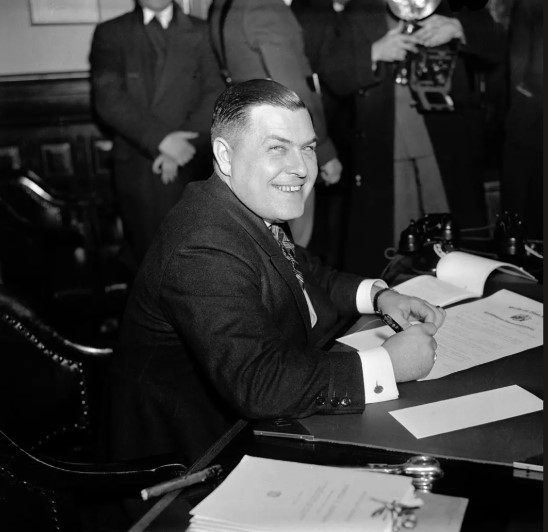
but the deals kept late hours. Harold G. Hoffman didn’t look like a man who ran
a racket. He looked like a banker who had misplaced his conscience—neat,
orderly, and the kind of governor who posed well for photographs while speaking
in the careful, padded language of committees and proclamations. Yet during his
turbulent tenure from 1935 to 1938, New Jersey became something else entirely:
a clearinghouse for second chances, a turnstile for convicts, and a place where
the word mercy could be translated into cash, influence, or political
favor.
They called it clemency. The
newspapers called it a scandal, the cops called it sabotage, and in the back
rooms of Newark, where political fixers and racketeers compared notes, they
called it good business. The issue was not simply whether individual pardons or
commutations were justified. The deeper question was whether the governor’s
power to grant mercy had become predictable enough to be exploited by the
people who understood the value of political influence.
New Jersey: The Crooked Hallway
By the mid-1930s, New Jersey was
already a crooked hallway connecting bigger, darker rooms. New York’s mobs used
the state as a staging area, Philadelphia’s outfits used it as a buffer, and
Newark had become a fortress of rackets involving gambling, the lingering
profits of Prohibition, labor shakedowns, and nearly every variety of political
fixing that could survive the repeal of the Eighteenth Amendment.
At the center of that web sat Abner
“Longie” Zwillman, a man with a soft voice, a hard reputation, and friends in
places that were not supposed to have friends like him. Hoffman did not invent
this world, but he stepped into it like a man boarding a moving train and
decided not to jump off. The Great Depression had hollowed out the state,
leaving people broke, angry, and tired. Politicians promised relief and
delivered speeches, while the rackets continued to generate money. Gambling did
not care about unemployment, protection money did not go on strike, and the
underworld still had cash when legitimate businesses had excuses.
What Hoffman brought to this ecosystem
was not muscle or charisma. It was something considerably more useful to a
political machine: a pen and the legal authority attached to it.
| Governor Who Looked Away: Len Small, Prohibition, and the Statehouse That Made Room for the Mob |
When Mercy Became a Political Currency
A governor’s power to pardon or
commute a sentence is supposed to function as a safety valve—a mechanism for
correcting miscarriages of justice, recognizing rehabilitation, or tempering
the strict application of the law with humanity. In Hoffman’s New Jersey,
however, critics increasingly saw the clemency process as something closer to a
vending machine. Put in the right coin, pull the right string, and a door could
open somewhere inside a prison wall.
The numbers began telling the story
before the headlines did. Clemency flowed from the governor’s office at a rate
that attracted the attention of judges, wardens, prosecutors, police officials,
and journalists. Men convicted of serious crimes found their sentences reduced
or erased. Some undoubtedly had compelling cases, while others did not. What
made the situation politically explosive was the perception that a remarkable
number of beneficiaries shared another characteristic: they were useful to someone
who was useful.
Prosecutors began noticing patterns,
as did police chiefs and reporters who still believed that government should
withstand daylight. Accusations followed quickly. Critics charged that the
administration was selling mercy. Hoffman denied wrongdoing, insisting that
individual cases were justified and that clemency decisions were subject to
review. Every signature, he maintained, was legitimate.
But in Newark, Hudson County, and the
smoky political rooms where fixers and racketeers compared information, the
perception was different. The statehouse had become predictable, and
predictability in the underworld can be more valuable than honesty. If people
believed that the right connections could influence what happened after
conviction, then the clemency system itself became another tool of political
and criminal power.
| The Sunshine Racket: Fuller Warren, Florida, and the State That Let the Slots Sing |
Abner Zwillman Didn’t Need to Knock
Abner “Longie” Zwillman did not need
to walk into the governor’s office to exert influence. Men like Zwillman rarely
needed to appear personally when lawyers, political insiders, ward heelers, and
intermediaries could carry messages for them. Their strength came from the
ability to move information and favors through a network without leaving
obvious fingerprints.
If a gambler was arrested, there was a
process. If a labor enforcer received a lengthy sentence, there was a process.
If a numbers runner ended up behind bars when he was expected to be back on the
street collecting money, there was a process. It did not necessarily begin with
an appeal to a higher court or an argument about constitutional principles. It
could begin with a name, a favor, a political connection, or a lawyer who knew
which door to knock on.
That was the attraction. Organized
crime did not necessarily need to own the system if it could learn how to
navigate it. A political connection did not have to guarantee an outcome every
time. It only had to create the expectation that an outcome could be
influenced.
The Men ho Built the Cases Watched
Them Collapse
For police officers and prosecutors,
the consequences were particularly corrosive. Imagine spending months building
a case, cultivating witnesses, surviving threats, gathering evidence, and
finally securing a conviction, only to see the governor’s office reduce or
erase the punishment. From the perspective of law enforcement, such decisions
could make years of work feel temporary.
Judges faced their own frustration. A
sentence imposed after a conviction represented the culmination of a judicial
process, yet clemency could alter that punishment from above. When this
happened repeatedly, the authority of the courtroom could begin to look less
absolute.
The result was not simply anger. It
was morale.
Law enforcement officers had to wonder
why they should spend years pursuing dangerous defendants if political
influence could eventually shorten the consequences. Judges could question
whether the sentences they imposed would carry the weight they were intended to
carry. And criminals watching the process learned something potentially more
valuable: the conviction was not necessarily the end of the story.
| The Loyalty Test: How Governors Learned to Fall in Line: The Safest Bet – Nevada Gov. Vail Pittman |
The Headlines Start Talking
The press had a field day. Editorials
sharpened their knives, columnists began counting names and connections, and
the phrase “pardon racket” moved from private conversation into public
headlines. Investigations were launched, committees were formed, and testimony
was taken in rooms that smelled of sweat, old wood, and political anxiety.
Hoffman appeared before microphones
and spoke the language expected of a governor. He talked about compassion,
fairness, rehabilitation, and the responsibility of the executive office to
consider individual circumstances. It was the language of respectable
government, and on paper it was difficult to argue with.
Outside the marble buildings, however,
the streets offered a less polished interpretation. Men who had been expected
to remain behind bars were returning to circulation. Some went straight, while
others went back to the rackets that had helped support them in the first
place. Every questionable release carried the same dangerous message: the
system was negotiable.
For organized crime, that was
precisely the message it wanted to hear.
Political Machines and Criminal
Machines
New Jersey in the 1930s was not simply
fighting criminals. It was fighting the political gravity created by decades of
machine politics. In places such as Jersey City and Newark, political
organizations had deep roots, long memories, and considerable reach. The
relationship between politicians and criminals did not always require an
obvious exchange of cash in a dark room.
Sometimes it was enough to understand
who knew whom.
A lawyer knew a politician. A
politician knew a party boss. A party boss knew a fixer. The fixer knew a
racketeer. Somewhere down that chain, a prisoner suddenly had a better chance
of receiving favorable consideration.
That was what made political
corruption so difficult to isolate. It did not always announce itself as a
criminal transaction. It could look like a favor, a recommendation, an
introduction, or an unusually persistent request for mercy. The individual acts
could appear harmless when viewed separately, while the larger pattern
suggested something far more troubling.
The Intermediaries
Investigators began looking beyond the
governor himself. They examined lawyers who appeared repeatedly in clemency
matters, political figures whose names surfaced in connection with prisoners
seeking relief, and intermediaries who seemed capable of turning hopeless cases
into cases worthy of reconsideration.
The same names appeared again and
again. The same counties seemed to surface repeatedly. The same political
relationships appeared in the background. Investigators were not simply looking
at individual prisoners anymore; they were looking at the machinery that
connected prisoners to people with influence.
Was every pardon corrupt? Almost
certainly not. There were undoubtedly legitimate cases in which mercy was
justified, and a governor’s constitutional authority to grant clemency exists
precisely because justice sometimes requires flexibility.
But corruption does not require every
transaction to be corrupt. It requires enough questionable transactions to
create a reliable expectation that influence can produce results. Once that
expectation becomes established, the perception itself becomes a form of power.
The Statehouse Becomes a Switchboard
By 1938, the noise had become
difficult to ignore. The scandals had accumulated, the headlines had become
increasingly aggressive, and Hoffman’s administration was being portrayed as
something less than an ordinary government operation. To critics, it looked
like a switchboard connecting prisoners to patrons, lawyers to politicians, and
influence to opportunity.
Hoffman left office under a cloud that
never completely lifted. What remains striking is not simply the volume of
clemency associated with his administration, but the perception that the system
had become predictable enough to manipulate. Executive power had begun to look
like a commodity—something that could be influenced, steered, arranged, or
negotiated.
For men like Zwillman, that was the
ideal environment. Organized crime did not necessarily need to control the
courts if it could influence the exits.
The Damage Was Bigger Than the Pardons
The long-term damage was quieter than
the headlines but potentially deeper. Public trust suffered, law enforcement
morale weakened, and judges could become cynical about the ultimate effect of
their sentences. At the same time, the underworld received another lesson about
the vulnerabilities of democratic government: influence could sometimes
accomplish what intimidation could not.
That was the real value of political
corruption. It did not have to destroy the system. It only had to make the
system predictable.
If criminals believed that the right
politician, lawyer, party insider, or intermediary could influence what
happened after conviction, then punishment itself became another variable in
the racketeering equation. A prison sentence was no longer necessarily the
final chapter. It could become the beginning of another negotiation.
Was Hoffman Corrupt—or Was He Useful?
Hoffman’s defenders could argue that
he was naïve, overwhelmed, or simply too generous for a hard political world.
Perhaps he believed that mercy was one of the responsibilities of executive
office and that individual cases deserved individual consideration.
But politics has a brutal habit of
judging results rather than intentions. Whatever Hoffman personally believed,
the outcome of his administration was a New Jersey in which organized crime had
another reason to believe that government could be influenced.
The important question is not whether
every clemency decision was purchased. The more important question is whether
enough people believed that political influence could produce favorable
treatment to make the system useful to those who understood how to manipulate
it.
That distinction matters because
corruption rarely announces itself with a suitcase full of cash. Sometimes it
looks like a lawyer making a call. Sometimes it looks like a political
recommendation. Sometimes it looks like a governor placing a signature on a
legal document.
Len Small Looked Away. Hoffman Signed.
In Illinois, Len Small had looked away
while the mob made money. Harold Hoffman in New Jersey represented something
more intimate in the story told by his critics: he signed.
That distinction is what makes the
Hoffman story so compelling. The weapon was not a gun, a bomb, or a threat
whispered in a dark alley. The weapon was the legal authority of the state,
exercised through a document that could shorten a prisoner’s sentence or open
the prison door entirely.
A pardon.
A commutation.
A signature.
A door opening.
For organized crime, that kind of
power was enormously valuable because it could operate in plain sight while
wearing the respectable clothing of government procedure.
The Business of Mercy
In noir stories, corruption is rarely
loud. It does not always kick down the door. More often, it opens the door with
a smile, offers you a chair, and explains why everything being done is
perfectly legitimate.
Harold Hoffman’s New Jersey was like
that—polite, procedural, and increasingly difficult to understand without
examining the connections between politics, clemency, organized crime, and
influence. The damage was not limited to the prisoners who walked free. It
extended to the people who began believing that justice depended on who you
knew.
The real lesson of the Hoffman era is
not simply that a governor possessed the power of clemency. It is that
organized crime understood something politicians sometimes forgot: power does
not always have to be stolen. Sometimes it only has to be influenced.
Hoffman’s administration turned mercy
into a system, at least in the eyes of its critics. And systems, once built,
can develop a momentum of their own. They continue operating through
relationships, expectations, favors, and political pressure, long after the
people who created them have left the room.
In the end, the question was never
simply who deserved mercy.
The question was who knew where to
find it.
References & Sources
- Sifakis, Carl. The Mafia Encyclopedia. Facts on
File, 2005. - Newark Evening News and New York Times archives
(1936–1938), coverage of the Hoffman clemency scandals. - State of New Jersey, Joint Legislative Committee
Investigation Records (late 1930s), clemency and pardon inquiries. - Roberts, Sam. “Abner ‘Longie’ Zwillman, the Al Capone
of New Jersey.” The New York Times, historical retrospectives. - Asbury, Herbert. The Gangs of New York and The
Gangs of Chicago (for regional organized crime context and political
protection systems). - U.S. Senate, Special Committee to Investigate
Organized Crime in Interstate Commerce (Kefauver Committee), 1950–1951
(background on political corruption and state-level protection networks). - New Jersey State Archives, Governor Harold G. Hoffman
administration records (1935–1938). - Lardner, James. The Chosen Few: How Education
Shaped Jewish History, 70–1492 (for biographical and Newark political
context around Zwillman-era power networks)