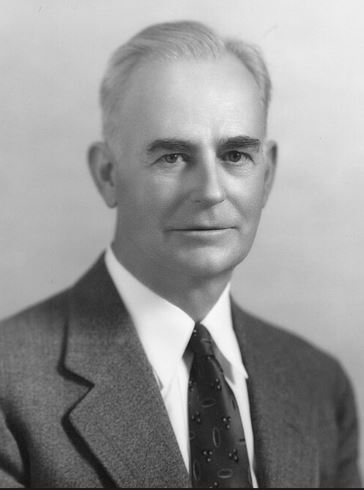
Article 5 in the series: “The Loyalty Test: How Governors Learned to Fall in Line”
The Desert Illusion of Clean Money
In the desert, money looks cleaner than it is.
Las Vegas in the mid-1940s was a rumor pretending to be a city. A scatter of neon, a handful of dusty roads, and a promise that anything could happen if you brought cash and didn’t ask for receipts. When Vail Pittman took the governor’s chair in 1945, Nevada was still selling itself as a frontier—wide open, lightly policed, eager for investment.
The kind of investment that doesn’t ask too many questions.
The war had just ended. America had money in its pockets and restlessness in its bones. Nevada had legal gambling, cheap land, and a government that wanted growth more than it wanted headaches. Organized crime noticed immediately.
They didn’t come with guns first. They came with architects.
Moe Dalitz was one of them. A Cleveland racketeer with a businessman’s posture and a syndicate’s backing, Dalitz and his associates saw Las Vegas not as a hideout, but as a portfolio. Casinos could be cleaned up. Papered over. Turned into respectable money machines that printed cash day and night.
What they needed wasn’t secrecy. It was permission.
Permission Without Paper
Under Pittman, they didn’t get permission in writing. They got something better: a regulatory climate that treated scrutiny like bad manners. Licensing was loose. Background checks were polite. Front men were accepted at face value. If a hotel had lights and payroll, the state tended to smile and move on.
The Strip began to change shape.
Projects grew bigger. Money grew thicker. The same names—often hidden, sometimes whispered—kept showing up behind different properties. Dalitz and his circle weren’t alone, but they were emblematic: men with criminal pedigrees and corporate ambitions, using Vegas as a bridge between the underworld and the balance sheet.
The state’s attitude was simple: if the money flows, don’t ask too many questions.
Pittman wasn’t a gangster. He was a politician who believed in development, and Nevada was starving for it. Mining was fading. Tourism was the future. Gambling was the engine. If people with checkered pasts wanted to build palaces in the desert, well—nobody had clean hands out here.
That’s how you get a system that doesn’t just tolerate the mob. You get one that makes it comfortable.
The Machinery of Acceptance
Licenses went to front men with good suits and better lawyers. Regulators asked about square footage and parking, not about Cleveland or Detroit or Chicago. The skim—the quiet siphoning of cash back to syndicate bosses—wasn’t Nevada’s problem. Nevada got its cut in taxes and jobs and headlines about growth.
And growth came fast.
Hotels rose where sand had been. The Flamingo’s ghost lingered, but new properties followed. The town learned how to sell fantasy at scale. Behind the scenes, the money learned how to travel in envelopes and ledgers that never quite balanced.
Federal agents were slow to arrive and quicker to realize what they were looking at. By the late 1940s and early 1950s, it was obvious to anyone paying attention that Las Vegas was becoming a preferred investment zone for organized crime. Not because the mob was hiding there—but because it didn’t have to.
The beauty of Nevada’s system was that it didn’t require conspiracy. It required indifference.
If you don’t ask who’s really paying for the concrete, you don’t have to like the answer.
Growth as Justification
Pittman’s administration defended its approach as practical. The state needed capital. It needed jobs. It needed visibility. And it got all three. The casinos weren’t back-alley joints. They were landmarks. They were payrolls. They were postcards.
Critics called it a sellout. Supporters called it realism. The mob called it the best deal in America.
For men like Dalitz, Vegas was a dream because it turned risk into respectability. You could take syndicate money, run it through a hotel, and come out the other side with dividends and a civic reputation. You could be a builder instead of a bookie. A developer instead of a driver.
And the state, eager and understaffed, let it happen.
Regulation existed, but it was a suggestion, not a wall. Enforcement existed, but it was selective, not structural. Everyone understood the priority: keep the lights on, keep the tourists coming, keep the money moving.
A City Built for Blind Spots
In noir stories, the city is usually corrupt before the hero arrives. Las Vegas was something stranger. It was designed that way—built with a smile and a blind spot.
By the time Pittman left office in 1951, the pattern was locked in. The mob wasn’t sneaking into Nevada. It was building it. The Strip had become a showroom for syndicate capital, dressed up in neon and optimism.
Later reforms would come. Later scandals would break. Later hearings would drag names into the light. But the foundation was already poured, and it had been poured during a time when asking questions was considered bad for business.
Nevada didn’t just tolerate organized crime.
It gave it a balance sheet.
The Philosophy of the Desert
That’s the real legacy of the Pittman years—not a single corrupt act, not a single smoking gun, but a philosophy: growth first, scrutiny later. In the desert, that philosophy turned the mob from a shadow into a stakeholder.
And once that happens, the house always wins.
References & Sources
- Sifakis, Carl. The Mafia Encyclopedia. Facts on File, 2005.
- Rothman, Hal. Neon Metropolis: How Las Vegas Started the Twenty-First Century. Routledge, 2002.
- Moe Dalitz and Las Vegas development coverage, Las Vegas Review-Journal historical archives.
- U.S. Senate, Special Committee to Investigate Organized Crime in Interstate Commerce (Kefauver Committee), Hearings, 1950–1951 (sections on Las Vegas and casino ownership).
- Newton, Michael. The Encyclopedia of American Law Enforcement. Facts on File, entries on Nevada gambling and organized crime.
- Nevada State Archives, Governor Vail Pittman administration records (1945–1951).
- Domanick, Joe. Cruel Justice: Three Strikes and the Politics of Crime in America (for historical context on Nevada crime policy and enforcement culture).
- Asbury, Herbert. The French Quarter and related underworld histories (for migration of organized crime into legal gambling markets).