The Mayor, the Mob and the Senate: William O’Dwyer’s Dangerous Friends
When New York’s Mayor Found Himself Sitting Across From the Senate
Politics has always depended on relationships. So has organized crime. The trouble begins when the people involved cannot—or will not—explain where legitimate political connections end and the influence of the underworld begins.
William O’Dwyer understood New York politics from several different vantage points. He had served as a prosecutor who pursued organized crime, won election as mayor of New York City, and eventually became the United States ambassador to Mexico. His career had been built, in part, on his reputation as a man who understood the city’s criminal underworld and knew how to fight it.
By 1951, however, O’Dwyer was facing uncomfortable questions about the people who had moved through his political world. The Senate’s Special Committee to Investigate Organized Crime in Interstate Commerce, better known as the Kefauver Committee, wanted to know more about his associations with individuals connected to gambling, racketeering, and powerful underworld figures.
The investigation placed O’Dwyer in an awkward position. The man who had once helped prosecute gangsters was now being asked to explain his relationships with people associated with them. The allegations did not establish that he was a Mafia member, but they raised serious questions about political patronage, money, and the company he had kept.
The story was no longer simply about what organized crime had done. It was about the people who might have helped create an environment in which it could thrive.
The Room: New York City, March 1951
The microphones were ready, and the television cameras were waiting. Only days earlier, Frank Costello had appeared before the Kefauver Committee, creating one of the most memorable spectacles of the early television era. Now the investigation was turning its attention toward another prominent New Yorker.
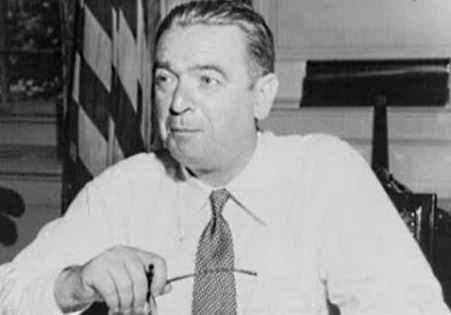
William O’Dwyer was not a gangster or a bookmaker. He was a former prosecutor, a former mayor of the nation’s largest city, and the sitting United States ambassador to Mexico. His presence before the committee carried a different kind of significance from that of the underworld figures who had already been questioned.
O’Dwyer had built part of his public reputation through his work against organized crime. During his tenure as New York County district attorney, his office pursued figures associated with Murder, Inc., the notorious network of contract killers connected to organized crime. His success helped establish him as a prominent law-enforcement figure before he entered municipal politics.
Now the Senate wanted answers about the relationships that surrounded his political career. Investigators were examining allegations involving people who had connections to gambling interests and underworld figures, including Frank Costello. They were also interested in whether political appointments, financial arrangements, and personal associations had created opportunities for improper influence.
For O’Dwyer, the questions were especially damaging because they challenged the distinction between his earlier reputation as a prosecutor and his later position as a political leader.
The committee was no longer interested only in the men who operated illegal enterprises. It wanted to know who knew them, who helped them, and whether any of those relationships had compromised public responsibility.
The Politician: From Prosecutor to Mayor
William O’Dwyer was not an accidental figure in New York politics. Born in Ireland in 1890, he immigrated to the United States as a young man, studied law, and built a career that eventually brought him into the city’s Democratic political establishment.
His service as New York County district attorney from 1939 to 1941 made him nationally known. His office’s prosecution of Murder, Inc. figures helped establish his reputation as a determined opponent of organized crime, and that reputation became an important part of his political identity.
In 1945, O’Dwyer won election as mayor of New York City. He secured a second term in 1949, placing him at the center of a municipal government operating within one of the most complicated political environments in the country.
New York’s criminal underworld did not exist separately from the city’s everyday institutions. Illegal gambling generated money, labor unions exercised considerable influence, and political organizations played an important role in appointments and public contracts. The waterfront, with its unions, businesses, and opportunities for racketeering, presented additional challenges for law enforcement.
Figures such as Costello had spent years developing relationships across this landscape. Their interests could intersect with those of businessmen, labor leaders, political intermediaries, and public officials, creating a network that investigators found difficult to untangle.
O’Dwyer governed within that environment. His position as mayor required him to navigate the city’s political institutions and relationships, but the Senate wanted to know whether particular associations had crossed the line from ordinary political contact into improper influence.
The contrast between his prosecutorial career and the later scrutiny of his political relationships made the investigation particularly compelling. The question was not simply whether O’Dwyer had known men associated with organized crime. It was whether those connections had affected the exercise of public authority.
| Five Families: Blood, Power, and the Empire Beneath New York |
The Other Guys: Costello, Sherman, Moran, and Weber
There was no single connection at the center of the O’Dwyer investigation. Instead, the Senate encountered a network of people whose relationships overlapped across politics, business, gambling, and government.
Frank Costello was among the most prominent. Known as a sophisticated underworld power broker, Costello had developed a reputation for cultivating relationships with influential people. His appearance before the Kefauver Committee had already placed those connections under national scrutiny.
Irving Sherman was another important figure. A businessman and political intermediary, Sherman knew O’Dwyer and Costello and became a significant witness during the Senate investigation. His testimony would raise questions about the nature of his relationships with both men and whether those relationships had created political difficulties for O’Dwyer.
James J. Moran, a longtime O’Dwyer associate, also attracted the committee’s attention. Moran had served as a deputy fire commissioner before O’Dwyer appointed him city water commissioner. The appointment became controversial as investigators examined Moran’s associations and allegations involving money.
Then there was Louis Weber, a Brooklyn policy operator whose relationship with Moran became another focus of the inquiry. Testimony concerning how frequently Weber had visited Moran’s office created questions about whether the nature of their association had been fully disclosed.
These were not isolated relationships. They existed within a broader political environment that included union officials, police officers, bookmakers, businessmen, and politicians. The Senate was attempting to determine how those connections operated and whether they provided protection or advantages to people associated with organized crime.
The challenge was separating ordinary association from improper conduct. A name appearing alongside a suspected criminal might justify further investigation, but it did not automatically establish guilt. Investigators needed to determine what each relationship involved and whether the evidence supported allegations of wrongdoing.
| The Attorney General, the Mob and New Orleans: Jack Gremillion’s Louisiana |
The Connection: Irving Sherman’s Story
Irving Sherman became one of the most revealing figures in the investigation because he occupied an unusual position between legitimate business and the underworld. He knew O’Dwyer, maintained associations with Costello, and had connections to other men identified with organized crime.
According to testimony later presented to the Senate, Sherman’s relationship with O’Dwyer began in the early 1940s through New York detective Jack Gorman, who introduced the two men. Their association developed over time, and they reportedly met in New York and crossed paths in Washington.
Sherman’s account became particularly significant when he described an episode connected to O’Dwyer’s 1945 mayoral campaign.
According to Sherman, he received a message through Gorman indicating that O’Dwyer wanted him to leave New York because newspapers were preparing a damaging story about his associations with O’Dwyer and Costello. Sherman said he left the city, traveled south, and remained away until after the election.
The allegation raised an obvious question: why would a mayoral candidate be concerned about the whereabouts of a businessman whose connections to underworld figures might attract unfavorable publicity?
There were several possible interpretations. The request, if accurately described, might have been a political precaution intended to avoid embarrassment during a campaign. It might also have reflected a deeper concern about the nature of the relationships being examined. The testimony alone did not settle every question about the motive behind the alleged request.
Nevertheless, the episode was precisely the kind of account that attracted the committee’s attention. Sherman’s testimony suggested that O’Dwyer’s political circle was aware of the potential damage that associations with Costello and other underworld figures could cause.
In August 1951, Sherman returned to testify before the committee. His account became part of the broader record concerning O’Dwyer’s relationships and the political consequences of those associations.
The testimony did not establish that O’Dwyer was a Mafia member. It did, however, provide investigators with another piece of evidence about his connections to individuals whose activities and reputations were under scrutiny.
| The Machine That Never Slept: New York, Downstate Politics, and the Art of Looking Tough |
Follow the Money: The Alleged Political Contributions
As the investigation developed, the questions surrounding O’Dwyer’s relationships became more serious. The committee was no longer examining only meetings, friendships, and political associations. Allegations involving money brought the possibility of financial misconduct into sharper focus.
In March 1951, John P. Crane, president of the Uniformed Firemen’s Association, testified before the Kefauver Committee that he had given O’Dwyer a $10,000 political contribution. O’Dwyer denied receiving the money.
Crane also testified that he had given $55,000 to James J. Moran, O’Dwyer’s longtime political ally. Moran denied receiving that money as well.
The conflicting accounts created a difficult problem for investigators. If the payments had occurred as Crane described, the committee needed to understand their purpose, the circumstances surrounding them, and whether they had any connection to official decisions or political favors. If the allegations were false, the committee needed to assess the credibility of the witness making them.
Contemporary reporting described the allegations as leading to income-tax and perjury inquiries involving O’Dwyer and Moran. O’Dwyer characterized Crane’s accusation as a lie, and the alleged payments remained disputed.
For O’Dwyer, the accusations presented a different kind of challenge from being seen with someone whose reputation was questionable. A photograph or a reported meeting might be explained as an ordinary social or political encounter. An alleged payment of $10,000 demanded a more specific explanation.
The accusation involving Moran was equally consequential. Moran had advanced through the municipal government during O’Dwyer’s political career and received a significant appointment from him. Investigators therefore had reason to examine whether the alleged money was connected to political support, improper influence, or some other arrangement.
The testimony did not, by itself, establish that either man had received the alleged payments. But the conflicting accounts ensured that the committee’s questions would extend beyond friendship and into the financial relationships surrounding City Hall.
What the Investigators Were Looking For
The Kefauver Committee was not operating as an isolated congressional curiosity. Its investigation drew upon information developed through law-enforcement inquiries, earlier crime commissions, contemporary reporting, and testimony from witnesses connected to organized crime.
The committee traveled to 14 major cities and interviewed hundreds of witnesses as it examined the relationship between criminal enterprises and the institutions surrounding them. New York was especially important because of the scale of its gambling operations, the influence of its political organizations, and the number of criminal figures whose activities intersected with legitimate businesses.
Investigators understood that illegal enterprises required more than the people who directly operated them. Gambling and racketeering could benefit from access to locations, money, transportation, labor networks, and protection from interference. Where public officials or political intermediaries were involved, the committee wanted to know whether their actions were legitimate or improper.
This meant following connections from one person to another. A businessman might know a political figure who had appointed a government official. That official might have associations with a gambling operator. A witness might then describe a meeting or payment that raised questions about the purpose of the relationship.
Each connection required examination in its own right. A political appointment was not proof of corruption, and a meeting with a suspected racketeer did not automatically establish complicity. The significance depended on the surrounding circumstances and the evidence available.
As investigators followed those relationships, their questions reached O’Dwyer’s inner circle. The former prosecutor was now being asked to explain not only his own associations but also the activities and relationships of people who had worked alongside him.
The Politician’s Answer: O’Dwyer Defends Himself
O’Dwyer did not quietly accept the accusations. He defended his record, denied wrongdoing, and rejected Crane’s allegation that he had received the $10,000 payment.
He acknowledged knowing people such as Irving Sherman and recognized that Costello exercised influence within the broader Tammany Hall political environment. At the same time, O’Dwyer maintained that Costello did not exercise that influence over him.
That distinction was central to his defense. O’Dwyer was not necessarily denying that organized crime had a presence in New York’s political environment. He was disputing the implication that his own decisions had been controlled or compromised by it.
The distinction mattered because the Senate’s questions went beyond whether the people involved knew one another. Investigators wanted to understand what the relationships had accomplished and whether any of them had affected official decisions.
Who introduced particular individuals? Who attended meetings? Who arranged appointments or delivered messages? Who provided political support, and who allegedly received money? These were questions that could not always be resolved through a general denial.
The committee also had to consider the credibility of its witnesses. Testimony given under oath was important evidence, but it was not automatically proof that every allegation was true. Conflicting accounts required corroboration and careful examination.
O’Dwyer’s position was that his relationships did not establish that he had acted improperly. The committee’s task was to determine whether the available evidence supported that position or raised further questions about his conduct.
The difference between the two was at the heart of the investigation. Knowing someone associated with organized crime was one thing; using public office to benefit that person was another.
The Dangerous Friend: James J. Moran and Louis Weber
James J. Moran became one of the most damaging figures in the controversy because his political relationship with O’Dwyer was direct and well established. Moran had served as a deputy fire commissioner before O’Dwyer appointed him city water commissioner, giving him a prominent position within municipal government.
The appointment drew scrutiny as the Senate investigated Moran’s connections to people associated with New York’s policy and gambling operations. One particularly important relationship involved Louis Weber, a Brooklyn policy operator whose visits to Moran’s office became a subject of conflicting testimony.
According to accounts of the investigation, Moran told investigators that Weber had visited him only a limited number of times. Other testimony placed Weber at Moran’s office more frequently, creating a discrepancy that raised questions about the accuracy of Moran’s statements.
The issue was not merely how often two men had met. Investigators wanted to understand the nature of their relationship and whether Moran had minimized his contacts with Weber because the association might appear politically damaging.
Moran eventually faced a perjury prosecution. Contemporary reporting stated that he was convicted and sentenced to five years in prison for perjury arising from testimony concerning his relationship with Weber.
The conviction was a serious development, but its significance for O’Dwyer was also political. Moran was not an obscure figure with no connection to City Hall. He was a longtime ally who had received an important municipal appointment from the mayor.
That connection made it more difficult for O’Dwyer to distance himself from the controversy surrounding Moran. It did not automatically establish that O’Dwyer had participated in Moran’s wrongdoing, but it placed the mayor’s judgment and political relationships under greater scrutiny.
As the investigation proceeded, the boundary between political patronage and the alleged protection of people connected to gambling became a central issue. The question was whether appointments and associations reflected ordinary political relationships or something more troubling.
The Sherman Question: A Relationship Under Oath
Irving Sherman’s testimony offered another glimpse into the overlapping social and political circles surrounding O’Dwyer. Sherman described himself as a businessman, but his relationships with Costello and other underworld figures gave investigators reason to examine his activities more closely.
His account of the alleged request to leave New York before the 1945 mayoral election was especially important because it linked a potentially damaging political story to the question of how O’Dwyer handled his associations.
Sherman claimed that O’Dwyer had effectively asked him to leave town before newspapers published material about his connections to Costello and others. If accurate, the account suggested that O’Dwyer’s political circle was concerned about how those relationships would be perceived by voters.
The allegation was investigated and reported at the time. It was not simply a story invented decades later to embellish a Mafia narrative. Sherman’s testimony formed part of the Senate’s examination of O’Dwyer’s political connections, and the committee’s report discussed the relationships among Sherman, O’Dwyer, and Costello.
Even so, the testimony had limits. It did not establish that O’Dwyer was a Mafia member, nor did it prove that every relationship he maintained with Sherman or Costello involved criminal conduct.
What it did establish was that a businessman with underworld associations had a relationship with a prominent political figure, and that the circumstances of this relationship raised questions serious enough to attract congressional scrutiny.
The significance lay in the questions the testimony generated about political judgment, the management of potentially damaging associations, and the extent to which public officials might be concerned about the people moving through their private and professional circles.
For the Senate, Sherman was one part of a much larger puzzle. His account helped investigators examine the connections surrounding O’Dwyer, but the meaning of those connections still depended on what the evidence could actually demonstrate.
The Record: A Reputation Under Pressure
The Kefauver investigation had serious consequences for O’Dwyer’s public standing. According to the Senate Historical Office’s account of the hearings, his testimony lacked specificity, and many members of the public interpreted his answers as evasive. The committee pursued perjury-related action, and the controversy badly damaged his reputation.
The Senate’s historical newsreel archive preserves the episode as part of the broader investigation into organized crime, listing the hearing under the title “Ex-N.Y. Mayor O’Dwyer Faces Senate Probe.”
The former mayor of America’s largest city had become a national figure in a controversy involving political relationships, allegations of financial misconduct, and associations with individuals connected to the underworld.
The investigation was particularly damaging because it placed O’Dwyer’s earlier career as a prosecutor alongside questions about the people who later occupied his political circle. His reputation had been strengthened by his work against organized crime, but that history did not protect him from scrutiny when allegations emerged concerning his own relationships.
O’Dwyer remained ambassador to Mexico after the hearings began, but the controversy followed him beyond New York. Eventually, he resigned from the diplomatic post.
His resignation did not, by itself, prove the allegations made against him. It did demonstrate how seriously the controversy had affected his public position and how difficult it had become to separate his diplomatic responsibilities from the questions surrounding his political past.
The investigation had evolved into something larger than a municipal scandal. It had become a national examination of the relationships between public officials and people associated with organized crime.
What We Know
The documented record establishes that William O’Dwyer knew people associated with Frank Costello and that Irving Sherman was part of his political and social circle. James J. Moran was a longtime political ally who received a major municipal appointment from O’Dwyer, while Louis Weber’s relationship with Moran became a focus of the Senate investigation.
The Kefauver Committee examined allegations involving O’Dwyer’s administration and heard John P. Crane testify that he had given O’Dwyer $10,000 and Moran $55,000. Both men denied receiving the alleged payments, and the accusations were disputed.
Moran later faced a perjury prosecution and was reported to have been convicted and sentenced to five years. O’Dwyer’s reputation suffered severely as the Senate’s investigation brought his relationships and political decisions under public scrutiny.
The record also establishes that the committee’s investigation formed part of a much wider examination of the overlap among organized crime, gambling interests, political machines, and government officials. The investigation was not limited to New York, but the city’s political environment provided an especially revealing example of the questions confronting congressional investigators.
These facts are sufficient to explain why O’Dwyer’s appearance attracted so much attention. The story does not require unsupported claims to demonstrate how damaging the controversy became.
What We Don’t Know
The historical record does not establish that every meeting between O’Dwyer and a person associated with organized crime was evidence of corruption. Nor does it demonstrate that O’Dwyer personally controlled the activities of every political ally or that he necessarily knew about every action taken by people in his circle.
The allegations made before the Kefauver Committee must also be evaluated carefully. Testimony under oath is an important part of the historical record, but conflicting testimony does not automatically resolve itself in favor of one witness. The alleged payments to O’Dwyer and Moran were denied, and their existence and purpose cannot be treated as established simply because Crane testified about them.
It is also important to use the term Mafia precisely. The committee was investigating a broad organized-crime environment involving illegal gambling, racketeering, political influence, labor interests, and criminal networks. Not every person who appeared in that environment was necessarily a member of the Mafia, and association alone does not establish membership.
The distinction between political contact and criminal collaboration is essential to understanding O’Dwyer’s story. His relationships raised serious questions and damaged his reputation, but those facts should not be expanded into conclusions that the evidence does not support.
Responsible history must examine what happened, acknowledge what the evidence establishes, and leave unresolved questions unresolved.
The Final Word: The Company a Mayor Keeps
William O’Dwyer had once been the prosecutor pursuing organized crime. As mayor, he became part of the political environment in which criminal figures, businessmen, labor leaders, and public officials sometimes crossed paths. By 1951, he was being asked to explain those relationships before a Senate committee that wanted to know whether the underworld had gained improper access to legitimate government.
That was the paradox at the center of his story. A politician did not have to be a gangster to become entangled in the world surrounding organized crime. The questions might begin with a meeting, a personal introduction, a political contribution, or an appointment to public office. They could then lead investigators toward a much larger network of relationships and competing accounts.
Who introduced a politician to a businessman? Who helped a friend obtain a government position? Who delivered a message before an election? Who provided financial support, and who denied receiving it when questions arose? These details could matter enormously when investigators tried to determine whether political relationships had crossed into improper conduct.
O’Dwyer survived the initial political storm and continued serving as ambassador to Mexico while the controversy unfolded. But his reputation had been damaged, and the questions surrounding his relationships followed him beyond the city where his political career had flourished.
The Senate did not establish that William O’Dwyer was a Mafia boss. The significance of the investigation lay elsewhere: it exposed how close the social and political circles of prominent officials could come to people associated with organized crime, and how difficult it could be to determine where ordinary association ended and improper influence began.
The underworld did not necessarily need to control City Hall to gain access to the people who ran it. Sometimes the more important question was who knew whom, who trusted whom, and whether those relationships affected public decisions.
O’Dwyer’s story remains a reminder that political influence does not always announce itself openly. It can develop through friendships, introductions, appointments, and favors that seem ordinary until investigators begin asking questions.
And when the Senate finally came looking for answers, the mayor’s company became part of the story.
References
United States Senate. “Special Committee on Organized Crime in Interstate Commerce (The Kefauver Committee).” U.S. Senate: Investigations. Washington, D.C.: Senate Historical Office. https://www.senate.gov/about/powers-procedures/investigations/kefauver.htm.
United States Senate. “Kefauver Committee Hearing: Ex-N.Y. Mayor O’Dwyer Faces Senate Probe.” U.S. Senate Historical Office Newsreel. Washington, D.C. https://www.senate.gov/about/powers-procedures/investigations/kefauver-committee/newsreel2-1.htm.
United States Senate. “Kefauver Committee Hearing: Firemen’s Head Claim Ex-Mayor Got $10,000.” U.S. Senate Historical Office Newsreel. Washington, D.C. https://www.senate.gov/about/powers-procedures/investigations/kefauver-committee/newsreel3-1.htm.
United States Congress. Senate. Special Committee to Investigate Organized Crime in Interstate Commerce. Final Report of the Special Committee to Investigate Organized Crime in Interstate Commerce. 82nd Cong., 1st sess., S. Rep. 307, 1951. Washington, D.C.: U.S. Government Printing Office, 1951.
United States Congress. Senate. Congressional Record. 82nd Cong., 1st sess., August 10, 1951. Washington, D.C.: U.S. Government Printing Office, 1951.
United States Congress. Senate. Congressional Record. 82nd Cong., 1st sess., May 7, 1951. Washington, D.C.: U.S. Government Printing Office, 1951.
Ottenberg, Miriam. “Crime Witness Links Costello, O’Dwyer Again.” Evening Star, August 15, 1951. Library of Congress, Chronicling America. Washington, D.C. https://www.loc.gov/resource/sn83045462/1951-08-15/ed-1/.
“O’Dwyer’s Good Friend.” Time, May 21, 1951. https://content.time.com/time/subscriber/article/0,33009,859162,00.html.
“Old Pal O’Dwyer.” Time, August 27, 1951. https://content.time.com/time/subscriber/article/0,33009,815229,00.html.
“O’Dwyer Faces Tax and Perjury Probes in NY.” Ludington Daily News, March 23, 1951. Historic Newspapers / newspaper archive.
“Sherman Said Ordered to Leave New York.” Medford Mail Tribune, August 16, 1951. Historic Oregon Newspapers, University of Oregon.
Kefauver, Estes. Crime in America. Washington, D.C., 1951. Contemporary newspaper serialization and related congressional material.