Carlos Marcello: The Swamp King of New Orleans
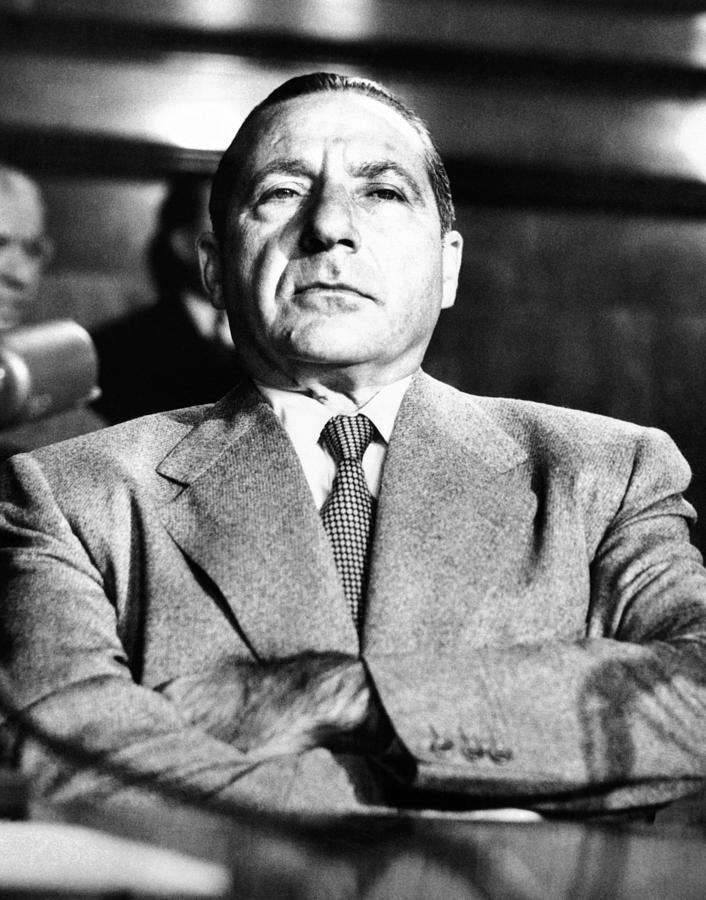
Carlos Marcello rarely looked impressed. Not by politicians. Not by federal agents. Not by reporters asking dangerous questions.
He sat heavily behind restaurant tables and office desks with the expression of a man who had already calculated everyone in the room and found them lacking. His voice stayed low. His face rarely changed. He projected the patience of a swamp predator—still, quiet, almost invisible until movement became necessary.
That calm made him terrifying.
For decades, Carlos Marcello ruled organized crime across New Orleans and much of the Gulf South with extraordinary efficiency. Unlike celebrity gangsters in New York or Chicago, Marcello built power through political corruption, gambling, labor control, and quiet intimidation deeply woven into Louisiana’s unique political culture.
He did not need national fame. He controlled territory. And territory meant power.
Over time, Marcello became one of the most feared Mafia bosses in America, a man so politically connected and insulated that even aggressive federal campaigns struggled to remove him permanently. His name eventually drifted into darker territory as conspiracy theories surrounding the assassination of John F. Kennedy pulled him into decades of speculation, rumor, and paranoia.
Whether guilty or not, Marcello became permanently associated with one of America’s deepest national obsessions.
That shadow never left him.
From Sicily to Louisiana
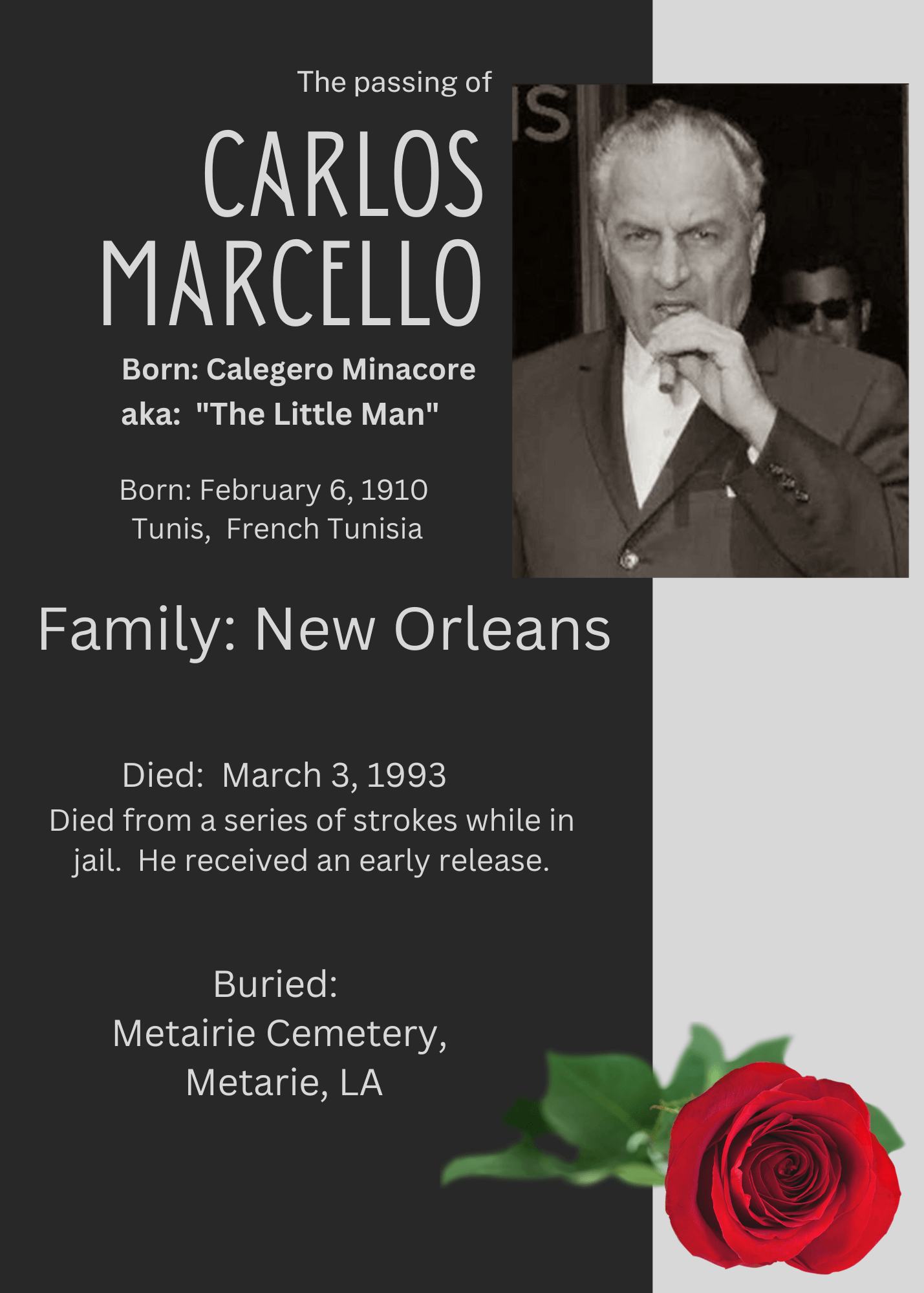
Carlos Marcello was born Calogero Minacore in Tunisia in 1910 to Sicilian parents before eventually growing up in Louisiana. His family settled in the New Orleans area, where Sicilian immigrant communities already maintained strong commercial and cultural networks tied to the city’s ports, produce markets, labor systems, and underworld operations.
New Orleans possessed a long Mafia history even before Marcello came of age.
Unlike newer criminal territories elsewhere, the city had experienced organized Sicilian criminal influence since the late nineteenth century. Gambling, waterfront corruption, political bribery, prostitution, and labor racketeering already operated beneath the surface of local society.
Marcello entered crime young.
As a teenager and young adult, he became involved in theft, armed robbery, bootlegging, and black-market operations. Arrests followed early. Violence became familiar. Yet unlike impulsive street gangsters, Marcello gradually developed a more calculated approach centered around organization rather than spectacle.
He learned quickly that political relationships could protect criminals more effectively than gunfire alone. That lesson shaped his empire.
Prohibition and Criminal Expansion
The Prohibition era created enormous opportunity for organized crime nationwide.
Marcello profited through bootlegging operations tied to liquor smuggling, distribution, and protection systems throughout Louisiana and neighboring states. New Orleans, with its ports, shipping networks, and deeply corrupt political environment, proved ideal territory for criminal expansion.
Marcello thrived there.
By the 1930s and 1940s, he had built influence through gambling operations, loansharking, narcotics trafficking, labor racketeering, and political bribery. He gradually rose inside the New Orleans Mafia structure until eventually becoming the dominant regional boss.
Unlike flamboyant gangsters such as Bugsy Siegel or violent public figures like Albert Anastasia, Marcello cultivated near-total public restraint.
He preferred business meetings over public drama. And business in Louisiana often meant politics.
The Political Machine
Marcello understood Louisiana politics intimately.
Mid-century Louisiana operated through overlapping systems of patronage, corruption, business influence, and political dealmaking where organized crime could flourish quietly beneath official institutions. Marcello reportedly cultivated relationships with local officials, law enforcement figures, judges, businessmen, and labor leaders for decades.
Federal investigators believed his influence reached astonishing levels.
Witnesses and law enforcement officials repeatedly described environments where politicians feared crossing him openly. Marcello allegedly controlled gambling operations stretching across multiple states while maintaining substantial leverage inside unions and commercial enterprises.
He ruled less like a street gangster and more like a regional political boss. That distinction mattered. Street gangsters often die quickly. Political operators can survive for decades.
The Kennedys Become Enemies
Marcello’s relationship with the Kennedy family became one of the defining conflicts of his life.
During the late 1950s and early 1960s, Attorney General Robert F. Kennedy launched aggressive campaigns against organized crime nationwide. Marcello became a major target.
The conflict turned deeply personal.
In 1961, federal authorities orchestrated Marcello’s sudden deportation to Guatemala despite ongoing legal disputes regarding his citizenship status. According to accounts from the period, Marcello was effectively seized and flown out of the country abruptly without standard procedural protections.
The humiliation enraged him.
Marcello eventually returned to the United States after legal challenges, but the hostility toward the Kennedys reportedly intensified permanently.
That history later fueled enormous speculation after President Kennedy’s assassination in Dallas in 1963.
The Assassination Theories
Few Mafia figures became more closely linked to Kennedy assassination conspiracy theories than Carlos Marcello. Partly because investigators and writers believed he possessed motive. Partly because he possessed influence.
And partly because New Orleans itself already occupied a strange place within the assassination narrative through connections involving Lee Harvey Oswald.
Numerous books, documentaries, prosecutors, journalists, and conspiracy researchers later explored theories suggesting Marcello may have played some role in orchestrating or facilitating the assassination.
No definitive evidence ever proved such claims conclusively. Marcello consistently denied involvement. Still, the suspicions never disappeared.
Especially after reported FBI surveillance recordings captured Marcello making cryptic statements interpreted by some investigators as indirect admissions or references to the Kennedy murder.
The mystery became part of his legend.
The Long Decline
By the 1970s and 1980s, federal law enforcement pressure intensified dramatically against organized crime nationwide.
RICO prosecutions, surveillance technology, informants, and political pressure weakened many Mafia organizations. Marcello himself eventually faced convictions connected to racketeering and conspiracy activities.
Even so, he remained influential for years.
Associates described him as deeply cautious, insulated, and strategically patient. He rarely exposed himself unnecessarily and delegated operations carefully. Federal authorities often struggled to tie him directly to criminal acts despite widespread belief in his enormous influence.
Age and illness eventually weakened him more effectively than prosecutors had.
Marcello suffered declining health during his later years, including Alzheimer’s disease and serious medical complications.
He died in 1993.
The Legacy of Carlos Marcello
Carlos Marcello represented organized crime in its most political form.
He was not merely a gunman or racketeer. He was a systems operator.
Unlike gangsters obsessed with public fear or media celebrity, Marcello built influence quietly through institutions—ports, unions, gambling operations, businesses, and political relationships stretching across the Gulf South.
He ruled through leverage. That made him extraordinarily difficult to destroy.
Marcello also embodied something uniquely American about organized crime: the fusion of criminal enterprise with regional political culture. In Louisiana especially, the boundaries between power, corruption, business, and organized crime often blurred dangerously.
He understood those blurred lines better than almost anyone. And then there was the Kennedy shadow.
Whether deserved or not, Carlos Marcello became permanently woven into the mythology surrounding one of the most traumatic events in American history. His name drifted beyond ordinary organized crime lore into conspiracy culture, political paranoia, and national obsession.
In noir terms, Marcello was the quiet kingpin sitting behind the restaurant table while history collapsed somewhere beyond the window.
Silent. Heavy-eyed. Patient. Watching everything.
Click the links below to see where he is buried.