Benjamin “Bugsy” Siegel: The Empire He Built Became His Execution Order
“Kiss the Ring. Dig Your Grave” series – Article 5
The American Mafia has always demanded loyalty, but it has never promised forgiveness.
Gangsters often believed that years of faithful service created an invisible insurance policy. They assumed old friendships, shared secrets, and decades of profitable partnerships would outweigh a single failure. The men at the top encouraged that belief because it inspired commitment. A loyal associate worked harder, took greater risks, and asked fewer questions.
Benjamin “Bugsy” Siegel believed it too.
He had stood beside the architects of modern organized crime when the National Crime Syndicate was still taking shape. He worked with Charles “Lucky” Luciano as the old Sicilian order gave way to a national criminal corporation. He shared an extraordinary friendship with Meyer Lansky, a partnership built on mutual respect, staggering profits, and absolute trust. Together, they survived gang wars, Prohibition, political corruption, and the birth of a new underworld.
Then Siegel was handed the Syndicate’s boldest assignment. Build a gambling empire in the Nevada desert. If he succeeded, he would change American history. If he failed, history would forget everything that came before. The desert would eventually become Las Vegas. For Bugsy Siegel, it became a graveyard.
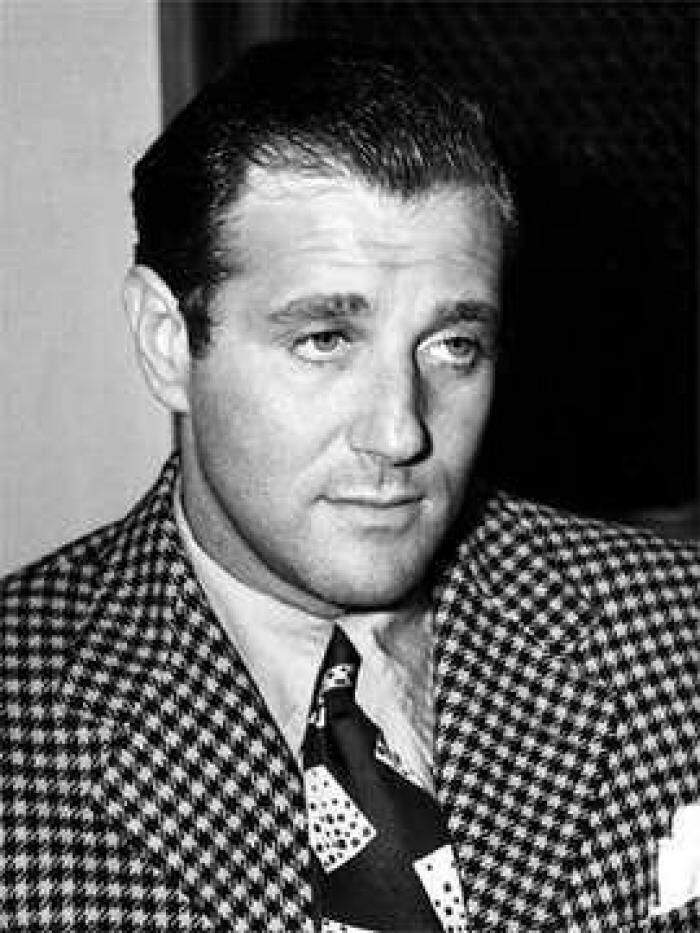
| Ben “Bugsy” Siegel |
A Partnership Forged in the Streets
Born Benjamin Siegel in Brooklyn in 1906, Bugsy grew up in the rough neighborhoods of Williamsburg, where violence and opportunity often occupied the same street corner. Intelligent, ambitious, and famously fearless, he quickly earned a reputation as a man willing to use violence to solve problems others preferred to avoid.
His closest criminal relationship began with Meyer Lansky.
The two young gangsters complemented one another perfectly. Lansky possessed the mind of a financial strategist, while Siegel supplied charisma, intimidation, and an appetite for risk. During Prohibition they became key players in bootlegging, labor racketeering, gambling, and enforcement operations that stretched far beyond New York.
When Charles ‘Lucky’ Luciano reorganized organized crime after the Castellammarese War, both Lansky and Siegel stood among the men helping create a more modern criminal enterprise. Personal friendships blended seamlessly with business alliances. The Syndicate rewarded talent regardless of ethnic background, allowing Jewish and Italian gangsters to work together in ways that had previously been uncommon.
For decades, the arrangement proved extraordinarily profitable.
| Five Families: Blood, Power, and the Empire Beneath New York |
The Syndicate’s Dream
By the mid-1940s, organized crime had discovered an opportunity unlike anything it had seen before. Nevada had legalized casino gambling.
Las Vegas remained little more than a dusty railroad town surrounded by endless desert, but visionaries inside the Syndicate recognized its potential. A city built around legal gambling offered something every criminal organization wanted: the ability to transform illegal money into legitimate wealth.
Siegel became the man chosen to make that dream reality.
The assignment reflected enormous confidence. Few people possessed the ambition necessary to attempt such an undertaking, and even fewer could persuade investors to pour millions into what many still considered an isolated patch of sand.
Bugsy embraced the challenge with characteristic confidence. He wasn’t merely constructing a hotel. He believed he was building the future of organized crime.
| Crazy Joey Gallo: The Man Who Finally Stopped Kissing the Ring |
The Flamingo
The Flamingo Las Vegas was unlike anything Nevada had ever seen.
Rather than another roadside gambling hall, Siegel envisioned luxury. Marble floors. Elegant restaurants. Expensive furnishings. Celebrity entertainment. Beautiful landscaping. Wealthy customers arriving not simply to gamble but to experience sophistication in the middle of the Mojave Desert.
The vision was revolutionary. It was also incredibly expensive.
Construction costs soared far beyond original estimates. Supply shortages, labor problems, design changes, and allegations of financial mismanagement caused budgets to explode. Investors grew increasingly frustrated as delays mounted and millions of dollars disappeared into a project that produced no immediate return.
Rumors spread quickly. Some believed Siegel was secretly skimming money. Others argued he was simply a perfectionist determined to build something extraordinary.
Historians still debate whether Bugsy actually stole significant sums from the project. Definitive evidence has never emerged. Inside the Syndicate, however, perception often mattered more than proof.
| Willie Moretti: When Even the Boss Couldn’t Save You |
Friendship Meets Business
Bugsy assumed history would protect him.
After all, he had helped build the very organization now questioning him. He had risked his life alongside Lansky. He had carried out dangerous assignments for Luciano. He had earned millions for powerful men who now occupied the highest levels of organized crime.
Surely that counted for something. It did. Just not enough.
The Syndicate operated according to a brutal principle: friendships were valuable only as long as they remained profitable. Once investors concluded that the Flamingo had become a financial disaster, sentiment quickly gave way to accounting. Old favors no longer balanced new losses.
The Opening That Changed Everything
The Flamingo opened on December 26, 1946. The debut was disastrous.
Rain reduced tourist traffic. Construction remained incomplete. Service problems frustrated guests. Revenue failed to meet expectations, and newspapers questioned whether the lavish casino would survive.
Although the resort later recovered and eventually became enormously successful, the damage had already been done. Powerful investors had lost confidence.
To them, Bugsy no longer looked like a visionary. He looked like an expensive mistake.
The Final Decision
The exact conversations remain hidden behind decades of secrecy, but historians generally agree that influential Syndicate leaders concluded Siegel had become too costly to tolerate.
Whether the decision originated primarily with Meyer Lansky, other Syndicate investors, or a broader consensus remains disputed. What appears clear is that decades of friendship did not stop the machinery once it began moving.
On June 20, 1947, Siegel sat inside the Beverly Hills home of his girlfriend, Virginia Hill. As he relaxed near a living room window, rifle fire shattered the glass. Multiple rounds struck him in the head and upper body. He died almost instantly. The gunman disappeared into the California night. Within hours, Syndicate representatives quietly assumed control of the Flamingo.
Business continued.
The Empire He Never Saw
The greatest irony of Bugsy Siegel’s life arrived after his death. The Flamingo eventually became profitable.
Las Vegas exploded into one of the world’s gambling capitals, attracting millions of visitors and generating fortunes beyond anything early investors had imagined.
Siegel had correctly predicted the future. He simply didn’t live long enough to enjoy it.
The city he helped create produced billions of dollars for organized crime during the following decades. Others collected the profits. Bugsy collected a funeral.
The Noir Lesson
Benjamin Siegel believed loyalty accumulated like money in a bank account.
Every dangerous assignment completed. Every fortune earned.
Every friendship forged in blood. Every secret protected. He assumed those years had purchased patience. Instead, he discovered that organized crime keeps no sentimental ledger.
When profits disappear, yesterday’s hero becomes today’s liability. The same men who once toasted your success quietly calculate the cost of your removal. They don’t erase your accomplishments because they hate you.
They erase you because business demands it.
Bugsy Siegel helped build the modern American underworld. He stood shoulder to shoulder with the men who reshaped organized crime into a national enterprise. He transformed a forgotten desert town into the foundation of a gambling empire that generated unimaginable wealth.
He believed that history, friendship, and loyalty would buy him one more chance. They bought him nothing.
On a warm California evening, someone squeezed a trigger from outside a window, and the man who dreamed of Las Vegas never saw the empire he created.
In the Mafia, loyalty is often measured in dollars. When the books no longer balance, neither do old friendships. Bugsy Siegel built an empire for the men he trusted. They repaid him with a rifle through the window.
References:
Bergreen, Laurence. Capone: The Man and the Era. New York: Simon & Schuster, 1994.
Geary, Rick. The Adventures of Benjamin Siegel. New York: NBM Publishing, 2012.
Jennings, Dean. We Only Kill Each Other: The Life and Bad Times of Bugsy Siegel. New York: Norton, 1967.
Raab, Selwyn. Five Families: The Rise, Decline, and Resurgence of America’s Most Powerful Mafia Empires. New York: Thomas Dunne Books/St. Martin’s Press, 2005.
United States Senate. Organized Crime and Illicit Traffic in Narcotics: Hearings Before the Permanent Subcommittee on Investigations. Washington, DC: U.S. Government Printing Office.
Federal Bureau of Investigation. La Cosa Nostra: An Introduction. Washington, DC: Federal Bureau of Investigation. https://www.fbi.gov/history/famous-cases/la-cosa-nostra
Ovid Demaris. The Last Mafioso. New York: Bantam Books, 1981.
Nevada State Journal. Contemporary coverage of the Flamingo Hotel opening, December 1946–June 1947.