Attorney–Client Privilege… and the Body Count
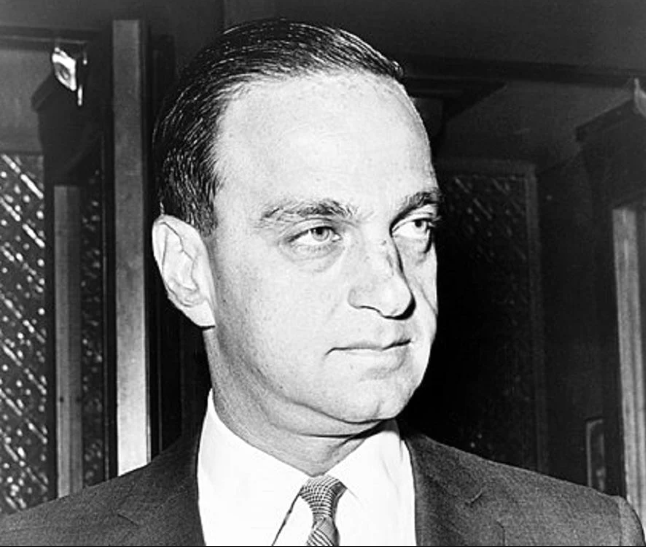
Roy Cohn: The Fixer Who Became the Story
Article 4 of a 5-part series: “Mob Mouthpieces: The Lawyers Who Danced with the Devil”
He defended mob bosses… and operated like one.
In New York, power doesn’t always wear a badge. Sometimes it wears cufflinks.
Roy Cohn understood that better than anyone. He didn’t just practice law. He weaponized it. He didn’t merely represent clients. He became their instrument — and occasionally, their reflection.
Cohn lived in the blurred margin between the courtroom and the backroom, between Senate hearings and social clubs, between political influence and organized crime muscle. He moved comfortably through all of it. For years, he appeared untouchable.
Until he wasn’t.
| Attorney–Client Privilege… and the Body Count: Jerry Giesler: Hollywood’s Defender and Bugsy Siegel’s Lifeline |
From Prosecutor to Power Broker
Before he became the consigliere-in-cufflinks, Cohn built his name as a young federal prosecutor. He gained national attention during the espionage trial of Julius Rosenberg and Ethel Rosenberg, later claiming — controversially — that he influenced the judge to impose the death penalty.
He then became chief counsel to Senator Joseph McCarthy during the anti-Communist hearings of the 1950s. There, Cohn refined a style that would define his career: attack first, deny everything, admit nothing, counterpunch always.
The McCarthy era collapsed under the weight of its own paranoia. Cohn did not.
He recalibrated.
New York was waiting.
The Mob’s Man in Manhattan
By the 1960s and 1970s, Cohn had transformed into a Manhattan power broker — part lawyer, part political operative, part social climber. His client list stretched from real estate developers to Studio 54 impresarios to captains of industry.
And then there were the mob bosses.
Most notably, Cohn represented Anthony Salerno, the Genovese family figure known as “Fat Tony.” Salerno was later convicted in the landmark Mafia Commission Case of 1986, which targeted the leadership of New York’s Five Families.
Cohn denied being a “mob lawyer.” He preferred to say he represented businessmen unfairly targeted by the government.
But the pattern was unmistakable.
When organized crime figures needed aggressive defense, courtroom theatrics, or backchannel influence, Cohn was often nearby. He cultivated relationships with judges, politicians, and law enforcement officials. He attended the right dinners. He made the right calls.
He blurred the line between representation and advocacy, between legal defense and political pressure.
He didn’t just defend mob bosses.
He operated like one.
| Attorney-Client Priviledge… and the Body Count: Frank Ragano: The Courier Between Worlds |
Influence as Currency
In Cohn’s world, influence was currency — and he spent it lavishly.
Witness tampering allegations swirled around him for years. So did accusations of coaching testimony, manipulating juries, and pressuring prosecutors. He cultivated friendships inside federal agencies and bragged about his access.
Cohn’s strategy was rarely subtle. He attacked prosecutors personally. He filed aggressive motions. He threatened countersuits. He turned every indictment into a spectacle.
It worked — until it didn’t.
The problem with building a career on intimidation is that eventually someone calls your bluff.
Throughout the 1970s and early 1980s, disciplinary complaints accumulated. Allegations of professional misconduct piled up in New York’s grievance committees. Clients accused him of financial improprieties. Critics accused him of exploiting privilege to obstruct justice.
Still, Cohn swaggered.
He had survived McCarthy’s fall. He had survived political shifts. He had survived investigations before.
He believed he would survive again.
The Untouchable Illusion
Part of Cohn’s mystique was proximity to power. He advised business leaders and politicians. Among those who sought his counsel in the 1970s was a young New York developer named Donald Trump. Cohn reportedly counseled him on litigation strategy during federal housing discrimination suits, preaching the same philosophy: never settle, always counterattack.
Cohn’s worldview was simple. The law was not a moral code. It was a battlefield. The goal was not justice — it was victory.
For mob clients, that mindset was invaluable.
For the legal profession, it was corrosive.
Cohn relished his reputation as a fixer. He cultivated fear. He flaunted connections. He treated ethical guidelines as inconveniences for lesser lawyers.
But even fixers need fixing eventually.
| Attorney-Client Priviledge… and the Body Count: Frank Ragano: The Courier Between Worlds |
The Fall
In 1986, the Appellate Division of the New York Supreme Court disbarred Roy Cohn. The charges were not abstract. They were specific and damning: misappropriation of client funds, dishonesty, fraud, and false statements on his bar application.
The court described a “pattern of conduct” involving deceit and unethical behavior. He had borrowed money from a dying client and pressured her to amend her will in his favor. He had lied about finances. He had crossed lines not as a defender of mobsters, but as a predator in his own right.
It wasn’t a dramatic RICO indictment.
It wasn’t a perp walk.
It was something quieter and, in its own way, more devastating: professional erasure.
Roy Cohn — the man who had intimidated prosecutors, sparred with senators, and dined with crime bosses — was stripped of his license.
Disbarred.
He died just weeks later, in August 1986, officially from complications related to AIDS, though he had publicly denied the diagnosis until the end.
The fixer became the story.
Privilege as Weapon
Attorney–client privilege exists to protect justice. It allows the accused to speak freely to counsel without fear of exposure.
But in Cohn’s hands, privilege often felt less like a shield and more like a blade.
He used confidential access to position himself as indispensable. He leveraged secrets as social capital. He operated in the gray areas where political influence met organized crime interests.
His representation of Salerno during the Commission Case was emblematic. As federal prosecutors sought to dismantle the Mafia hierarchy using RICO statutes, Cohn attacked the credibility of witnesses and challenged the structure of the charges. He framed the case as government overreach rather than systemic criminal enterprise.
To some, he was a brilliant defense attorney doing his job.
To others, he was an enabler — using legal expertise to shield violent organizations from accountability.
The truth, as always in noir, lives somewhere in the shadows.
Ego, Power, and the Body Count
Unlike a capo, Cohn didn’t command soldiers. He didn’t order hits. He didn’t run rackets.
But he defended the men who did.
In doing so, he extended the lifespan of enterprises built on intimidation and violence. Every successful delay, every mistrial, every procedural victory bought time for organizations whose business model included extortion and murder.
That’s the uncomfortable math of this series.
The body count isn’t always literal. Sometimes it’s systemic. Sometimes it’s the cumulative cost of prolonging a criminal empire.
Cohn believed he was above consequences. His ego was armor. His Rolodex was a weapon. He treated ethics committees the way a mob boss treats subpoenas — as nuisances to be neutralized.
He blurred the line between lawyer and operative so thoroughly that the distinction almost disappeared.
And when the system finally caught up, it didn’t do so with sirens.
It did so with a disbarment order.
The Legacy of the Fixer
Roy Cohn remains a symbol — not just of McCarthyism, not just of Manhattan excess, but of what happens when law becomes performance art for power.
He taught a generation of clients that aggression could substitute for principle. That influence could bend outcomes. That public attack could silence scrutiny.
For a time, he was right.
But the law has a long memory.
In the end, the man who defended mob bosses found himself judged not by a jury, but by his peers. The ruling was clinical, methodical, and final.
He had crossed the line.
Not in a single dramatic act, but in a pattern of conduct that revealed the truth: Roy Cohn didn’t merely defend the powerful. He sought to become power itself.
And power, unchecked, consumes.
In the dim light of legal history, Cohn stands as a warning. Attorney–client privilege is sacred. Influence is seductive. Ego is dangerous.
He defended mob bosses.
And in the process, he became indistinguishable from the world he claimed only to represent.
References:
Roy Cohn – New York Appellate Division, First Department, Disbarment Order (June 1986); New York State Unified Court System disciplinary records.
Anthony Salerno – United States v. Salerno et al., Mafia Commission Case, U.S. District Court, Southern District of New York (1986).
Julius Rosenberg & Ethel Rosenberg – Trial transcripts, U.S. District Court, Southern District of New York (1951).
Joseph McCarthy – U.S. Senate Permanent Subcommittee on Investigations records (1953–1954).
Donald Trump – Wayne Barrett, Trump: The Greatest Show on Earth (2016); New York Times archives on Trump–Cohn relationship.
Nicholas von Hoffman, Citizen Cohn (1988).
Ken Auletta, “Roy Cohn’s Last Days,” The New Yorker, 1986.