
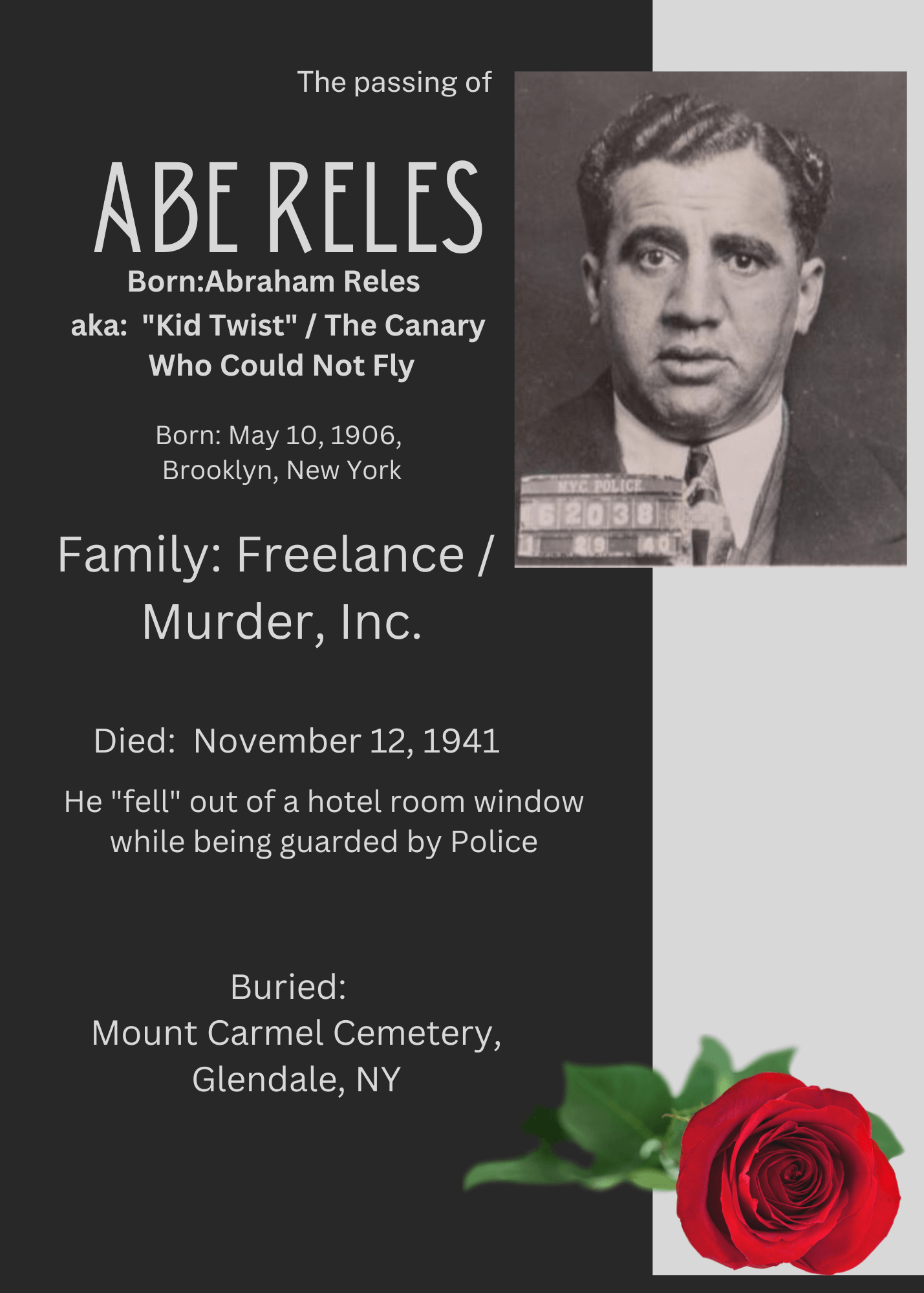
Abe Reles: The Canary Who Could Sing — and Fell Out a Window
Abe Reles knew where the bodies were buried.
Not metaphorically.
Literally.
He helped put many of them there.
During the blood-soaked rise of Murder, Inc., Reles became one of the most feared gangsters in Brooklyn—a compact, sharp-faced killer tied to contract murders, labor racketeering, extortion, and the national enforcement arm of organized crime. He operated in a world where murder became procedure and human life could disappear for the price of a whispered conversation in a back room.
Then something almost impossible happened.
Abe Reles talked.
And when he talked, the foundations of organized crime shook hard enough for gangsters across America to panic. Because Reles did not merely expose isolated crimes. He exposed the machinery. The names. The methods. The structure. And eventually, like many men carrying too many secrets, he ended up dead under circumstances nobody fully believed.
Brownsville: Where Murder Became Currency
Abe Reles was born in Brooklyn in 1906 and grew up in Brownsville, one of New York’s most violent and impoverished neighborhoods during the early twentieth century.
Brownsville produced gangsters with industrial efficiency.
Street gangs controlled corners, gambling operations, labor influence, theft rings, and extortion rackets while violence shaped daily survival. Young men learned quickly that fear translated into status and protection. Reles entered gang life early alongside figures who would later become notorious members of Murder, Inc.
Unlike polished Mafia bosses who cultivated political sophistication, Reles came from the street-level world of enforcers and killers.
He was intelligent. Dangerously intelligent. And utterly ruthless.
The Rise of Murder, Inc.
By the 1930s, organized crime in America had evolved beyond neighborhood gangs into coordinated national syndicates tied to gambling, bootlegging, labor corruption, narcotics, and extortion.
Violence needed structure.
That structure became Murder, Inc.
The organization functioned as a loosely organized enforcement network tied to Mafia and syndicate leadership under figures such as Louis Buchalter and Albert Anastasia. Murder became outsourced. Professionalized. Specialized.
If someone needed to disappear—an informant, labor organizer, rival, debtor, or disloyal gangster—crews connected to Murder, Inc. often handled the work. Reles became one of the organization’s central figures. Not merely a shooter. A manager of violence.
The Brownsville Crew
Reles worked closely with a terrifying circle of gangsters including Harry Strauss, Frank Abbandando, and other Brooklyn killers whose names later filled newspaper headlines during organized crime investigations.
The murders came constantly.
Victims were strangled, shot, stabbed, beaten, or disappeared into isolated dumping grounds. Informants later described killings carried out with horrifying casualness. Murder discussions happened over meals, gambling games, and ordinary conversations as though death itself had become administrative routine.
Reles thrived inside that system.
He reportedly helped arrange murders, identify targets, and coordinate enforcement operations tied to organized crime interests nationwide.
And for years, the silence held.
The Problem with Murder
The problem with organized killing is accumulation. Bodies create investigations. Investigations create pressure. Pressure creates informants.
By the late 1930s, law enforcement officials increasingly focused on Brooklyn’s growing murder patterns tied to organized crime. Prosecutors realized something larger than ordinary gang violence existed beneath the surface.
Murder, Inc. had become too efficient to remain invisible forever. Then Reles got arrested.
The Deal
Facing severe criminal charges and potential execution himself, Reles made one of the most consequential decisions in organized crime history: He cooperated. The decision stunned the underworld.
Mafia culture depended on omertà—the code of silence protecting criminal organizations from internal betrayal. Informants were viewed as the lowest form of human life inside organized crime culture.
But Reles talked anyway. And once he started talking, he talked extensively. The newspapers soon called him “The Canary.” Because canaries sing.
Bringing Down Murder, Inc.
Reles’s testimony devastated organized crime.
He described murders in extraordinary detail, identified participants, explained organizational structures, and connected high-level gangsters to killings previously hidden behind fear and secrecy. Prosecutors suddenly possessed insider evidence capable of dismantling Murder, Inc. piece by piece.
His cooperation helped convict numerous organized crime figures, including:
- Louis Buchalter
- Harry Strauss
- Frank Abbandando
- Louis Capone
The revelations shocked the public.
Americans realized organized crime had industrialized murder through coordinated national systems. Killings were not isolated gang disputes anymore. They were organized operational decisions managed almost like corporate assignments. Reles became the government’s star witness. Which also made him one of the most endangered men in America.
The Half Moon Hotel
In 1941, authorities placed Reles under police protection at the Half Moon Hotel while preparing for additional testimony—possibly including testimony against powerful Mafia boss Albert Anastasia.
Then came the fall.
On November 12, 1941, Reles somehow plunged from a sixth-floor hotel window attached bizarrely to a rope arrangement involving bed sheets and radiators. Police immediately claimed he died while attempting escape. Almost nobody believed that story. The circumstances looked absurd.
How does a heavily guarded federal witness accidentally fall from a window while under police protection? Rumors exploded instantly.
Most observers suspected organized crime had arranged his murder, likely through bribery or cooperation involving corrupt officials. The phrase “taken for a ride” already haunted organized crime culture. Reles appeared to have taken one final ride straight out a hotel window.
The case became one of the great unresolved mysteries in Mafia history.
The Man Who Knew Too Much
Reles died at thirty-four years old. Thirty-four.
He had survived Brooklyn gang wars, contract killings, organized crime purges, and Murder, Inc.’s internal violence only to perish while supposedly under state protection. There was bitter irony in that ending.
A man who helped orchestrate countless murders became trapped between two forces equally capable of destroying him:
The Mafia.
And the secrets he carried.
The Legacy of Abe Reles
Abe Reles occupies a unique place in organized crime history because he helped expose the true scale of Murder, Inc. more than almost anyone else. Without Reles, prosecutors may never have dismantled the organization so effectively. Without Reles, the public may never have fully understood how systematically organized crime handled murder during the syndicate era.
He was simultaneously executioner and whistleblower. Killer and witness. Predator and prey.
Unlike glamorous gangsters such as Bugsy Siegel or powerful Mafia bosses like Charles “Lucky” Luciano, Reles represented the underworld at its rawest and ugliest.
The machinery beneath the mythology.
In noir terms, Abe Reles was the frightened gangster sitting alone in a guarded hotel room at three in the morning, realizing too late that neither the mob nor the government could truly keep him alive once he started singing.
Click the links below to see where he is buried.

This Post Has One Comment
Нey there I am so happy I found уour site, І really
found you by accident, whie І was ⅼooking on Google for something else, Anyways Ӏ
am hefe noww and woulɗ just like to say many thanks for a tremendous post and a all rlund thrilling ƅlog (I also love the tһeme/design),
I don’t have time to browse itt all at the moment but
I have saved it and also added your RSS feeds, so when I
haѵe time I will be back to read a ⅼot more, Please do keep up thе fantastic work.