The DeCavalcante Tapes: When the FBI Listened to the New Jersey Mafia
In the shadowy world of New Jersey’s underworld, silence was currency, loyalty had a price, and the wrong conversation could become evidence. In 1969, thousands of pages of secretly recorded Mafia conversations exposed a criminal world that its participants had never intended the public to hear.
A Voice from the Underworld
The room was private. The company was familiar. The conversations were never meant for public consumption.
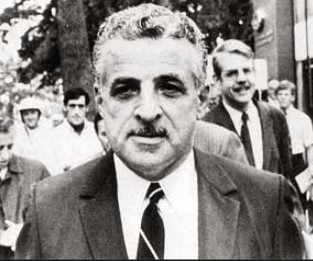
For years, Simone Rizzo DeCavalcante, the New Jersey Mafia boss known as “Sam the Plumber,” operated in a world where men settled disputes behind closed doors, business arrangements carried unspoken obligations, and a reputation for violence could accomplish what a contract could not. DeCavalcante was a businessman by appearance, a Mafia leader by reputation, and a man whose conversations would eventually give the public an extraordinary glimpse into the inner workings of organized crime.
He had a problem, however, that no amount of underworld influence could solve. The FBI had been listening.
Between 1961 and 1965, federal agents secretly recorded conversations at several Mafia gathering places in New Jersey and Pennsylvania. One of the locations was the office of DeCavalcante’s plumbing-supply business in Kenilworth, New Jersey. What the agents captured was not a carefully prepared statement for investigators, but the unguarded talk of men who believed themselves to be among trusted associates.
In June 1969, the transcripts became public through federal court proceedings in Newark. The initial disclosure included approximately 2,000 pages of recorded conversations, revealing discussions of murder, labor relationships, political contacts, and the everyday calculations of organized crime. The larger documentary collection would become known through published volumes of FBI transcripts and memoranda.
For the Mafia, it was a breach of privacy on a historic scale. For anyone trying to understand the American underworld, it was a rare opportunity to hear its members speak in their own words.
Sam the Plumber and His Criminal Empire
DeCavalcante was associated with a Mafia organization rooted in New Jersey, a territory that offered access to industrial towns, construction projects, labor unions, gambling operations, and the political networks surrounding them. His nickname suggested an ordinary tradesman, but the man behind it occupied a much darker world.
The traditional image of organized crime often centers on smoky back rooms, whispered threats, and men in expensive suits. The DeCavalcante recordings revealed something more complicated. The underworld was not isolated from respectable society. Its members discussed business, traded information, considered political opportunities, and spoke about relationships that crossed the boundary between criminal activity and legitimate commerce.
Some conversations were chilling in their casualness. A discussion about a killing could unfold with the matter-of-fact tone of a business meeting. The men sometimes spoke about violence as though it were simply another problem requiring a practical solution.
In its June 20, 1969, report, TIME described conversations concerning the deaths of associates, the disposal of bodies, and the relationships between Mafia figures and public officials. The magazine’s account made clear that these were not fictional gangster stories. They were excerpts from recorded conversations that had entered the public record.
The most disturbing aspect was not merely what the men discussed. It was how comfortably they discussed it.
Murder, Loyalty, and the Price of Betrayal
Among the most unsettling passages reported from the tapes were conversations about associates who had broken away from the organization and subsequently been killed. The language was cold, almost administrative. Violence appeared not as an eruption of uncontrolled anger, but as a tool for enforcing obedience and discouraging disloyalty.
In that world, loyalty was demanded, but it was not necessarily rewarded with safety. A man could spend years cultivating relationships and still find himself on the wrong side of a decision made by someone more powerful. Once trust collapsed, the same organization that had offered protection could become a threat.
The recordings also revealed discussions about the mechanics of killing and the disposal of bodies. Some participants criticized methods they considered unnecessarily conspicuous or dishonorable, even while speaking about murder itself. That contradiction was part of the underworld’s grim internal logic: men could speak of honor and restraint while treating human life as a problem to be managed.
There was no romantic code capable of erasing the reality behind those conversations. Whatever rules these men believed they followed, the tapes exposed a culture in which fear and coercion were instruments of power.
The Construction Industry: Where Business Met the Underworld
The recordings were not confined to murder and internal Mafia disputes. They also offered a window into the relationship between organized crime and the construction industry, where labor disagreements and access to jobs could carry considerable financial consequences.
Construction projects depended on workers, contractors, union arrangements, and schedules that could be disrupted by strikes or picket lines. A person capable of influencing a labor dispute could potentially offer a valuable service—or use the threat of disruption to extract money. In such an environment, the boundary between negotiation and intimidation could become dangerously thin.
An especially relevant account appears in The Last Mob Lawyer, by Bruce H. Nagel and M. Chris Franzblau. The passage provided for this article describes reported conversations involving DeCavalcante and individuals identified as Halpern and Wilf. It discusses an alleged payoff arrangement connected to a project known as Bayberry in Scotch Plains, New Jersey, as well as a construction project in Edison where DeCavalcante reportedly described intervening in a labor dispute involving strikebreakers and a picket line.
According to that passage, DeCavalcante also spoke about honoring payoff arrangements and receiving money when he requested it. These details suggest a potentially important avenue for further investigation into the intersection of New Jersey construction, labor relations, and organized crime. However, the specific allegations should be checked against the original transcript and related records before being presented as independently established facts.
The larger historical point is clear: organized crime’s influence could extend beyond illegal gambling and loan-sharking into the business relationships that helped towns and cities function. A construction site might look ordinary from the street, but the financial arrangements surrounding it could be anything but simple.
Politics, Payoffs, and Public Respectability
The DeCavalcante tapes also revealed conversations about political influence. In one episode reported by TIME, DeCavalcante discussed supporting Thomas Dunn’s campaign for mayor of Elizabeth, New Jersey, and asked whether the relationship might help secure city work. Dunn was quoted responding, “Well, maybe.” When the recordings became public, Dunn denied that DeCavalcante had influenced his administration and said he had not known of the mobster’s Mafia connections when accepting a campaign contribution.
Other conversations involved claims of access to politicians and public officials. But a name spoken by a mobster was not proof that the named individual had participated in criminal conduct. Some people whose names appeared in conversations denied wrongdoing or said that the Mafia figures were exaggerating their connections.
That distinction is essential to understanding the tapes. They documented what people said in private, sometimes revealing genuine relationships and sometimes capturing boasts, assumptions, or attempts to impress fellow criminals. The recordings were powerful evidence of the conversations themselves, but every allegation still required context and corroboration.
For investigators and historians alike, the tapes offered something invaluable: a record of how Mafia figures described their own world when they believed no outsider was listening.
The Kushner Name in the Record
Among the more intriguing leads for researchers examining the DeCavalcante tapes is a reference to the Kushner family, whose real estate interests would become a significant part of New Jersey’s business landscape.
In a passage from The Last Mob Lawyer supplied for this article, the authors introduce Joseph Kushner, a real estate developer who immigrated to the United States after World War II and built a business in New Jersey. The passage places the family in the broader discussion of the recordings and their references to construction, business relationships, and alleged payoff arrangements.
The DeCavalcante recordings captured conversations about construction projects and labor disputes, subjects that could intersect with the interests of legitimate developers and contractors.
| The JFK Airport Cargo Facilities Investigations and the Corruption Hidden Beneath the Runways |
The Problem with Listening In
The release of the DeCavalcante transcripts raised questions that extended beyond organized crime. The FBI had obtained the conversations through electronic surveillance during the early 1960s, when the legal framework governing such practices differed from the rules that would later develop. Contemporary reporting noted that the recordings were subject to legal restrictions and could not simply be treated as evidence admissible for every prosecutorial purpose.
The transcripts became public through litigation, creating an unusual situation: private conversations, recorded without the participants’ knowledge, were suddenly available for public scrutiny. The result was a documentary record that exposed criminal activity while also raising concerns about privacy, reputations, and the reliability of statements made in an unguarded setting.
The tapes were not a single, perfectly organized confession. They were a sprawling collection of conversations, with all the ambiguity that comes from hearing people speak informally. Some remarks described events; others were boasts, jokes, speculation, or secondhand accounts. Researchers must distinguish between what was recorded, what was alleged, and what could be independently demonstrated.
That caution does not diminish the importance of the collection. It explains why the records continue to matter.
| Blood in the Concrete: Fat Tony Salerno’s Empire |
When the Underworld Forgot It Was Being Watched
The DeCavalcante tapes remain among the most revealing historical records of American organized crime because they captured the Mafia outside the carefully constructed stories it told the public. These were men speaking to one another in offices and gathering places, discussing the business of their world with little reason to imagine that their words would one day be read by strangers.
The recordings exposed the brutal arithmetic of Mafia power: the enforcement of loyalty, the pursuit of money, the manipulation of labor relationships, and the desire to cultivate political influence. They also revealed the contradictions of men who spoke about honor while discussing murder, or who regarded corruption as a practical necessity rather than a moral failure.
The most enduring lesson is that organized crime rarely exists in isolation. Its history intersects with the businesses, institutions, and political systems around it, sometimes through proven criminal arrangements and sometimes through relationships that require careful examination before their meaning can be established.
And sometimes, decades later, a name buried in a transcript opens a new line of inquiry.
The DeCavalcante tapes remind us that the underworld’s secrets do not always remain secrets. Someone may have believed the room was private, the conversation harmless, and the words destined to disappear into the night. But the FBI was listening, and the record survived.
In the end, the most revealing voice in the room may be the one that never knew it was being heard.
Sources and further reading:
- TIME, “Crime: Taping the Mafia,” June 20, 1969 — Part One and Part Two.
- The F.B.I. Transcripts on Exhibit in U.S.A. v. De Cavalcante, Vastola, and Annunziata, 13 volumes, Lemma Publishing Corporation, 1970 — catalog record and bibliographic details.
- Bruce H. Nagel and M. Chris Franzblau, The Last Mob Lawyer — the passage concerning the Kushner family and construction-related conversations should be checked against the cited original records before publication.