The Meat Wagon: The Westies’ Murder Van and the Darkest Symbol of Hell’s Kitchen
In Hell’s Kitchen, a white van could mean many things. For the Westies, it could mean someone wasn’t coming home.
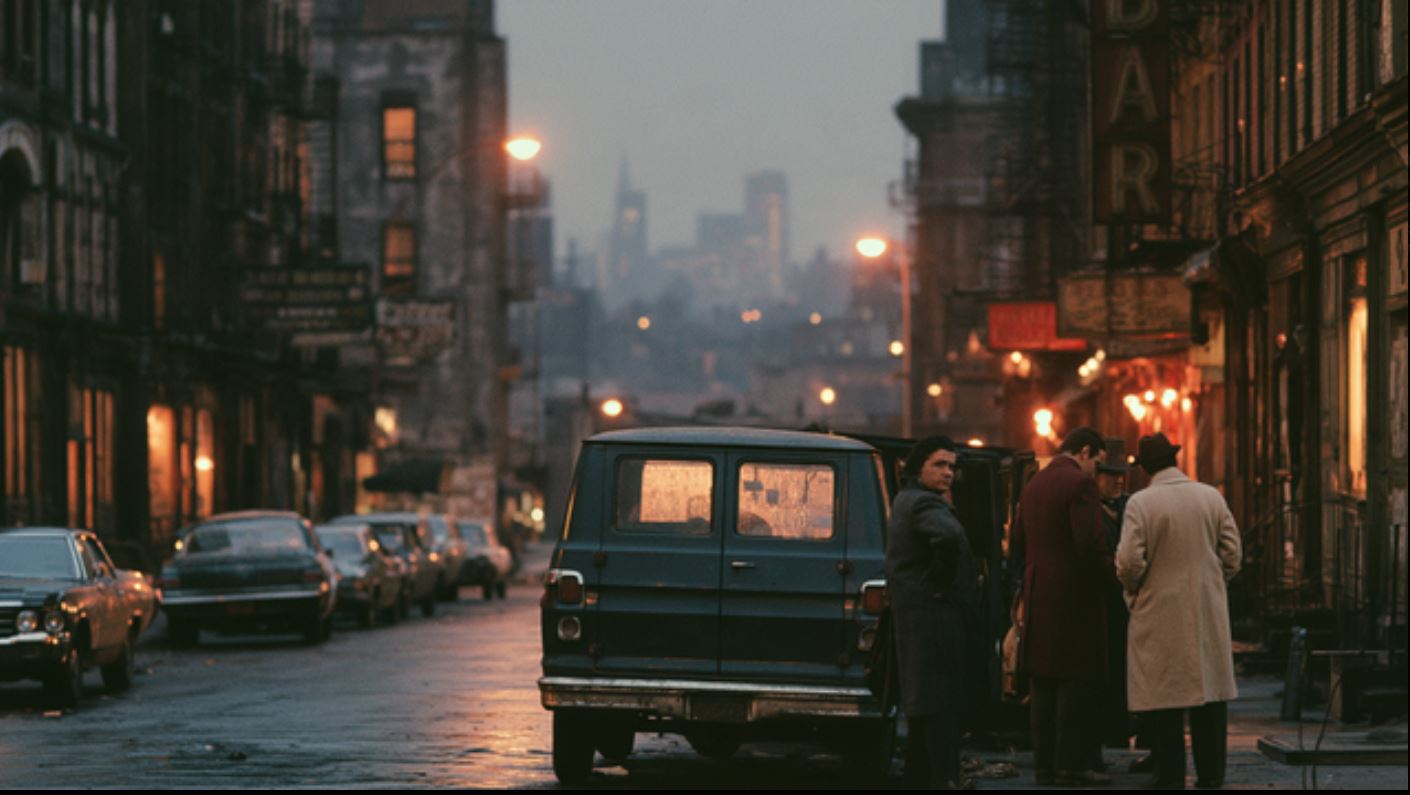
The vehicle became known as the “Meat Wagon,” one of the most disturbing symbols associated with Jimmy Coonan’s Irish-American gang. Accounts of the Westies describe the van as a mobile tool of the organization—used in connection with weapons, disguises, surveillance and, most notoriously, the transportation and disposal of human remains. One later account identified Jimmy “Mac” McElroy as its driver and described the vehicle as a red van used to transport body parts for disposal.
The conflicting descriptions of its color are worth noting. The details surrounding the vehicle have been repeated and embellished in later retellings, so the precise specifications of the van are less certain than its reputation.
What matters is what the Meat Wagon represented. It was not simply a vehicle. It was a piece of criminal infrastructure.
| Jimmy Coonan vs. the Five Families: The Irish Gangser Who Refused to Kneel |
A Gang Needed More Than Guns
The Westies have become almost inseparable from stories of murder. Jimmy Coonan. Mickey Featherstone. Jimmy McElroy. Eddie “the Butcher” Cummiskey. Roy DeMeo.
The names read like a cast list from a gangster movie.
But organized crime doesn’t survive on violence alone. Violence creates fear. Money creates longevity.
The Westies needed transportation. They needed weapons. They needed places to meet. They needed ways to watch targets without attracting attention. They needed to move people and things around Hell’s Kitchen without making every trip look like a criminal operation.
The Meat Wagon fit neatly into that machinery. It could sit outside a bar while men inside were watched. It could carry weapons. It could provide a place for disguises and other equipment. And according to accounts of the gang, it could carry the remains of people who had been murdered.
That versatility was what made it frightening. A gun is useful once. A vehicle can be useful every day.
| The Westies “Houdini” Murders: How Hell’s Kitchen Made Bodies Disappear |
Jimmy Mac Behind the Wheel
James “Jimmy Mac” McElroy became one of the most important enforcers in Coonan’s organization. He was a product of Hell’s Kitchen and, according to accounts of his life, knew many of the men who eventually became Westies from childhood. He was a former boxer who developed into a violent enforcer and rose to become one of Coonan’s most trusted lieutenants.
The New York Times, in a 2011 obituary of McElroy, described him as the third-ranking member of the Westies and noted his association with the group’s “meat wagon.” A contemporaneous account reported that McElroy drove the van used by the gang to transport body parts for disposal.
That detail is important. The man behind the wheel wasn’t an anonymous chauffeur. He was part of the organization’s command structure.
McElroy was involved in violence himself. His criminal career included murder, extortion and racketeering, and his eventual federal imprisonment ended only with his death in 2011.
The Meat Wagon therefore became associated with a man who already embodied the Westies’ violent side. The vehicle acquired the reputation of its driver. And the driver acquired the reputation of the vehicle.
| Ruby Stein: The Millionaire Who Made the Mistake of Crossing Jimmy Coonan |
A Rolling Toolbox for Murder
One of the more revealing stories about the Meat Wagon concerns a failed hit. According to an account of the Westies, Coonan, McElroy and Mickey Featherstone spent hours waiting outside a bar while looking for a union official they intended to kill. They were sitting in the Meat Wagon while watching the location.
When they believed the target had emerged, Coonan and Featherstone got out to determine whether they had the right man. They didn’t. The hit was abandoned. The men returned to the van.
The story is significant because nothing actually happened. No shooting. No corpse. No dramatic getaway. Instead, it shows the mundane side of organized violence.
There was surveillance. There was waiting. There was identification. There was the problem of getting the target right. And there was a vehicle sitting nearby containing the equipment necessary for the operation.
The Westies’ violence was not always spontaneous. Sometimes it was planned like a job.
| The Loyalty Test: How Mickey Featherstone Destroyed the Westies |
The Disguise Business
That same account describes Coonan and Featherstone using disguises during the attempted hit. That detail makes the Meat Wagon even more revealing. The vehicle was not merely a place to dump something after a murder. It was part of the preparation.
The Westies understood that murder created logistical problems. How do you approach somebody without being recognized? How do you carry weapons? How do you change your appearance? How do you move away from the scene? How do you transport evidence? How do you get rid of what cannot be left behind?
The van provided an answer to several of those questions. It gave the gang mobility. It gave them storage. And, perhaps most importantly, it gave them a degree of privacy.
A criminal organization does not need a sophisticated headquarters if it can carry its headquarters with it.
The Murder Van and the “Houdini” Method
The Meat Wagon also connects directly to one of the darkest aspects of Westies history: the disappearance of murder victims. The gang developed a notorious reputation for dismembering victims and disposing of their remains. T.J. English’s The Westies helped establish the “Houdini” image that later became inseparable from the organization.
The purpose was not merely to make a murder gruesome. It was to make the victim disappear. A body created evidence. A missing body created uncertainty. The Westies understood that distinction.
The federal prosecution of Coonan and other Westies eventually provided a much more concrete record of murders involving dismemberment. In United States v. Coonan, the Second Circuit discussed the murders of Richard Tassiello and Charles “Ruby” Stein, among other crimes committed by the organization.
The Meat Wagon belonged to that larger system. It was transportation for a criminal organization that wanted its victims to become evidence without a corpse.
Hell’s Kitchen on Four Wheels
There is something particularly disturbing about the image of the van. A mob clubhouse is obviously suspicious. A dark backroom is suspicious. A man carrying a gun is suspicious. A van parked on a New York street? Not necessarily. That was the beauty of it.
Hell’s Kitchen was full of vehicles. Delivery trucks. Construction vans. Taxis. Commercial vehicles. Cars belonging to residents and businesses. A van could disappear into the scenery.
The Westies knew their neighborhood intimately. They knew the streets, the bars, the waterfront and the people who occupied them. That familiarity was a weapon. A vehicle did not need to look sinister. It only needed to look ordinary.
The Waterfront Connection
The Meat Wagon also fits into the Westies’ broader relationship with the waterfront.
The gang’s criminal activities eventually extended beyond street-level gambling and loansharking. Federal prosecutors established that the Westies controlled criminal activities on the West Side piers and extorted jobs and payments from labor unions. Their alliance with the Gambino crime family gave them access to a larger criminal network.
The waterfront provided somewhere else to move. Somewhere else to meet. Somewhere else to conduct business. And somewhere else where a vehicle could become part of the landscape.
Hell’s Kitchen was not isolated from the rest of New York’s underworld. The Westies had become connected to it. The Meat Wagon was one of the physical links between street-level violence and that larger organization.
When the Machine Started Breaking Down
The Westies’ greatest strength eventually became their weakness. Too many people were involved. Too many crimes had witnesses. Too many gangsters knew too many secrets. And the federal government eventually succeeded in turning pieces of that criminal organization into evidence.
In 1988, federal juries convicted Westies members in a major prosecution involving racketeering and violent crimes. The government’s case demonstrated that investigators did not need to catch the gang in the middle of an act of violence to establish the existence of the organization. Testimony and other evidence could reconstruct what had happened after the fact.
The Meat Wagon could transport evidence away. It could not transport every memory away.
McElroy’s Final Role
Ironically, Jimmy McElroy eventually became part of the legal history that helped expose the criminal world he had once served. In 1990, he testified in connection with the prosecution of John Gotti, describing his involvement with the Westies and their relationship with the Gambino organization. Gotti was acquitted in that case, while McElroy remained imprisoned on his own racketeering conviction.
The enforcer who had once driven the Meat Wagon had become a government witness. The man who had helped move secrets was now talking about them. That is how organized crime often ends. Not with one spectacular gunshot.
With somebody talking.
The Vehicle Became the Legend
The Meat Wagon survives in Westies history because it represents almost everything about the organization in one object. It was mobile. It was practical. It was anonymous. And it was frightening. It carried the machinery of violence without advertising what was inside. That made it an almost perfect symbol for Hell’s Kitchen’s most notorious gang.
The Westies did not need to walk down the street announcing that they were criminals. They could sit in a van. They could watch a target. They could wait. They could move. And when the job was done, they could disappear into Manhattan traffic.
That was the real power of the Meat Wagon. Not the legend. The logistics.
Because behind every gangster myth is a less glamorous reality: somebody has to drive. Somebody has to watch the target. Somebody has to carry the weapons. Somebody has to clean up. Somebody has to move the evidence. Jimmy Coonan built an organization capable of doing all of those things.
The Meat Wagon was simply the vehicle that carried the operation from one dark corner of Hell’s Kitchen to another.
And somewhere along those streets, an ordinary-looking van became one of the darkest symbols of the Westies.
References:
English, T. J. The Westies: Inside New York’s Irish Mob. New York: G. P. Putnam’s Sons, 1990.
Dwyer, Jim. “Saying Farewell to a Gangster of a Bygone Era.” The New York Times, May 10, 2011. Article on James “Jimmy Mac” McElroy and the Westies.
United States v. Coonan, 938 F.2d 1553 (2d Cir. 1991). United States Court of Appeals for the Second Circuit.
United States v. Coonan, 839 F.2d 886 (2d Cir. 1988). United States Court of Appeals for the Second Circuit.
Forsyth, Owen. “Jimmy whacks Whitey Whitehead in the Plaka Bar.” The Irish Mob, January 27, 2019.
“Jimmy McElroy.” Five Families of New York City, May 2011. Account of McElroy’s role in the Westies and his association with the “meat wagon.”
“James McElroy.” IrishCentral, May 11, 2011. Biographical account of the Westies enforcer and his criminal career.