The Senator and the Mob Boss — When Frank Costello Came to Washington
When Washington’s Power Brokers Met the Men of the Underworld
Politics has always depended on relationships. So has organized crime. In mid-century America, the two worlds sometimes intersected in ways that raised uncomfortable questions about who held power, how that power was exercised, and whether the men entrusted with public office understood just how close the underworld had come to legitimate government.
In March 1951, one of the most influential figures in American organized crime found himself sitting before a United States Senate committee. Frank Costello had spent decades building a reputation as a sophisticated operator who preferred political connections and quiet influence to public displays of violence. Now, under the glare of television lights, he was being asked to explain himself to a nation watching from home.
The encounter would become one of the most memorable moments in the early history of televised congressional investigations. Yet the real story extended far beyond a nervous pair of hands or a series of evasive answers. It concerned the relationships Costello had cultivated, the political world in which he operated, and the larger question of how organized crime could thrive alongside the institutions meant to restrain it.
The Room: New York City, March 1951
The room was crowded, the microphones were live, and television cameras waited for a face. Instead, millions of Americans were given a view of Frank Costello’s hands.
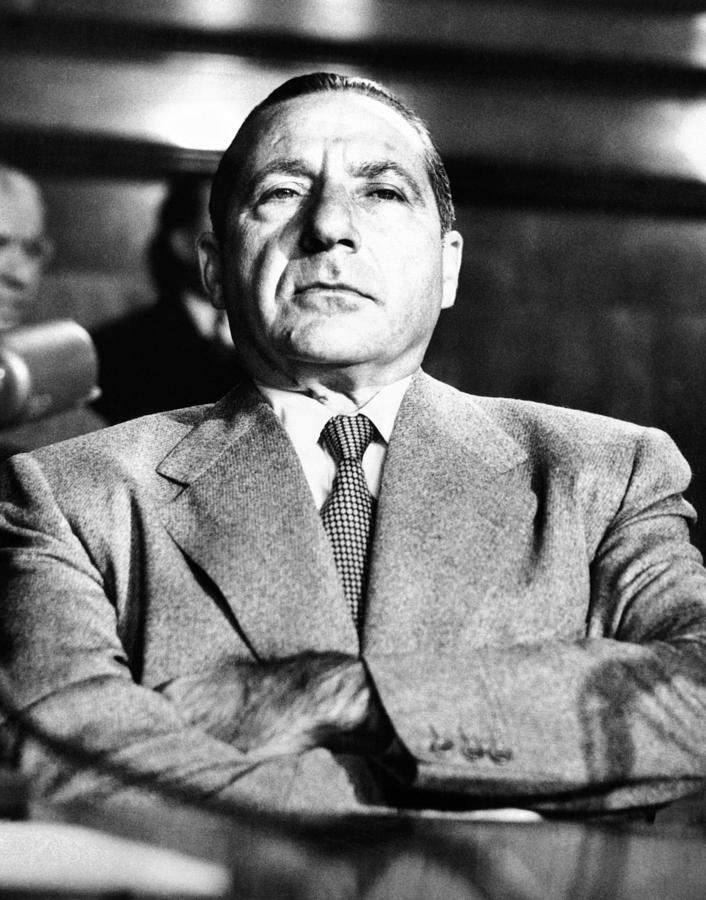
Costello appeared before the Senate’s Special Committee to Investigate Organized Crime in Interstate Commerce, commonly known as the Kefauver Committee. He looked more like a successful businessman than the popular image of a gangster. His suit was carefully tailored, his hair neatly groomed, and his manner suggested a man who understood that influence did not always require a raised voice.
He had not come to deliver a speech or explain the inner workings of his business voluntarily. The committee wanted to understand how organized crime operated across the United States, how illegal enterprises generated and protected their profits, and whether powerful criminal figures enjoyed assistance from people inside legitimate government.
Costello’s attorneys objected to television cameras showing his face. The committee ultimately permitted the broadcast to continue with the cameras trained on his hands instead. The compromise produced an extraordinary image: the voice of one of America’s most notorious underworld figures accompanied by hands that twisted, clenched, and fidgeted as chief counsel Rudolph Halley questioned him.
For viewers accustomed to reading about gangsters in newspaper headlines, the experience was unprecedented. Organized crime had entered their living rooms, and its representatives were being questioned before the entire country.
But the hands were only the beginning. The more consequential story concerned the connections that had helped Costello build his influence long before he ever entered the witness chair.
| Kingmaker in the Shadows: Frank Costello and the Rotten Heart of Tammany Hall |
The Politician: Senator Estes Kefauver
The man leading the investigation was Senator Estes Kefauver, a Tennessee Democrat who had emerged as the public face of the Senate’s campaign against organized crime. His committee had been established in 1950 amid growing concern that criminal organizations were no longer confined to individual neighborhoods or cities. Gambling syndicates, racketeering operations, and networks of corrupt officials appeared to be part of a much broader national problem.
The committee’s mandate focused on organized crime’s use of interstate commerce. Investigators wanted to understand how criminal enterprises operated across state lines, who directed their activities, and what made their businesses so difficult to dismantle. The investigation was not simply an effort to identify gangsters responsible for illegal gambling or violent crime. It was an examination of the systems that allowed those activities to continue.
Who collected the money? Who provided protection? Who controlled gambling operations and the businesses that supported them? And when criminal organizations encountered resistance from law enforcement, was there someone with enough political influence to make the problem disappear?
Those questions led investigators into territory that extended well beyond the underworld itself. Organized crime could not operate successfully on money and intimidation alone. It needed access to people, institutions, and information that could help its enterprises survive.
Kefauver’s committee traveled to 14 major cities and heard testimony from hundreds of witnesses. Its proceedings became one of the great television events of the early 1950s, with an estimated 30 million Americans watching the hearings in March 1951.
For the first time, a vast national audience could watch alleged underworld power brokers being questioned by congressional investigators. The hearings also brought an uncomfortable possibility into public view: the men being investigated might not have achieved their positions entirely on their own.
| Hanging Game: Suicide, Strength, and the Silence of Power |
The Other Guy: Frank Costello
Frank Costello was precisely the sort of witness the committee wanted to examine.
Born Francesco Castiglia in Italy in 1891, Costello grew up in New York and developed a reputation through his associations with gambling, bootlegging, and organized crime. By the time he appeared before Kefauver’s investigators, he had spent decades establishing himself as a powerful figure in the criminal underworld.
He did not cultivate the rough image of a street thug. Costello preferred expensive clothing, discreet conversations, and relationships with people whose influence extended beyond criminal circles. His reputation earned him the nickname the Prime Minister of the Underworld, a title that reflected the political sophistication attributed to him.
Costello’s significance lay partly in his understanding of how power worked. Organized crime could use threats and violence, but those methods carried risks and attracted attention. A well-placed relationship could accomplish the same objective with considerably less disruption.
A telephone call might be more useful than a gun. A friendship might prove more valuable than a threat. And a politician who owed someone a favor could be an asset long after the immediate reason for that favor had disappeared.
This did not mean that every politician who knew Costello was corrupt or that every association between a criminal and a public official involved wrongdoing. It meant that Costello operated in a world where personal relationships could carry enormous practical value, and investigators wanted to understand how those relationships functioned.
The Kefauver Committee was interested in more than a man with a criminal reputation. It wanted to examine the networks surrounding him.
| Five Families: Blood, Power, and the Empire Beneath New York |
The Connection: Where Politics and the Underworld Met
Costello’s appearance before the committee took place against a broader investigation into the relationships linking organized crime with legitimate business and public institutions. Investigators examined political protection, police corruption, labor racketeering, and the connections between criminal enterprises and the people who conducted business with them.
That made Costello an appropriate figure with whom to begin The Company Senators Keep. He represented a particular kind of underworld influence: power built not only through criminal activity but also through access to people and institutions outside the criminal world.
New York City provided fertile ground for examining those connections. It was a place where political machines influenced appointments and contracts, police departments exercised considerable discretion, and gambling operations could generate substantial revenue. Criminal figures, businessmen, labor leaders, and politicians might occupy different positions within the city’s hierarchy, but their interests could intersect.
The committee’s investigation also brought former New York City mayor William O’Dwyer under scrutiny. O’Dwyer, who was serving as U.S. ambassador to Mexico, appeared before the committee amid questions about corruption allegations associated with his administration. The controversy surrounding his record eventually damaged his reputation and contributed to his resignation from the diplomatic post.
Costello and O’Dwyer were different men, occupying different positions in American public life. Their appearances before the same Senate investigation nevertheless illustrated the breadth of the problem confronting Kefauver and his colleagues. Understanding organized crime required investigators to look beyond the gangsters themselves and examine the political and institutional environments in which they operated.
Cities had mayors, police departments, judges, political organizations, and businessmen seeking licenses, contracts, favors, and protection. The underworld did not necessarily need to control every part of that system. Access to a few strategically placed individuals could be valuable enough.
The central question was how far those connections extended, what they accomplished, and whether the available evidence demonstrated criminal conduct or merely proximity to people suspected of it.
| Mobbed Up: Teamster Files: Union Power, Mafia Muscle, and the Secrets They Tried to Bury |
Follow the Money: Gambling and Political Protection
Illegal gambling was central to the Kefauver investigation for good reason. Betting operations could generate substantial amounts of cash, but collecting wagers was only one part of running a profitable criminal enterprise. A successful operation required bookmakers, locations, money collectors, communications, transportation, and some means of protecting the business from interference.
That protection could take several forms. In some cases, investigators suspected that money changed hands to secure cooperation or discourage enforcement. In others, personal relationships and political influence could provide advantages that were harder to document. The existence of those possibilities made gambling an important starting point for examining the broader relationship between criminal enterprises and public institutions.
The interstate dimension complicated the investigation. A bookmaker might operate in one city while money moved through another jurisdiction. An organization based in one state might maintain gambling interests across several others, creating a network that could not easily be understood by looking at a single location.
The Senate’s authority to investigate the use of interstate commerce provided a means of examining these larger operations, even though individual states retained authority over gambling within their borders. Investigators wanted to know how criminal organizations coordinated their activities and whether their operations depended on relationships that crossed the boundary between illegal enterprise and legitimate public life.
Costello occupied an important place in that inquiry because of his reputation and his longstanding associations with gambling interests. His appearance gave the committee an opportunity to examine a figure widely regarded as more sophisticated than the stereotypical gangster.
Yet the money alone could not explain the system. Investigators also needed to understand who benefited from the operations, who might have protected them, and how influence was exercised when criminal enterprises encountered obstacles.
What the FBI Knew
The Kefauver Committee did not conduct its investigation entirely on its own. According to the Senate’s historical account, Sergeant at Arms Joseph Duke enlisted the assistance of FBI Director J. Edgar Hoover in locating reluctant witnesses. Duke and Hoover helped bring notorious figures before the committee, including Chicago crime figure Jacob “Greasy Thumb” Guzik and Frank Costello.
That cooperation reflected the seriousness with which investigators regarded the problem. The hearings were not simply a collection of newspaper rumors or public accusations. The committee assembled witnesses, examined records, and took testimony as part of a formal congressional investigation into organized crime.
Costello was among its most prominent witnesses because investigators regarded him as an important figure in the criminal world they were attempting to understand. His appearance attracted public attention, but the committee’s purpose extended beyond the spectacle of a well-known gangster answering questions before a national audience.
The confrontation became contentious enough that the Senate ultimately pursued contempt proceedings against him. The Library of Congress preserves records of the formal proceedings associated with the committee’s action against Costello in March 1951.
For the committee, the televised hearings offered an opportunity to expose the scale and nature of organized crime to the public. But public attention was not the same as investigative success. The more difficult task was establishing what the witnesses knew, how their operations functioned, and whether the evidence could demonstrate specific wrongdoing.
Costello’s appearance put the underworld on display. Whether the investigation could fully illuminate the relationships surrounding it was another matter.
The Politician’s Answer: Power Without Public Office
Frank Costello never held a seat in the United States Senate, nor was he a government official who could be removed from office. His influence, as it was understood by investigators and described by contemporary observers, rested on a different foundation: reputation, business interests, and relationships cultivated over many years.
That distinction made him an especially revealing figure in the Kefauver hearings. Political power and criminal influence could exist within the same city without appearing to belong to the same world. One man might hold elected office and possess the authority of government, while another could command attention through money, personal connections, and a reputation for influence.
The two kinds of power were not equivalent, and the existence of contact between them did not automatically establish corruption. Nevertheless, the possibility that an underworld figure could benefit from relationships with legitimate institutions raised questions that could not be answered simply by identifying the people involved.
The committee’s broader investigation recognized this problem. It was not enough to examine individual gangsters while ignoring the circumstances that allowed their enterprises to operate. Investigators needed to consider the people, institutions, and commercial arrangements surrounding them.
Costello’s testimony therefore became part of a much larger inquiry into the environment in which organized crime flourished. The challenge was to distinguish influence from control, association from complicity, and suspicion from demonstrable wrongdoing.
The Record: What the Evidence Establishes
The documented history of the Kefauver Committee provides a firm foundation for understanding Costello’s place in the investigation. Established in 1950, the Senate committee examined organized crime in interstate commerce, traveled to major American cities, and heard testimony from hundreds of witnesses.
Costello appeared before the committee in New York City in March 1951. The official congressional transcript records the proceedings at the United States Courthouse at Foley Square. His attorneys objected to television cameras showing his face, producing the famous images of his hands moving nervously as he answered questions.
The committee subsequently pursued contempt proceedings against him, and the Library of Congress preserves the associated Senate records. These documents establish the significance of his appearance and provide a basis for examining what happened during the hearings.
There is, however, an important distinction between what the record establishes and what later interpretations might suggest. The fact that a politician knew Costello does not, by itself, prove that the politician was corrupt, controlled by the mob, or involved in criminal activity. Similarly, a meeting or association may raise legitimate questions without providing a definitive answer.
That distinction matters for anyone attempting to reconstruct the relationships between American organized crime and political power. Historical investigations must be grounded in documents, testimony, contemporary reporting, and corroborated evidence rather than reputation alone.
The questions surrounding Costello are worth examining precisely because they require that level of care. His influence was widely discussed, but determining how it operated in particular circumstances requires more than accepting the legend that surrounded him.
What We Don’t Know: The Questions Behind the Headlines
The Kefauver hearings brought Costello before a national audience, but they could not resolve every question about his influence. How much political power did he actually possess, and how much of his reputation rested on the belief that he could influence people in important positions?
Which politicians sought him out, and which encountered him through the ordinary overlap of business, social life, and city politics? Did particular relationships produce identifiable benefits, or did Costello’s reputation itself provide an advantage by making others cautious about crossing him?
These questions are difficult because relationships do not always leave behind a neat documentary trail. A meeting might appear in a newspaper without revealing its purpose. A telephone call might be recorded without establishing what was discussed. Financial records, testimony, and recollections might illuminate an association, but they can also be incomplete or contradictory.
Witnesses may have had reasons to minimize their connections, exaggerate their importance, or portray events in a way that protected their reputations. Politicians could deny improper conduct, while criminal figures might encourage others to believe they possessed more influence than they actually did.
The historian’s responsibility is to weigh those competing possibilities rather than force the evidence into a simple narrative. A direct line between a mobster and a politician might make for a compelling story, but the historical reality is often a complicated web of associations, competing interests, and uncertain motives.
That complexity does not make the subject less interesting. It makes the investigation more important. The goal is not to assume that every relationship concealed corruption, but to determine what the evidence can establish about how influence worked in American political life.
| Frank Costello |
The Final Word: The Company He Kept
Frank Costello never needed a seat in the United States Senate to become a figure of national importance. His power, or at least the reputation for power that surrounded him, came from a different source: the relationships he had built and the position he occupied within the American underworld.
In March 1951, the Senate brought him before a committee and demanded answers. Millions of Americans watched the encounter unfold on television, seeing the polished businessman, hearing his responses to difficult questions, and observing the nervous hands that became an enduring image of the hearings.
Yet the most revealing part of the Costello story was not the performance in the witness chair. It was what that appearance represented: a congressional investigation attempting to understand how organized crime could operate within the same cities, commercial networks, and political environments as legitimate American institutions.
For decades, gambling interests, labor racketeering, business relationships, and political machines had created opportunities for competing interests to intersect. Costello understood the value of relationships in that environment, while the Kefauver Committee sought to determine how those relationships worked and where they might conceal wrongdoing.
The hearings brought unprecedented public attention to the underworld, but they also raised a question that extended beyond any single gangster. If Costello’s influence depended partly on the company he kept, who were the people willing to keep his company, and what, if anything, did those relationships accomplish?
Those questions cannot be answered by assuming guilt through association. They require careful examination of the historical record, one politician, one relationship, and one documented connection at a time.
That is where The Company Senators Keep begins: with Frank Costello, the Senate committee that called him to account, and the uneasy intersection of organized crime and legitimate power. The next step is to examine the men who occupied the political side of that world—and the evidence surrounding their connections to the underworld.
References:
National Archives. “Guide to Senate Records: Chapter 18.” National Archives and Records Administration. Records of the Special Committee to Investigate Organized Crime in Interstate Commerce, 1950–1951. https://www.archives.gov/legislative/guide/senate/chapter-18.html.
United States Congress. Senate. Special Committee to Investigate Organized Crime in Interstate Commerce. Proceedings Against Frank Costello for Contempt of the Senate. 82nd Cong., 1st sess., March 30, 1951. Washington, D.C.: U.S. Government Printing Office, 1951. Library of Congress. https://www.loc.gov/item/2022700542/.
United States Congress. Senate. Special Committee to Investigate Organized Crime in Interstate Commerce. Proceedings Against Frank Costello. March 15, 1951. 82nd Cong., 1st sess. Congressional Serial Set, Serial No. 11487. Library of Congress. https://tile.loc.gov/storage-services/service/ll/llserialsetpdf/11/48/7_/00/_0/0/11487_00_00-014-0199-0000/SERIALSET-11487_00_00-014-0199-0000.pdf.
United States Senate. “Special Committee on Organized Crime in Interstate Commerce (The Kefauver Committee).” U.S. Senate: Investigations. https://www.senate.gov/about/powers-procedures/investigations/kefauver.htm.
United States Senate. “Frank Costello.” U.S. Senate Historical Office. Photograph of Frank Costello Testifying Before the Kefauver Committee, Library of Congress. https://www.senate.gov/about/images/costello-kefauver-committee.htm.
United States Senate. “The Kefauver Committee.” U.S. Senate Historical Office. https://www.senate.gov/about/powers-procedures/investigations/kefauver-committee/slideshow.htm.
United States Senate. “Lights! Camera! Action! The Senate Televised.” U.S. Senate Historical Office. https://www.senate.gov/artandhistory/senate-stories/lights-camera-action-the-senate-televised.htm.
Library of Congress. Aumuller, Al. “Frank Costello, Half-Length Portrait, Seated, Behind Microphone, Testifying Before the Kefauver Committee Investigating Organized Crime.” World Telegram & Sun, 1951. https://www.loc.gov/pictures/item/98506867/.
United States Senate Historical Office. History of Notable Senate Investigations: The Kefauver Committee. U.S. Senate. https://www.senate.gov/about/resources/pdf/kefauver-committee-full-citations.pdf.