Article 3 in the series: “The Loyalty Test: How Governors Learned to Fall in Line”
Earl Long, Carlos Marcello, and Louisiana’s Open-Door Underworld
In Louisiana, politics was never a clean business. It was a street fight with better suits.
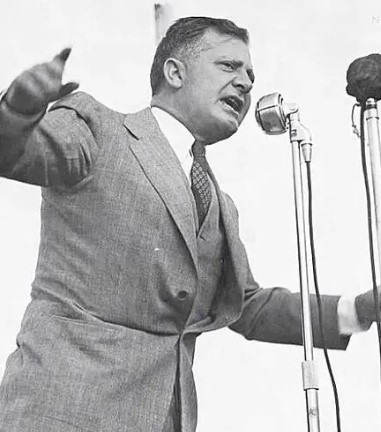
Earl Kemp Long knew that better than anyone. He’d grown up in the shadow of his brother Huey, a legend who ruled the state like a king and died like a martyr. Earl wasn’t the visionary. He wasn’t the speechmaker. He was the survivor—the grinning, backslapping, whiskey-scented operator who treated government like a traveling show and the statehouse like the biggest tent in town.
When he came back into the governor’s office in 1956, Louisiana didn’t get stability. It got weather. Loud, unpredictable, and impossible to ignore.
And in that climate, one man found it especially comfortable: Carlos Marcello.
Marcello didn’t look like much. Short, thick, soft-spoken, with the manners of a grocer and the reputation of a kingpin. But by the 1950s, he was exactly that—the undisputed boss of New Orleans, a man whose reach extended through gambling, vice, labor rackets, and the long, dark corridors where politics and police business quietly met.
Earl Long didn’t put Marcello in power. But he made sure it was rarely inconvenient to have him there.
Louisiana in the 1950s was a state where the line between law and politics was drawn in pencil and erased often. Sheriffs were political creatures. Judges were political creatures. Prosecutors were political creatures. And the governor was the biggest creature of them all, a walking storm system who could make careers with a phone call and break them with a shrug.
Long loved to intervene. He couldn’t help himself. He leaned on parole boards. He leaned on hospital administrators. He leaned on prison officials, judges, and local bosses. Sometimes he did it for poor farmers. Sometimes he did it for political allies. Sometimes the reasons were harder to see and easier to smell—like cigar smoke and old favors.
In New Orleans, Marcello’s people noticed patterns.
Raids that went nowhere. Cases that softened. Investigations that lost urgency. Gambling houses that seemed to live charmed lives. It wasn’t that the law never moved against them—it did—but it moved like it was walking through wet concrete. Slow. Tired. And usually pointed in some other direction.
Federal agents noticed too.
By the late 1950s, Washington had started paying serious attention to organized crime, and Louisiana kept coming up in their reports like a bad penny. Investigators described the state as one of the most mob-friendly environments in the country. Not because everyone was crooked, but because the system itself seemed… accommodating.
That word came up a lot.
Earl Long didn’t need to sit down with Marcello to make things work. He didn’t need secret meetings or whispered promises. All he had to do was keep the political ecosystem just unstable enough, just personal enough, that pressure always mattered more than procedure.
And pressure was Earl Long’s native language.
He ruled by impulse and favor. One day he was champion of the little guy. The next day he was threatening to fire half a department. He fought with newspapers, with judges, with his own party. He drank too much. He talked too much. He laughed at the wrong moments and raged at the wrong ones. The state never knew what mood he’d wake up in—and neither did the people who were supposed to enforce its laws.
For a criminal empire, that kind of chaos can be a gift.
Marcello’s operations didn’t need protection in the old-fashioned sense. They just needed space. Space to run numbers. Space to run gambling rooms. Space to lean on unions and businesses. Space to make sure witnesses forgot things and juries had doubts. Space to operate in a state where politics was personal and enforcement was optional.
Earl Long provided that space without ever having to admit it existed.
When officials pushed too hard, they found themselves transferred, isolated, or suddenly unpopular. When local lawmen got ambitious, they discovered the governor had opinions about their budgets, their appointments, or their futures. When judges proved inconvenient, the political machinery started humming around them like mosquitoes.
None of this required a memo.
It just required a governor who believed that the state was his to manage like a family argument—and who had no patience for anyone who took rules too seriously.
Carlos Marcello thrived in that environment. He wasn’t flashy like the Chicago bosses of old. He didn’t want headlines. He wanted continuity. He wanted a New Orleans where the rackets stayed profitable and the heat stayed local. Under Earl Long, that’s exactly what he got.
When federal pressure mounted, Long bristled—not because he loved Marcello, but because he hated being told what to do. Washington interference fit badly with his self-image as Louisiana’s unruly guardian. If the feds were pushing, Earl pushed back. And when he pushed back, the people who benefited were often the same people who’d always benefited from Louisiana’s political fog.
The Kefauver Committee and other federal investigators started connecting dots that locals had been stepping around for years. They saw the patterns. They saw the reluctance. They saw a state government that seemed allergic to sustained, serious confrontation with organized crime.
They also saw Earl Long, center stage, cracking jokes, issuing threats, and treating the entire process like a personal insult.
It wasn’t that he took orders from Marcello. It was that he ran a system where Marcello’s problems rarely became urgent.
That’s an important distinction, and a damning one.
In a healthy system, organized crime has to fight the current. In Louisiana under Earl Long, the current had a habit of shifting.
The stories piled up. A pressured official here. A softened stance there. A sudden change in tone. A quiet intervention that no one could quite trace but everyone could feel. It wasn’t a conspiracy with a blueprint. It was governance as mood, power as personality, and justice as something that could wait until tomorrow.
And tomorrow, in politics, is always negotiable.
Long’s defenders said he was a populist, not a crook. That he fought for regular people. That he hated elites and loved chaos. All of that is true. But chaos has beneficiaries, and in Louisiana, one of them was the man who ran New Orleans from behind a curtain.
Marcello didn’t need the governor to be loyal. He just needed him to be himself.
By the time Earl Long left office in 1960, the pattern was set. Louisiana had a reputation, and not the romantic kind. Federal files were thick. Local cynicism was thicker. The rackets were still there. The politics were still personal. The system had bent so many times it barely remembered how to stand straight.
In noir stories, the villain is often easy to spot. He carries a gun or a knife or a grudge. The more interesting danger is the man who runs the room by never keeping it still.
Earl Long was that man.
He turned governance into weather—unpredictable, dramatic, and exhausting. And in that storm, Carlos Marcello didn’t just survive. He settled in.
Because sometimes the best protection isn’t a shield.
It’s a climate.
References & Sources
- U.S. Senate, Special Committee to Investigate Organized Crime in Interstate Commerce (Kefauver Committee), Hearings and Reports, 1950–1951 and follow-up investigations.
- Sifakis, Carl. The Mafia Encyclopedia. Facts on File, 2005.
- Moldea, Dan E. The Hoffa Wars: The Rise and Fall of Jimmy Hoffa. Paddington Press, 1978 (for Marcello’s influence and Gulf South organized crime networks).
- Kurtz, Michael L. Earl K. Long: The Saga of Uncle Earl and Louisiana Politics. Louisiana State University Press, 1990.
- Brinkley, Alan. Voices of Protest (for broader context of populist Southern politics and power structures).
- New Orleans Times-Picayune archives (1950s), coverage of gambling, vice, and political pressure cases.
- U.S. Department of Justice historical summaries on Carlos Marcello and organized crime in Louisiana.
- Asbury, Herbert. The French Quarter: An Informal History of the New Orleans Underworld. Alfred A. Knopf, 1936 (background on New Orleans underworld culture and legacy systems).