New York City has always sold itself as a city of dreams.
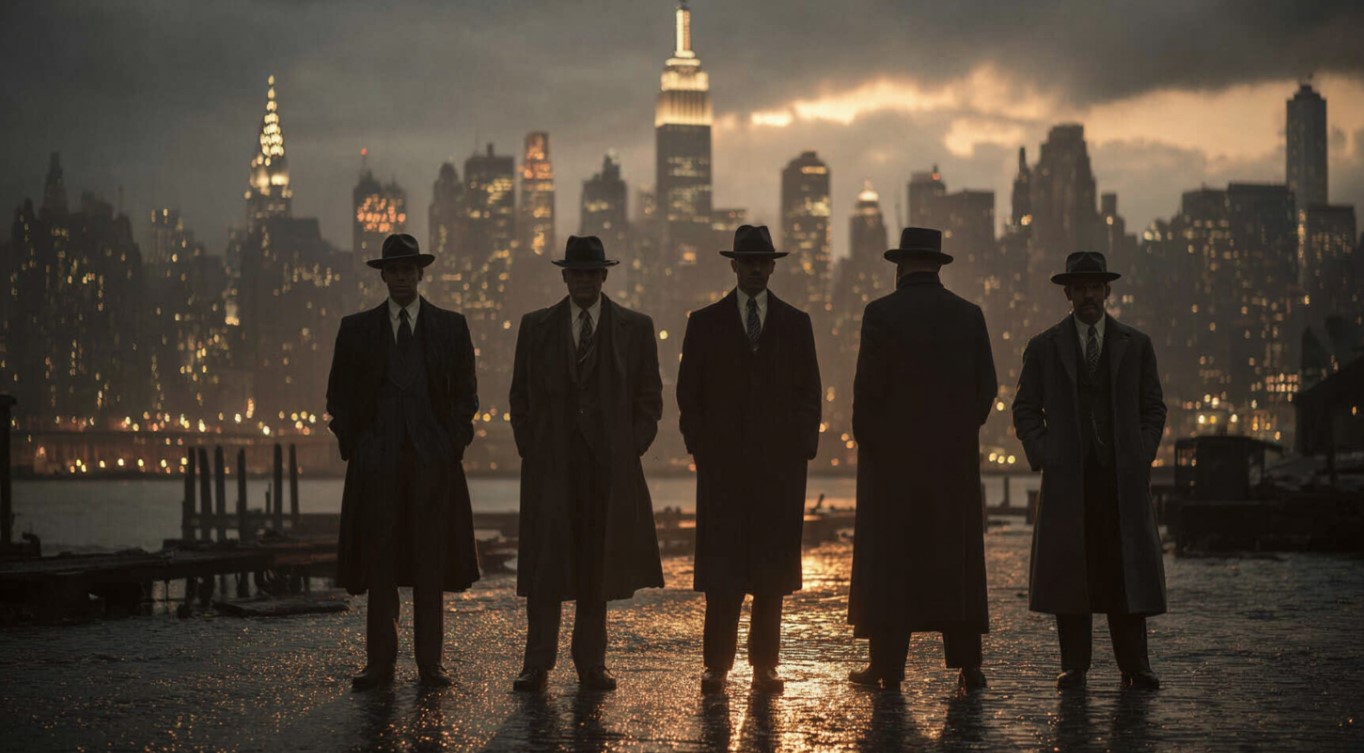
Its skyline rises like a monument to ambition. Its streets pulse with money, power, and opportunity. Millions have arrived at its shores hoping to build fortunes, reinvent themselves, or carve out a place in history. Yet beneath the glittering towers, crowded avenues, and flashing marquees, another New York existed for generations. It was a city hidden in shadows, governed not by elected officials or police commissioners, but by men whose authority came from fear, loyalty, and violence.
For much of the twentieth century, that hidden city belonged to the Mafia.
At the center of that underworld stood five criminal dynasties that came to dominate organized crime in America. Their influence extended far beyond New York’s boroughs, reaching into labor unions, construction projects, casinos, trucking companies, waterfront operations, and political circles. Their names became synonymous with power, corruption, and the uniquely American evolution of La Cosa Nostra.
The Genovese, Gambino, Lucchese, Bonanno, and Colombo families were not merely street gangs. They were criminal institutions with their own rules, traditions, leadership structures, and codes of conduct. They survived government crackdowns, internal betrayals, bloody wars, and relentless media attention. While individual bosses rose and fell, the families endured.
Their story is one of ambition wrapped in violence, fortunes built on fear, and an empire that operated beneath the surface of America’s largest city.
The War That Created an Empire
The Five Families emerged from one of the bloodiest periods in American organized crime history.
During the late 1920s and early 1930s, New York’s underworld was consumed by a violent conflict known as the Castellammarese War. Rival factions battled for control of the city’s lucrative rackets as Prohibition poured unimaginable wealth into criminal organizations. Illegal alcohol transformed gang leaders into millionaires, but it also created fierce competition among those seeking to control the profits.
The conflict centered on two powerful bosses: Joe Masseria and Salvatore Maranzano. Their followers fought across New York’s streets, restaurants, social clubs, and waterfront districts. Murders became so frequent that even hardened gangsters began to recognize the war as bad for business. Money was being lost, alliances were collapsing, and law enforcement scrutiny was increasing.
A younger generation of mobsters believed the old guard had become obsessed with personal power at the expense of profitability. Among those younger leaders was Charles “Lucky” Luciano, a visionary criminal who understood that organized crime could become far more profitable if it operated like a corporation instead of a battlefield.
Luciano helped orchestrate the deaths of both Masseria and Maranzano in 1931. With the old bosses removed, he reorganized the American Mafia into a more structured and disciplined organization. He established the Commission, a governing body designed to resolve disputes, prevent wars, and regulate organized crime’s expanding business interests.
From that reorganization emerged the Five Families, each controlling territory, rackets, and crews throughout New York City.
The structure Luciano created would survive for generations.
The Genovese Family: The Quiet Powerhouse
Among law enforcement officials and organized crime historians, the Genovese family is often regarded as the most powerful and sophisticated of the Five Families.
Its roots stretch back to the earliest days of Italian organized crime in New York. The family eventually took its name from Vito Genovese, one of the most feared and ambitious gangsters in Mafia history. Genovese combined ruthless instincts with political intelligence, allowing him to accumulate extraordinary influence within the underworld.
The family developed a reputation for secrecy that distinguished it from its rivals. While other organizations frequently suffered from internal conflicts, high-profile prosecutions, and damaging defections, the Genovese family often managed to keep its leadership structure hidden from public view. Investigators regularly described it as the most difficult family to penetrate.
Several legendary figures emerged from its ranks. Frank Costello became known as “The Prime Minister of the Underworld” because of his political connections and influence. Vincent “The Chin” Gigante later gained notoriety for his elaborate performance of mental instability. For years he wandered New York streets in a bathrobe, muttering to himself and appearing confused. Federal authorities eventually concluded the behavior was an act designed to avoid prosecution and conceal his role as boss of the family.
The strategy worked remarkably well, allowing Gigante to operate for years while maintaining a veil of uncertainty around his leadership.
The Gambino Family: Power in the Spotlight
No Mafia family has attracted more public fascination than the Gambinos.
The organization achieved its greatest strength under Carlo Gambino, a boss whose quiet demeanor concealed an extraordinary ability to accumulate power. Unlike many gangsters who sought attention, Gambino preferred to remain invisible. He rarely granted interviews, avoided public displays, and concentrated on building influence behind closed doors.
His approach proved highly effective.
By the 1960s and early 1970s, the Gambino family had become one of the most powerful criminal organizations in the United States. Its influence extended into construction, labor unions, shipping operations, and international smuggling enterprises. Gambino’s authority within the Commission was so significant that many observers viewed him as the most powerful Mafia leader in America.
Everything changed after his death.
The family eventually came under the control of John Gotti, whose leadership style could not have been more different. Gotti embraced media attention, appearing in expensive suits and becoming a fixture in newspaper headlines and television reports. Reporters dubbed him “The Dapper Don” because of his polished appearance and confidence in front of cameras.
For a time, his acquittals in multiple criminal cases led the press to call him “The Teflon Don.” Yet the publicity that helped build his legend ultimately contributed to his downfall. Federal prosecutors secured his conviction after obtaining testimony from underboss Sammy Gravano, one of the highest-ranking Mafia figures ever to cooperate with authorities.
Gotti’s conviction marked the end of an era when Mafia bosses could operate as public celebrities.
The Lucchese Family: The Businessmen of the Underworld
The Lucchese family rarely received the same headlines as the Gambinos, but its influence was enormous.
Named after Tommy Lucchese, the family excelled at infiltrating legitimate industries and generating consistent revenue through labor racketeering, extortion, and corruption. Its members developed deep connections within New York’s transportation and construction sectors, creating opportunities that produced profits for decades.
The family became especially skilled at manipulating unions and controlling industries that most ordinary citizens never realized were vulnerable to organized crime influence. Through these relationships, Lucchese leaders gained access to streams of income that often appeared entirely legitimate on the surface.
One of the family’s most famous associates was Henry Hill, whose life later inspired the film Goodfellas. Hill’s cooperation with federal authorities provided the public with an unprecedented glimpse inside Mafia culture. His testimony exposed criminal operations ranging from hijackings and loan-sharking to murders and internal family politics.
The resulting revelations helped demystify organized crime while simultaneously contributing to its enduring fascination in popular culture.
The Bonanno Family: A Dynasty Torn Apart
The Bonanno family began as one of the most stable organizations within the Mafia.
Its founder, Joseph Bonanno, was one of the original bosses recognized by Luciano’s Commission. Intelligent, disciplined, and deeply committed to traditional Mafia values, Bonanno viewed himself as a statesman within organized crime. He often spoke about honor, loyalty, and leadership with a confidence that reflected his standing among other bosses.
For years, the family prospered.
That stability began to unravel during the 1960s when power struggles and strategic miscalculations triggered an internal conflict known as the Banana War. Rival factions battled for control, creating years of instability that weakened the organization and damaged its reputation.
The family faced additional setbacks in later decades as government investigations intensified and multiple members chose to cooperate with federal authorities. Perhaps the most shocking betrayal came when boss Joseph Massino became the first official head of a New York crime family to turn government witness.
His decision shattered one of organized crime’s most enduring assumptions: that a Mafia boss would remain loyal to the organization regardless of the consequences.
The Colombo Family: Violence From Within
If the Bonannos were known for instability, the Colombos became infamous for internal warfare.
Originally known as the Profaci family, the organization eventually adopted the Colombo name after Joseph Colombo assumed leadership. Colombo attracted national attention by founding the Italian-American Civil Rights League, placing himself in front of television cameras while simultaneously facing allegations of organized crime involvement.
His public profile made him one of the most recognizable Mafia figures in America.
In 1971, Colombo was shot during a rally in Manhattan. Although he survived, he never fully recovered. The attack created a leadership vacuum that contributed to decades of turmoil.
Unlike other families that generally resolved disputes behind closed doors, the Colombos repeatedly descended into open conflict. Rival factions engaged in assassinations, attempted murders, and prolonged power struggles that drew intense attention from law enforcement.
The family endured despite these challenges, demonstrating the resilience that has characterized all five organizations throughout their histories.
The Commission: The Boardroom of Organized Crime
Luciano’s creation of the Commission transformed organized crime in America.
The organization functioned much like a corporate board of directors, allowing Mafia leaders to negotiate disputes without resorting to large-scale warfare. Major decisions involving leadership changes, territorial conflicts, and significant criminal ventures often required consultation among Commission members.
The arrangement was not always peaceful. Betrayals, murders, and rivalries remained part of Mafia life. Nevertheless, the Commission reduced the chaos that had defined earlier periods of organized crime history and helped create a structure capable of generating extraordinary profits.
For decades, it served as the governing body of America’s criminal underworld.
The Final Word
The story of the Five Families is ultimately the story of a hidden New York.
It is a story that unfolded behind the doors of social clubs, restaurants, union halls, and quiet suburban homes. While millions of people went about their lives above ground, an invisible network of bosses, captains, soldiers, and associates shaped events from the shadows. They influenced industries, corrupted institutions, and built fortunes through a combination of intimidation, loyalty, and opportunity.
The men who led the Five Families rarely viewed themselves as common criminals. Many saw themselves as businessmen, leaders, or guardians of tradition. Yet the foundations of their empire were built upon extortion, violence, corruption, and fear. Every dollar earned and every territory controlled carried a hidden cost that was often paid by victims whose names never appeared in headlines.
Federal prosecutions, informants, and changing economic realities have diminished the power once wielded by the Five Families. The days when Mafia bosses could openly dominate entire industries have largely faded into history. Even so, the legend of the Five Families remains deeply woven into the identity of New York City.
Their empire may have existed beneath the city, but its shadow stretched across generations. Long after the bosses are gone and the social clubs have closed, the story of the Five Families continues to haunt the streets where America’s most powerful criminal dynasty once ruled.
References:
Critchley, David. The Origin of Organized Crime in America: The New York City Mafia, 1891–1931. Routledge, 2008.
Raab, Selwyn. Five Families: The Rise, Decline, and Resurgence of America’s Most Powerful Mafia Empires. Thomas Dunne Books, 2005.
Maas, Peter. Underboss: Sammy the Bull Gravano’s Story of Life in the Mafia. HarperCollins, 1997.
Bonanno, Joseph. A Man of Honor: The Autobiography of Joseph Bonanno. St. Martin’s Press, 1983.
Capeci, Jerry. The Complete Idiot’s Guide to the Mafia. Alpha Books, 2002.
Jacobs, James B. Mobsters, Unions, and Feds: The Mafia and the American Labor Movement. NYU Press, 2006.
United States Department of Justice. “The Commission Case: United States v. Anthony Salerno et al.” Federal Organized Crime Prosecution Records.
Federal Bureau of Investigation. “La Cosa Nostra: The Five New York Families.” FBI Organized Crime Historical Files.
Hill, Henry, and Douglas Century. The Wiseguy Cookbook: My Favorite Recipes from My Life as a Goodfella to Cooking on the Run. Penguin Books, 2002.
Volkman, Ernest. Gangbusters: Organized Crime in America. Franklin Watts, 1987.