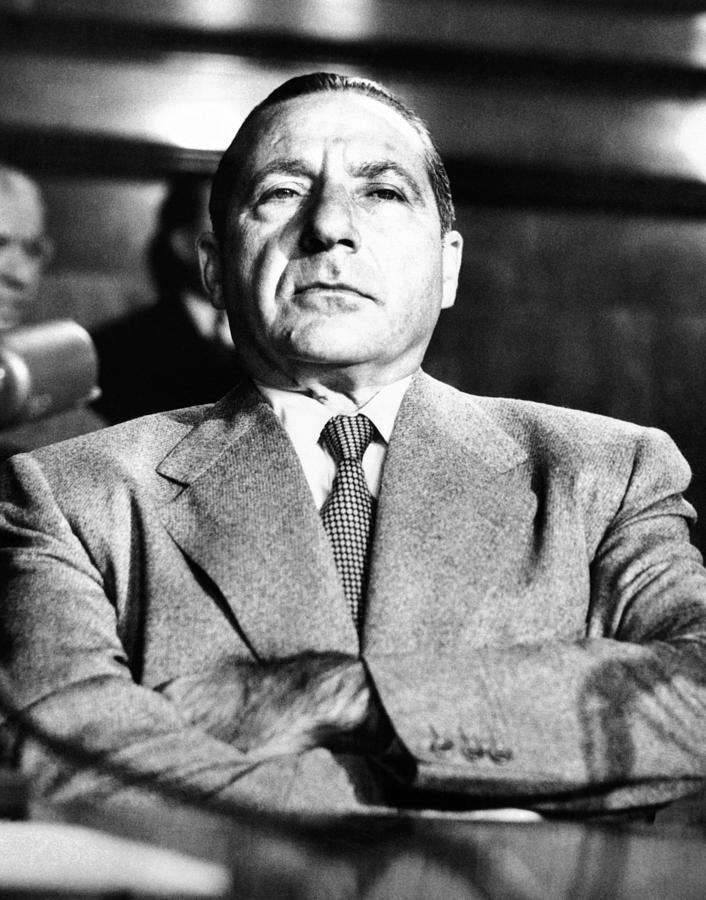
Frank Scalice: Loyalty to the Executioner
“Kiss the Ring. Dig Your Grave” series – Article 2
The Mafia has never lacked ambitious men. Every generation produced gangsters eager to climb the ladder, earn a button, command a crew, and eventually sit at the head of the table. Some fought their way upward through fear. Others built fortunes through gambling, labor racketeering, or political corruption. A select few mastered something even more valuable—earning the absolute trust of the boss.
Frank Scalice did exactly that.
For years, he stood among the most powerful figures in the American Mafia, serving one of its most feared leaders, Albert Anastasia. Scalice remained loyal through shifting alliances, bloody wars, and endless political maneuvering inside the Commission. He never publicly challenged Anastasia’s authority. He never attempted to build a rival faction. He stayed exactly where every boss claimed to want his lieutenants—steadfast, dependable, and obedient.
It should have guaranteed his survival. Instead, it guaranteed his death.
Frank Scalice learned one of organized crime’s oldest lessons: when the boss becomes a problem, anyone standing too close to him becomes part of the solution.
A Sicilian Beginning
Born Francesco Scalisi in Caccamo, Sicily, in 1891, Frank Scalice arrived in the United States during an era when thousands of Sicilian immigrants carried with them old loyalties, family ties, and criminal traditions. Like many future Mafia leaders, he settled in New York, where organized crime was evolving from neighborhood gangs into sophisticated criminal enterprises.
Unlike flashy gangsters who craved newspaper headlines, Scalice preferred the shadows. He built his reputation through discipline rather than spectacle, cultivating the image of a traditional Sicilian Mafioso who valued hierarchy, discretion, and stability above personal fame.
Those qualities made him valuable. They also made him trustworthy in the eyes of men who rarely trusted anyone.
As the American Mafia matured under the influence of figures like Charles ‘Lucky’ Luciano, Scalice found himself rising within what would become the Gambino crime family. He survived the violent power struggles of the 1930s not because he was the most ruthless man in the room, but because he understood the importance of choosing the right alliances.
Eventually, one alliance would define—and destroy—his career.
The Rise of Albert Anastasia
If Frank Scalice represented quiet discipline, Albert Anastasia represented controlled terror.
Known as the “Lord High Executioner,” Anastasia earned his reputation through extraordinary violence. Though popular history often exaggerates his direct leadership of Murder, Inc., there is little doubt that his name became synonymous with intimidation, enforcement, and murder.
Yet Anastasia was more than a killer.
He was a political operator who understood that fear alone could not hold together one of America’s largest Mafia families. He needed capable administrators, experienced captains, and trusted advisers. Frank Scalice fit that role perfectly.
Scalice supported Anastasia through years of leadership, helping maintain internal discipline while the boss expanded his influence over labor unions, waterfront operations, gambling, and business rackets throughout New York. Their relationship appeared stable.
Beneath the surface, however, resentment was quietly growing.
Standing Beside the Wrong Boss
Power inside the Mafia is rarely permanent.
Bosses survive only as long as they remain profitable, predictable, and politically acceptable to the Commission. Violence may build an empire, but too much violence eventually frightens even fellow gangsters.
By the mid-1950s, many influential Mafia leaders viewed Anastasia as increasingly reckless.
His independent streak worried them. His unpredictable behavior created unnecessary attention. Rivals questioned whether he could continue leading without provoking law enforcement or upsetting the fragile balance among the Five Families.
As opposition quietly formed, Frank Scalice never distanced himself.
He continued supporting Anastasia. He remained publicly loyal. He stayed exactly where he had always stood—at the boss’s side. In any other profession, that kind of commitment would have been admired.
In organized crime, it became evidence.
The Politics of Elimination
The Mafia often portrays murder as punishment. In reality, many assassinations are preventative.
Potential witnesses are eliminated. Potential rivals disappear. Potential obstacles are quietly removed before they can react.
Scalice had done nothing to betray the organization. He had not become an informant. He had not stolen money.
He had not challenged the Commission.
His greatest offense was remaining closely associated with a leader whose political support was collapsing.
Once powerful men concluded that Anastasia’s reign had to end, his most trusted allies suddenly appeared dangerous. Loyal lieutenants could organize retaliation. They could rally supporters. They could preserve the old regime.
From the conspirators’ perspective, eliminating Scalice before removing Anastasia made strategic sense.
It wasn’t revenge. It was preparation.
Murder Before the Main Event
On June 17, 1957, Frank Scalice attended a fruit market in the Bronx, believing he was conducting ordinary business.
Instead, gunmen opened fire. Scalice died in a hail of bullets, months before Albert Anastasia himself would be assassinated. To outside observers, the murder appeared shocking.
Inside organized crime, many recognized it for what it was. A warning.
The campaign against Anastasia had already begun. The boss simply hadn’t realized it yet.
Scalice’s murder removed one of Anastasia’s most dependable supporters, leaving the increasingly isolated boss with fewer experienced allies capable of defending his position.
The conspiracy was dismantling the king’s castle one stone at a time.
| Wag the Mob: How the FBI Sold America a Lie While the Mafia Sat at the Table |
The Barber Chair
Four months later, on October 25, 1957, Albert Anastasia entered the barbershop inside New York’s Park Sheraton Hotel. He never walked out.
Masked gunmen burst into the shop and riddled him with bullets while he sat in the barber’s chair. One of the most iconic assassinations in Mafia history instantly became legend, immortalized in books, documentaries, and Hollywood films.
Most people remember Anastasia. Few remember Frank Scalice.
Yet his death revealed the ending before the story reached its climax. The loyal lieutenant had fallen first.
Loyalty Has an Expiration Date
Scalice spent years proving himself dependable. He understood hierarchy. He respected authority. He honored Mafia tradition.
None of it mattered once the political winds changed. His career illustrates a truth that appears throughout organized crime history. Bosses expect loyalty. The organization expects flexibility.
Those two expectations inevitably collide.
A lieutenant who remains faithful after everyone else has begun looking toward the future often becomes trapped between yesterday’s leadership and tomorrow’s ambitions.
Scalice never adapted. He never switched sides. He remained exactly what he had always been. That consistency became fatal.
| Five Families: Blood, Power, and the Empire Beneath New York |
A Seat Too Close to Power
The Mafia celebrates loyalty in public and punishes it in private.
Every initiation ceremony speaks of lifelong devotion. Every oath demands obedience. Every boss insists that honor and respect are the foundations of the organization.
History tells another story. The men who stand closest to power frequently become collateral damage when that power shifts.
Frank Scalice was not murdered because he lacked courage. He was not murdered because he failed Albert Anastasia. He was murdered because everyone believed he would never fail Albert Anastasia. That distinction mattered more than anything he had actually done.
In the criminal underworld, perception often outweighs truth.
The Noir Lesson
Dark streets have long memories.
They remember the flashy gangsters who chased headlines, but they also remember the quiet men who believed loyalty alone could keep them alive. Frank Scalice wasn’t a celebrity gangster. He wasn’t loud, charismatic, or endlessly quoted in newspapers. He was something far more valuable to his boss—a man who could always be counted on.
Unfortunately, dependable men become predictable men. Predictable men become obstacles. Obstacles disappear.
Scalice spent decades climbing toward the center of power, convinced that standing beside one of the Mafia’s most feared bosses offered security. What it actually offered was proximity to an execution order already being written behind closed doors.
He never betrayed the man he served. The Mafia simply decided that was reason enough to kill him. In organized crime, loyalty isn’t always rewarded.
Sometimes it’s simply evidence that you’re standing on the wrong side of history.
| Thomas “Tommy” Bilotti – The Ultimate “Yes” Man |
References:
Anastasia, George. The Goodfella Tapes. New York: HarperCollins, 2011.
Capeci, Jerry. The Complete Idiot’s Guide to the Mafia. Indianapolis: Alpha Books, 2002.
Critchley, David. The Origin of Organized Crime in America: The New York City Mafia, 1891–1931. New York: Routledge, 2009.
Davis, John H. Mafia Dynasty: The Rise and Fall of the Gambino Crime Family. New York: HarperCollins, 1993.
Raab, Selwyn. Five Families: The Rise, Decline, and Resurgence of America’s Most Powerful Mafia Empires. New York: Thomas Dunne Books/St. Martin’s Press, 2005.
Federal Bureau of Investigation. Famous Cases: La Cosa Nostra. Washington, DC: Federal Bureau of Investigation. https://www.fbi.gov/
New York Times. “Albert Anastasia Slain in Hotel Barbershop.” October 26, 1957.
United States Senate. Organized Crime and Illicit Traffic in Narcotics: Hearings Before the Permanent Subcommittee on Investigations. Washington, DC: U.S. Government Printing Office, various editions.