The Governor’s Money Man: Fuller Warren, the Mob and Florida’s Gambling Machine
Florida liked to sell itself as paradise.
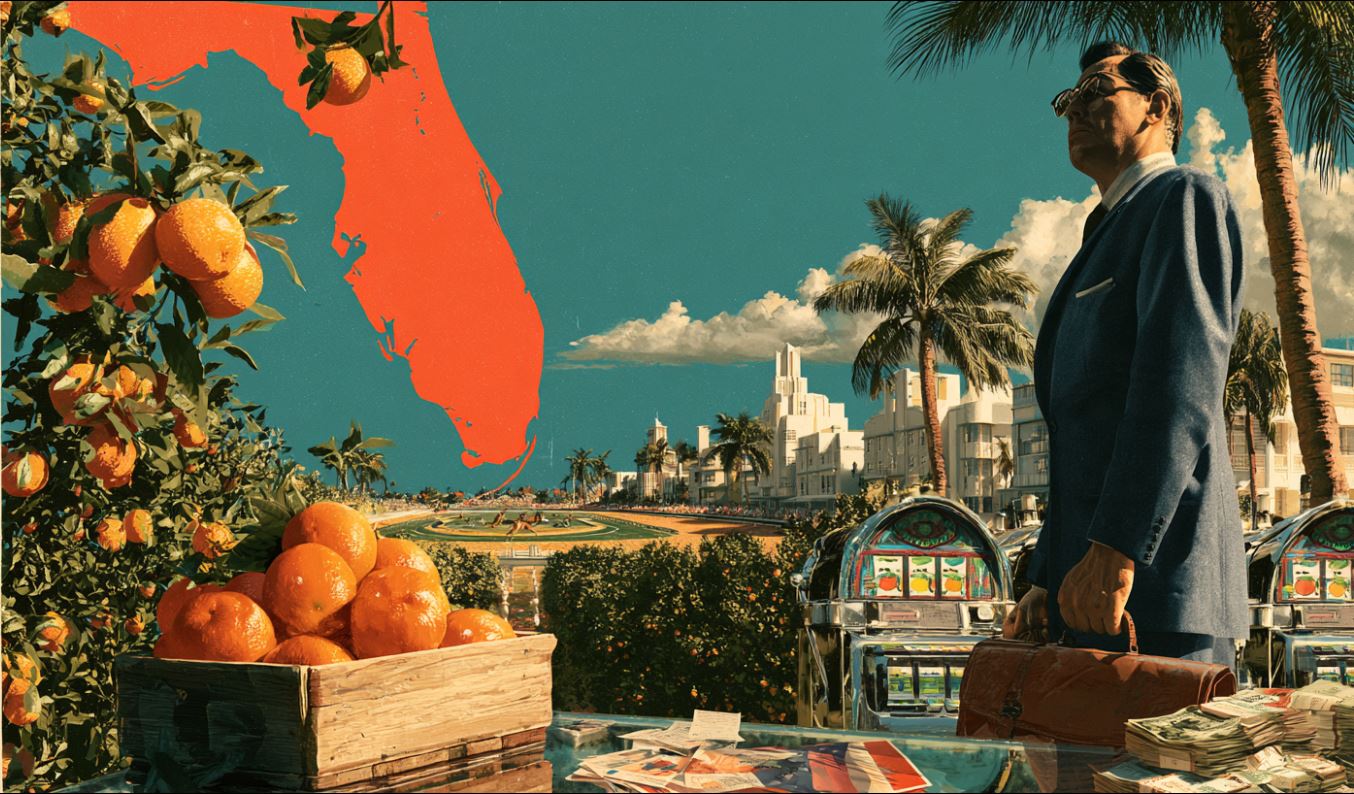
In the years after World War II, the sales pitch was especially effective. Sunshine, beaches, palm trees, racetracks and a booming tourist trade made the state look like an escape from the cold, gray machinery of the Northeast. But beneath the palms, another Florida was taking shape—one built around gambling, political influence and men who understood that money could accomplish things that bullets could not.
At the center of that world stood Governor Fuller Warren.
Warren’s relationship with organized crime has been examined before, particularly his political connections to figures associated with the old Capone organization. But the more revealing story is not necessarily whether Warren personally sat down with Mafia bosses or accepted envelopes stuffed with cash. It is what happened when gambling money entered Florida politics on a massive scale.
The money did not have to look dirty.
It only had to buy influence.
The $462,000 Question
When Warren won the Florida governor’s race in 1948, his campaign reportedly operated with a war chest of approximately $462,000, an enormous amount of money for a statewide political campaign of the period.
One contribution immediately attracted attention.
Approximately $154,000 reportedly came from William H. Johnston, a powerful dog-track operator with interests in Florida and Illinois. Johnston was not simply a wealthy businessman who happened to like Warren. The Kefauver Committee described him as an old associate of men connected to Al Capone’s organization. TIME likewise identified Johnston as a major gambling figure with Chicago connections.
The contribution was particularly troublesome because Florida law prohibited officers or stockholders of racing-license corporations from making political contributions. That should have been the beginning of a very uncomfortable conversation in Tallahassee.
Instead, it became part of a much larger scandal.
The Kefauver Committee eventually examined three major contributors to Warren’s 1948 campaign: William H. Johnston, Louis E. Wolfson and C. V. Griffin. According to the committee’s final report, those three men alone contributed more than $400,000.
There was another problem.
The committee said Warren had submitted an affidavit reporting only $8,825 in campaign contributions and had omitted Johnston, Wolfson and Griffin from the schedule of contributors. That discrepancy is far more interesting than another story about a gangster shaking hands with a politician. It suggests a question that hung over Florida politics for years:
Who really paid for political power?
Follow the Money
The Kefauver investigators were not naïve about political contributions from organized gambling.
Their report specifically identified political donations as one of the warning signs of organized crime. The committee concluded that known gamblers contributed to Warren’s campaign and stated that it could see little reason for men engaged in large-scale gambling operations to make such contributions unless they expected some eventual benefit—a political quid pro quo.
That conclusion did not necessarily mean that every dollar contributed by a gambler was Mafia money. That distinction matters.
There is no sound basis for simply declaring that Fuller Warren personally laundered Mafia proceeds. The historical record is much more complicated. But there is abundant evidence that gambling interests possessed enormous financial resources and used those resources to cultivate political relationships.
And that is where the story begins to resemble a primitive money-laundering machine.
Illegal gambling produced enormous amounts of cash. Legitimate racetracks generated legitimate revenue. Politicians needed campaign money. Businessmen wanted favorable treatment. Law-enforcement officials controlled enforcement.
The lines between those worlds could become remarkably thin.
| Governor Who Looked Away: Len Small, Prohibition, and the Statehouse That Made Room for the Mob |
The Gambling Machine
Florida’s gambling industry was not confined to a few back-room card games. Miami, Hialeah, Tampa, Jacksonville, Fort Lauderdale and West Palm Beach were all part of a sprawling gambling environment that included dog racing, horse racing, bookmaking, bolita, casinos and other forms of wagering. The Kefauver investigation found evidence of organized gambling operations reaching across state lines.
The state’s racetracks were especially valuable. They possessed something the traditional bookmaker did not: a veneer of legitimacy.
A racetrack could operate under a state license. It could advertise. It could attract tourists. It could employ hundreds of people. It could make large sums of money while presenting itself as a respectable business.
That made the track a perfect meeting point between legitimate commerce and the gambling underworld. William Johnston occupied precisely that territory.
He operated multiple Florida dog tracks as well as a track in Illinois, giving him both legitimate business interests and connections to the broader gambling world. When a man like that put hundreds of thousands of dollars behind a gubernatorial candidate, Florida’s political establishment had to understand that the money came with expectations.
The question was not simply where did the money come from? It was what could the money buy?
| The Pardon Machine: Harold Hoffman, New Jersey, and the Business of Mercy |
Protection Was the Real Currency
One of the most explosive allegations surrounding Warren involved George Petemezas, a former law-enforcement officer in Miami-Dade County. Petemezas testified about a gambling-protection system in which money allegedly flowed from gambling operations to law-enforcement personnel. He claimed that he collected approximately $800 a week from several gambling interests and that raids were sometimes preceded by warnings to the establishments being targeted.
Petemezas also testified that gambler Leon Bishop told him he had been sent by Governor Warren to take over gambling operations in Hialeah. Warren denied the allegation.
That denial is important because Petemezas’s testimony should not be treated as proof that Warren personally ordered protection for gambling operations. It was an allegation made during a period of extraordinary political warfare and investigation.
But the testimony reveals something more important.
Protection itself had become a commodity.
A gambling operation did not necessarily need the governor to own it. It needed sympathetic officials, friendly political relationships and advance warning when the machinery of law enforcement was about to come crashing through the door. In such a system, political contributions could function like insurance premiums.
The Missing Money
The most disturbing part of the Warren controversy may therefore have been the campaign-finance problem. The Kefauver Committee was not merely interested in who Warren knew. It wanted to know who had helped put him in office. The committee’s investigators found that several major gambling-connected figures had contributed enormous sums to his campaign while those contributions did not appear in Warren’s official accounting as the committee expected.
That transformed the scandal. If the issue had been only personal friendship, Warren could dismiss it as political association. Money was harder to explain. Money leaves trails.
Checks leave records. Campaign statements leave paperwork. Corporate ownership leaves documents. Political favors leave witnesses. And when hundreds of thousands of dollars move into a gubernatorial campaign, investigators naturally want to know why.
The University of Florida’s Fuller Warren Papers contain campaign materials, financial information and correspondence relating to Warren’s battle with the Kefauver investigation. The collection also includes documentation concerning the organized-crime investigation during his administration.
The paper trail survives.
The Machine Fights Back
Warren did not simply sit quietly while the investigation unfolded. He fought.
The governor publicly defended himself and his administration while the Kefauver Committee continued examining Florida’s gambling operations. His administration also took action against some local law-enforcement officials, including Dade County Sheriff Jimmy Sullivan, as the scandal widened. Contemporary reporting described Warren as attempting to clean up portions of the state’s corrupt gambling environment even while investigators continued to examine his own political connections.
That contradiction is one of the most fascinating elements of the Warren story. A politician could attack corruption while simultaneously being surrounded by people accused of benefiting from it.
Florida’s problem was therefore larger than one governor. It was an ecosystem.
The Price of Doing Business
The political consequences reached beyond Warren.
The Kefauver hearings generated such outrage in Florida that lawmakers moved toward stronger campaign-finance regulation. A 1954 study in the American Political Science Review noted that Floridians had become alarmed by the connections between gangsters and politicians and that the public reaction to the Kefauver hearings helped produce demands for tighter controls on campaign financing.
Meanwhile, Warren’s political successor, Governor Dan McCarty, went after the racetrack interests that had enjoyed so much influence.
In 1953, McCarty signed legislation increasing the state’s share of revenue from dog racing. TIME reported that the measure would cost Johnston’s four dog tracks approximately $417,625 a year and described the legislation as a victory over a group that had previously enjoyed extraordinary influence.
That episode is revealing.
If political influence had been purchased through campaign contributions, the new administration was effectively changing the price of doing business. The machine had discovered that political money could buy influence. Now the politicians were reminding the gamblers that influence could also be taken away.
Was It Money Laundering?
That question deserves a careful answer. Not in the modern legal sense.
There is no evidence presented here establishing that Fuller Warren personally operated a Mafia money-laundering scheme. Calling him a money launderer as a statement of fact would go beyond the historical record.
But something close to the underlying concept was plainly visible.
Money generated through gambling interests could enter the political system through campaign contributions. Political access could then protect or benefit gambling interests. Protection could preserve gambling revenue. That revenue could generate more money for political influence.
It was a circle. And circles like that are difficult to break because everyone inside them can claim that his hands are clean. The gambler calls himself a businessman. The politician calls the money a campaign contribution. The official calls the payment a political favor.
And the money keeps moving.
The Governor and His Money Man
Fuller Warren left office in 1953. The gambling interests did not. The political relationships did not. And Florida’s reputation as a playground for organized gambling certainly did not disappear when Warren’s term ended.
What the Kefauver investigation exposed was something darker than a governor’s questionable friendships. It exposed the infrastructure of influence—the racetracks, gamblers, political contributors, law-enforcement officials and campaign organizations that could operate in the same orbit without necessarily appearing to be part of the same machine.
William Johnston became the symbol of that system because he brought enormous gambling wealth into Florida politics. Warren became its most famous political beneficiary.
Whether the governor understood every source of every dollar is another question. Whether he personally participated in laundering criminal proceeds is a claim the surviving evidence does not establish.
But the larger lesson is harder to dismiss.
Florida’s gambling machine did not need to put a gangster in the governor’s chair.
It only needed to help decide who sat there. And once the money had bought the seat, the real business could begin.
References:
- United States Senate Special Committee to Investigate Organized Crime in Interstate Commerce. Third Interim Report of the Special Committee to Investigate Organized Crime in Interstate Commerce. 82nd Cong., 1st sess., 1951.
- United States Senate Special Committee to Investigate Organized Crime in Interstate Commerce. Fourth Interim Report of the Special Committee to Investigate Organized Crime in Interstate Commerce. 82nd Cong., 1st sess., 1951.
- “Gambling: Big Show in Miami.” TIME, July 24, 1950. TIME Archive
- “Gambling: Florida Songbird.” TIME, December 11, 1950. TIME Archive
- “Investigations: The Man with the Big Laugh.” TIME, July 16, 1951. TIME Archive
- “Catching the Rabbit.” TIME, June 8, 1953. TIME Archive
- Florida. Governor (1949–1953: Warren). Report of Fuller Warren: Governor of Florida. Tallahassee: State of Florida, 1953.
- University of Florida, George A. Smathers Libraries, Special and Area Studies Collections. “Fuller Warren Papers,” MS 110. Fuller Warren Papers — University of Florida Archives
- Key, V. O., Jr. “Florida’s New Campaign Expense Law and the 1952 Democratic Gubernatorial Primaries.” American Political Science Review 48, no. 2 (June 1954): 465–476.
- Florida Department of State, Division of Elections. “Campaign Finance Database.” Florida Division of Elections — Campaign Finance Database