The Mafia’s Favorite President? Richard Nixon and the Politics of Enemies: The Press was Another Target
Nixon’s enemies weren’t limited to Democratic politicians.
Journalists who irritated the White House could find themselves treated as political adversaries.
The National Archives’ records specifically identify journalists among those appearing on the 1971 opponents list. The list included Mary McGrory and Daniel Schorr, among others.
Nixon’s administration also attempted to investigate or pressure organizations and individuals associated with hostile coverage.
This is useful for your site because it creates a much bigger story than Watergate:
Nixon’s enemies included politicians, journalists, activists, bureaucrats and businessmen.
The Press Was Another Target
Richard Nixon understood the power of the press.
He also distrusted it.
During the Nixon years, newspapers and television networks were no longer simply observers of presidential politics. They were becoming powerful political actors in their own right, capable of exposing government secrets, shaping public opinion, influencing elections, and turning a single investigation into a national scandal. Nixon believed that much of the press was hostile to him, and his administration increasingly treated certain journalists and news organizations not merely as critics, but as political opponents.
The conflict became especially intense after the publication of the Pentagon Papers in 1971. What began as a dispute over a classified history of American involvement in Vietnam quickly developed into a constitutional battle over freedom of the press. Behind the courtroom fight, however, another story was developing inside the White House: the administration was looking for ways to control damaging coverage, punish hostile journalists, pressure news organizations, and identify the people it believed were working against the president.
The methods varied.
Some were ordinary political warfare. Others involved pressure campaigns, threats, attempts to manipulate regulators, surveillance, and the creation of a secret White House investigative unit. The administration did not simply attack the press from the podium. It sometimes looked for ways to use the machinery of government against the people who were embarrassing it.
And once that machinery began moving, the line between fighting bad publicity and attacking the institution that produced it became increasingly difficult to see.
| The Mafia’s Favorite President? Richard Nixon and the Politics of Enemies: Waterfate: The Crime That Brought Down a President |
Nixon and the Newspaper Problem
Nixon’s hostility toward the press did not begin with Watergate.
He had spent much of his political career believing that major newspapers and influential journalists were biased against him. The 1960 presidential election, his defeat in California’s 1962 gubernatorial race, and his later political comeback all reinforced his suspicion that the national press corps was populated by people who considered him an acceptable target.
The White House tapes reveal how frequently Nixon and his senior aides discussed the press. Reporters, editors, newspapers, television networks, and individual journalists repeatedly appeared in private conversations concerning administration policy and political strategy. One June 1971 conversation between Nixon and press secretary Ronald Ziegler, for example, dealt extensively with press coverage of the Pentagon Papers and the administration’s response to reporting by The New York Times and CBS.
This was more than irritation over an unfavorable headline.
The administration was developing a strategy.
The goal was not necessarily to silence every journalist. That would have been impossible, and Nixon understood the political value of a free press when it was reporting favorably on his administration. The objective was more selective: reward friendly outlets, punish hostile ones, restrict access when possible, challenge unfavorable stories, threaten legal action when useful, and make certain journalists understand that attacking the administration could have consequences.
In that environment, access itself became a weapon.
A reporter who received access to senior officials could produce stories that competitors could not. A newspaper that was shut out of the White House could find itself at a disadvantage. Television networks depended on interviews, briefings, administration appearances, and government sources to fill their broadcasts.
The White House knew this.
| The Mafia’s Favorite President? Richard Nixon and the Politics of Enemies: The Huston Plan |
The Enemy List Had a Press Problem
The administration’s concern about the press eventually became connected to its broader effort to identify political enemies.
The famous White House enemies lists were not exclusively lists of journalists. They contained politicians, businessmen, activists, celebrities, labor figures, and others. But journalists and media organizations occupied an important place in the administration’s political thinking.
A Senate Finance Committee historical report examining the Nixon administration’s treatment of political opponents noted that some of the earliest manifestations of the administration’s “enemies” mentality appeared in memoranda concerning the news media. One 1969 memorandum discussed presidential requests for action against what the administration considered unfair coverage and contemplated using agencies including the FCC and IRS in response to media criticism.
The significance of those documents is not that every recommendation became government policy.
It is that officials were thinking about the press in governmental terms.
An unfavorable newspaper story was no longer simply an unfavorable newspaper story. Inside the political operation, it could be treated as part of a larger campaign against the administration. Once that happened, the natural question became what resources the government might possess that could be used in response.
That was a dangerous way to look at journalism. The press could be criticized. A reporter could be challenged. A newspaper could be sued if there were legitimate grounds.
But using governmental authority to punish a news organization because it published unfavorable political material raised a fundamentally different question.
The Pentagon Papers Explode
Then Daniel Ellsberg changed the temperature in Washington.
The Pentagon Papers were a massive classified study of American involvement in Vietnam, formally titled the Report of the Office of the Secretary of Defense Vietnam Task Force. The study had been commissioned by Defense Secretary Robert McNamara in 1967 and ultimately comprised thousands of pages. In June 1971, portions of the report were leaked to The New York Times and subsequently published by other newspapers.
The Nixon administration was furious.
The issue was not merely that the documents were embarrassing. Administration officials argued that publication of classified material could damage national security and expose sensitive information. The government therefore sought to prevent newspapers from continuing publication.
The newspapers refused.
The confrontation moved rapidly into federal court and ultimately reached the Supreme Court in New York Times Co. v. United States. The case involved both The New York Times and The Washington Post, and the Court considered whether the government could prevent publication of the classified material in advance.
The Court ruled against the government’s attempt at prior restraint.
The decision did not mean that the press possessed an unlimited right to publish anything under any circumstances. It did, however, establish a major constitutional victory for the newspapers in the specific dispute over the government’s attempt to block publication.
For Nixon, the episode was deeply frustrating. The administration had attempted to stop publication through the courts, and the courts had refused to give the government what it wanted.
The president’s enemies had won a battle. But inside the White House, the response was not simply to accept the decision and move on. The administration began looking for another way to fight back.
| The Mafia’s Favorite President? Richard Nixon and the Politics of Enemies: Daniel Ellsberg and the Pentagon Papers |
The Plumbers Enter the Picture
The Pentagon Papers helped produce one of the most consequential decisions of the Nixon presidency: the creation of a secret White House unit designed to deal with leaks and national-security disclosures.
The group became known as the Plumbers.
- Howard Hunt and G. Gordon Liddy were among the figures associated with the operation. The unit was created in the aftermath of the Pentagon Papers controversy and operated outside the normal structure of the FBI and other established agencies. Its activities eventually included the burglary of the office of Daniel Ellsberg’s psychiatrist in Beverly Hills in September 1971.
The National Archives describes the Watergate chronology as beginning in June 1971 with the Pentagon Papers leak and the formation of the clandestine Plumbers group, whose later activities became part of the broader Watergate story.
This was an important turning point. The White House had already tried the courts. It had already attempted to manage the press. Now it was creating a secret operation to investigate the people it believed were responsible for leaks and political attacks.
The Ellsberg operation showed where that mentality could lead. Instead of relying exclusively on prosecutors or conventional investigators, people operating around the White House turned to covert methods.
The press conflict had moved into the shadows.
| The Mafia’s Favorite President? Richard Nixon and the Politics of Enemies: The Use of Federal Agencies Against Opponents |
Reporters Became Targets
The administration’s concerns did not stop with Ellsberg.
Individual journalists became objects of intense White House attention. The surviving tapes reveal discussions of reporters by name, along with conversations about newspapers, television networks, editors, publishers, and their relationships with administration officials.
The administration was particularly concerned about The New York Times and The Washington Post. Both organizations had national influence and both published reporting that could damage the White House.
A January 1973 conversation between Nixon and Charles Colson, for example, included extensive discussion of press relations, the New York Times, the Washington Post, individual reporters, access, rewards and punishments, and the possibility of cutting off access to administration officials.
The language of access is important.
Presidents have always decided which journalists receive interviews, briefings, and private meetings. Political officials have always rewarded friendly coverage with access and complained about unfavorable stories. Those practices alone do not constitute an abuse of power.
The Nixon administration pushed the concept further by treating access as part of an organized political strategy. Journalists could be rewarded. They could be frozen out. Their stories could be attacked.
Their employers could be pressured.
And in some cases, the White House explored whether government regulatory authority could be brought into the fight.
| How ’bout a Perdon, Mr. President? |
The Washington Post
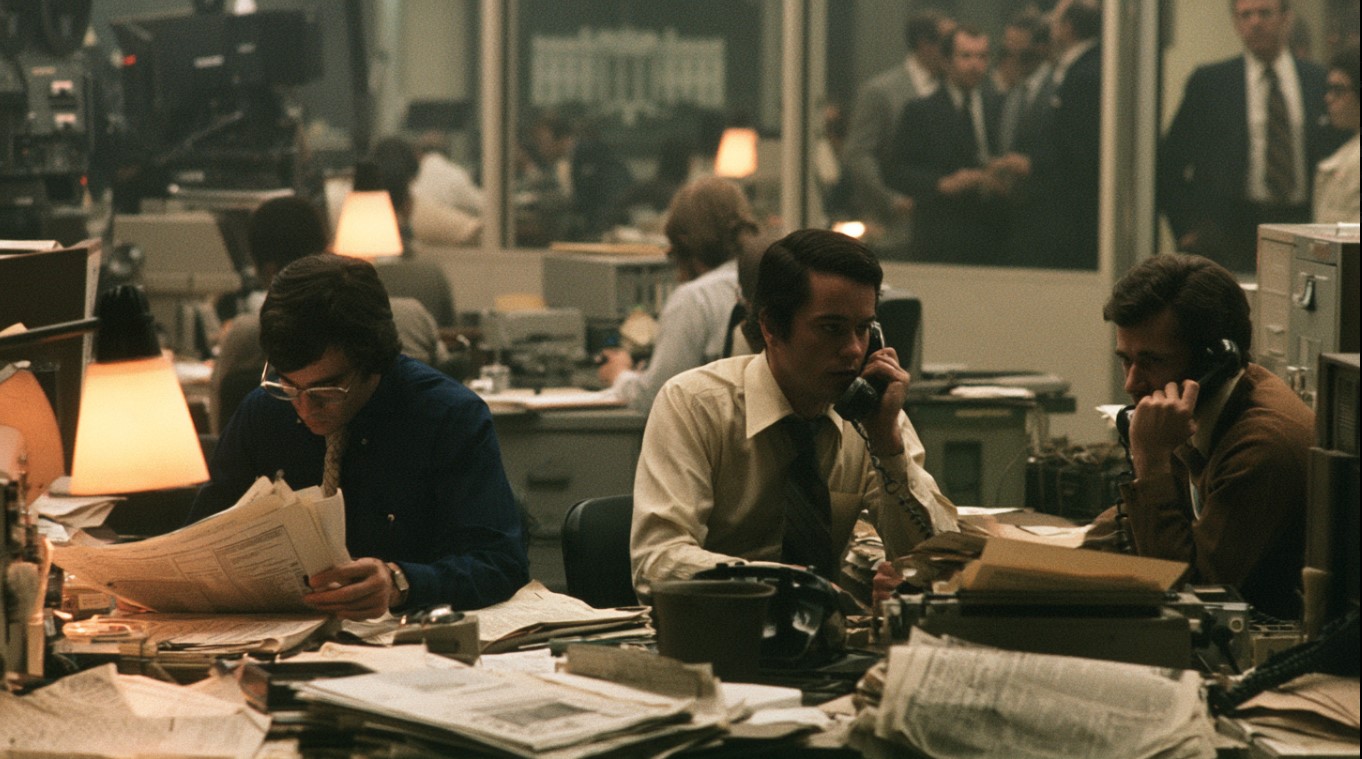
No newspaper became more closely associated with Nixon’s press war than The Washington Post. Publisher Katharine Graham, executive editor Benjamin Bradlee, and reporters including Bob Woodward and Carl Bernstein eventually became central figures in the Watergate story. But the hostility toward the newspaper existed before Watergate became the defining scandal of the Nixon presidency.
The White House regarded the Post as a particularly influential opponent. The tapes document repeated conversations about the paper, its reporters, its publisher, and the administration’s response to its coverage. In October 1972, Nixon and Charles Colson discussed the Post, White House strategy, press relations, television ownership, and possible FCC action involving stations associated with the newspaper.
That conversation illustrates the complexity of the administration’s approach. The Washington Post was not merely a newspaper.
It was also connected to broadcast properties, giving the White House another potential avenue for pressure through the regulatory system. The question was not simply whether the administration could convince the public that the Post was wrong. The question was whether the government could make the organization uncomfortable enough to change its behavior.
That distinction would become increasingly important as the administration’s conflict with the press intensified.
The FCC as a Pressure Point
The Federal Communications Commission presented an especially tempting weapon because broadcast licenses were subject to federal regulation.
Television was enormously influential in the early 1970s. A network could reach millions of Americans in a single evening, while local stations depended on federal licensing and regulatory approval. The White House therefore had an obvious interest in the FCC’s relationship with broadcasters.
The Nixon administration explored ways to use that regulatory environment against news organizations it considered hostile. A historical Senate record describes proposals involving the FCC and efforts to develop mechanisms for responding to unfavorable broadcast coverage. Later congressional investigations examined the administration’s attempts to pressure broadcasters and the use of complaints as part of that strategy.
There is an important distinction here.
The Nixon administration did not simply take control of the FCC and order it to punish every hostile broadcaster. In fact, the administration encountered institutional and legal barriers, and many of the contemplated actions did not become formal regulatory proceedings. Some of the pressure took the form of threats, complaints, political contacts, and attempts to encourage others to challenge broadcasters.
That distinction matters because political pressure and formal governmental action are not identical. But political pressure can still be powerful.
A network executive did not need to receive an official order from the FCC to understand that the administration was unhappy. A broadcaster did not necessarily need to lose a license to become concerned about a potential investigation.
Sometimes the possibility was enough.
CBS and the Battle Over Television
CBS became another focus of White House attention. The network’s chairman, William S. Paley, was a powerful figure in American broadcasting, and CBS News was one of the country’s most influential sources of television journalism. Nixon’s administration believed the network’s coverage was frequently hostile.
The surviving tapes show the president and his aides discussing CBS and other networks in connection with political coverage. Conversations about the press were often intertwined with broader questions about public opinion, presidential appearances, Vietnam, political opponents, and the administration’s media strategy.
This was the beginning of a new kind of political warfare. The newspaper could be attacked through editorials and speeches. Television was different.
The administration could attempt to shape the narrative before the cameras rolled. It could pressure networks through access. It could encourage complaints. It could attack individual reporters. It could challenge the credibility of broadcasts and threaten regulatory consequences.
The battle was no longer merely about what had happened. It was about who controlled the public’s understanding of what had happened.
The Reporters Were Watching Back
There was one problem the administration could never completely solve. Reporters were watching.
The more aggressively the White House tried to control the flow of information, the more determined some journalists became to find information the administration did not want published.
The Pentagon Papers were the clearest example, but the pattern continued. Reporters investigated government secrecy, intelligence operations, campaign activities, and eventually Watergate itself.
By 1972 and 1973, the relationship between the White House and major news organizations had become openly antagonistic. The White House did not merely complain about stories. It developed strategies for responding to them.
Nixon and his aides discussed the New York Times, Washington Post, television networks, individual reporters, possible lawsuits, access, public relations, and political counterattacks. The tapes demonstrate that press relations were not an occasional irritation; they were a recurring subject at the highest levels of the administration.
That is an important distinction. The president’s frustration with the press was personal, political, and strategic, but it also became institutional.
The administration developed machinery for fighting the press.
Watergate Changes Everything
Then the story came full circle. The Plumbers, created partly because the administration was furious about leaks, became connected to the Watergate burglary. On June 17, 1972, five men were arrested inside the Democratic National Committee headquarters at the Watergate complex.
The break-in might have remained a political crime of limited importance if the investigation had stopped there.
It did not. Reporters began following the money. The FBI began investigating. Congress began asking questions. And The Washington Post kept publishing.
The same press organization that Nixon’s White House regarded as a political enemy became one of the institutions most responsible for exposing the growing scandal.
Woodward and Bernstein were not operating alone. Other newspapers, television networks, prosecutors, congressional investigators, judges, and government officials were also pursuing the story. Watergate became impossible to contain because information was emerging from multiple directions.
The press was no longer simply reporting a scandal. It was helping uncover one.
That development transformed Nixon’s long conflict with journalists into something much larger than a dispute over unfavorable coverage.
The Tapes Become the Story
The irony became almost complete when the Nixon administration’s own secret recording system preserved conversations that documented its battles with the press. The president had a recording system inside the White House.
Those recordings eventually became evidence.
The tapes documented discussions about reporters, newspapers, networks, political strategy, and the administration’s efforts to respond to damaging stories. They also preserved conversations concerning Watergate and the attempt to manage the scandal. The administration had spent years worrying about leaks.
Now its own records were leaking into public view through courts, congressional investigations, and official releases. The system designed to preserve presidential conversations became one of the great documentary sources of the Watergate era. The irony was hard to miss.
The White House wanted control over information. The White House had created a system to preserve information.
And eventually, that information helped undermine the White House.
When the Press Became Part of the Constitutional Fight
By 1974, the struggle between the Nixon administration and the press had become part of a much larger constitutional crisis. The issue was no longer whether Nixon liked reporters. Presidents are entitled to dislike journalists, criticize newspapers, challenge stories, and complain about unfair coverage.
The deeper question was whether presidential power could be used to punish or intimidate journalists because they were doing their jobs.
The Pentagon Papers case had already established a powerful constitutional barrier against the government’s attempt to prevent publication in advance. Watergate added another dimension by demonstrating how political hostility toward the press could become entangled with investigations, surveillance, regulatory pressure, and covert operations.
The National Archives’ Watergate materials explicitly identify the role of the media alongside abuses of governmental power and the constitutional conflict involving the three branches of government.
The press was not above criticism. Neither was the president. But the government possessed powers that individual journalists did not. That imbalance was precisely why the press clause of the First Amendment mattered so much.
A newspaper could publish an embarrassing story. The federal government could investigate. A reporter could expose a secret. The government could attempt to prevent publication. A television network could criticize the president. The administration could attempt to pressure its executives.
Those powers were not equivalent.
The Press as the Enemy
The Nixon administration’s struggle with the press was not simply a story about a president who disliked criticism. It was a story about what happened when political resentment became institutional strategy.
The administration could fight a newspaper through public statements. It could challenge reporters through press conferences. It could attempt to discredit stories, cultivate friendly journalists, restrict access, and use political allies to create counter-narratives.
Those were ordinary weapons of political combat. The darker territory began when government authority entered the fight.
The IRS could audit. The FBI could investigate. The Justice Department could prosecute. The FCC could regulate. The White House could gather information. And covert operatives could operate in the shadows. Each power had a legitimate purpose.
The danger came when the political enemy became the reason for using it. That was the recurring theme of Nixon’s conflict with the press.
The administration did not succeed in controlling the American media. Newspapers continued publishing. Television networks continued broadcasting. Reporters continued investigating. The Supreme Court rejected the government’s attempt to stop publication of the Pentagon Papers, and journalists continued pursuing Watergate despite intense political pressure.
In the end, the press proved difficult to intimidate because it was not one institution.
It was thousands of reporters, editors, publishers, broadcasters, lawyers, photographers, producers, and news organizations competing with one another. Silencing one newspaper did not silence another. Attacking one reporter did not stop another from making the next telephone call.
The more the administration fought the press, the more the press had reason to investigate the administration. And eventually, the stories became bigger than the president’s ability to control them.
That was the final irony.
Richard Nixon had spent years believing that the press was one of the forces arrayed against him. He had watched reporters challenge his statements, question his policies, expose embarrassing information, and publish material the administration wanted kept secret.
But the press was never merely Nixon’s enemy. It was one of the institutions capable of watching the government while the government was watching everyone else. During the Nixon years, that distinction mattered.
Because once the federal government began looking at political opponents as targets, somebody had to look back.
The reporters did.
And they kept looking.
References:
- National Archives and Records Administration. “Pentagon Papers.” National Archives.
- National Archives and Records Administration. “National Archives and Presidential Libraries Release Pentagon Papers.” June 8, 2011.
- National Archives and Records Administration. “Watergate Gallery.” Richard Nixon Presidential Library and Museum.
- National Archives and Records Administration. “Nixon and Watergate.” Watergate records and historical materials.
- U.S. Supreme Court. New York Times Co. v. United States, 403 U.S. 713 (1971).
- U.S. Senate Committee on Finance. Tax Administration: IRS and Political Activities. Historical congressional materials concerning the Nixon administration and political use of federal agencies.
- Miller Center, University of Virginia. “Secret White House Tapes: Conversation 6–84.” July 1, 1971.
- Miller Center, University of Virginia. “Secret White House Tapes: Conversation 5–97.” June 16, 1971.
- Miller Center, University of Virginia. “Secret White House Tapes: Conversation 829–12.” January 1, 1973.
- Miller Center, University of Virginia. “Secret White House Tapes: Conversation 374–3.” October 25, 1972.
- Kutler, Stanley I. The Wars of Watergate: The Last Crisis of Richard Nixon. New York: W. W. Norton, 1990.
- Bernstein, Carl, and Bob Woodward. All the President’s Men. New York: Simon & Schuster, 1974.
- Herken, Gregg. The Georgetown Set: Friends and Rivals in Cold War Washington. New York: Knopf, 2014.
- Greenfield, Jeff. A Texan Looks at Lyndon: A Study in Illegitimate Power. New York: Delacorte Press, 1976.