Jacob “Gurrah” Shapiro: The Muscle Behind the Garment District
Before the Mafia became a national institution, before Las Vegas glittered with mob money, and before organized crime perfected the art of hiding criminal enterprises behind legitimate businesses, New York’s underworld was built in the streets.
In that world, muscle mattered.
Jacob “Gurrah” Shapiro was one of the men who provided it. A feared labor racketeer and enforcer, Shapiro became a central figure in the violent struggle for control of New York’s garment industry during the early twentieth century. He operated alongside Benjamin “Dopey” Benny Fein, Lepke Buchalter, and other underworld figures who understood that controlling workers could be just as profitable as robbing banks.
Shapiro did not need a famous crime family behind his name to become powerful. His empire was built through intimidation, labor racketeering, extortion, and violence, particularly within New York’s garment industry. For years, manufacturers and workers learned that defying him could carry a heavy price.
He was the kind of gangster who understood that a fist could accomplish something a negotiation never could.
From Russia to New York
Jacob Shapiro was born in 1899 in Odesa, Russia, and came to the United States with his family while still young. Like thousands of Jewish immigrants arriving in New York during the early twentieth century, he entered a city where poverty and opportunity existed side by side.
The Lower East Side and surrounding neighborhoods were crowded, noisy, and fiercely competitive. Immigrant families worked long hours in sweatshops and factories while criminal gangs controlled gambling, prostitution, protection rackets, and labor disputes. For ambitious young men with few legitimate opportunities, the underworld could provide money and status far faster than a factory floor.
Shapiro found his way into that world.
He became involved with Benjamin “Dopey” Benny Fein, a major figure in the Jewish underworld, and quickly developed a reputation for violence. Shapiro was not simply a street tough. He was learning how organized crime could turn violence into a business model.
That lesson would eventually make him extremely wealthy.
The Garment Industry Becomes a Battlefield
New York’s garment industry was enormous, employing hundreds of thousands of workers and generating vast amounts of money. The industry also presented organized crime with a unique opportunity.
Unions could control access to jobs. Strikebreakers could be hired or intimidated. Manufacturers could be pressured into paying for protection. And labor disputes could become sources of enormous criminal revenue.
Shapiro understood the possibilities. Along with Fein and other underworld figures, he became deeply involved in labor racketeering, using violence and intimidation to influence unions and manufacturers. The streets around the garment district became another kind of battlefield. Gangsters fought not simply for territory but for control over workers, contracts, and the flow of money through one of New York’s most important industries.
Shapiro became one of the men willing to enforce that control.
The Purple Gang
Shapiro’s career was closely associated with the gang known as the Purple Gang, a violent Jewish-American criminal organization that operated in New York during the 1910s and 1920s.
The group developed out of labor racketeering and street violence and became notorious for attacks against union officials, manufacturers, and rival gangsters. Shapiro’s relationship with Fein placed him near the center of this increasingly powerful criminal network. The gang’s methods were brutal.
Intimidation was common, and violence was used to settle labor disputes and enforce agreements. The difference between a legitimate union representative and a gangster could become almost impossible to see from the outside.
For Shapiro, that ambiguity was useful. The more deeply criminal organizations embedded themselves within legitimate labor structures, the more difficult it became for authorities to separate business from racketeering.
The Rise of Lepke Buchalter
One of the most important relationships in Shapiro’s life was his association with Louis “Lepke” Buchalter.
Buchalter began his career in the same world of garment-industry racketeering and gradually emerged as one of the most powerful labor racketeers in New York. Shapiro became one of his trusted associates and helped provide the muscle necessary to enforce Buchalter’s influence.
The partnership represented an important evolution in organized crime.
Violence was no longer simply about stealing money or defending territory. It became a tool for controlling legitimate industries. If a manufacturer refused to cooperate, pressure could be applied. If a union leader resisted, intimidation could follow. If a rival organization attempted to move into the territory, men like Shapiro were available to settle the dispute. Buchalter understood the business. Shapiro understood the enforcement.
Together, they helped create a model that would later be used by organized crime throughout the country.
A Reputation for Violence
Shapiro’s nickname, “Gurrah,” became associated with his reputation as a tough and intimidating figure. Accounts of his career describe a man who could be brutal when dealing with opponents, particularly when labor disputes threatened the interests of the criminal organizations controlling them.
But violence alone does not explain his success.
Shapiro understood relationships. He knew which officials could be pressured, which workers could be intimidated, and which business owners would rather pay than risk having their operations disrupted. His greatest weapon was not any individual act of violence but the expectation that violence could follow if someone refused to cooperate.
That expectation was often enough. In organized crime, fear can become a form of currency.
The Buchalter Connection
As Buchalter’s influence expanded, Shapiro remained part of the network that connected labor racketeering with the broader New York underworld.
Buchalter would eventually become one of the central figures associated with Murder, Inc., the loosely organized network of professional killers used by organized crime to eliminate troublesome individuals. Shapiro’s career predated the period when Murder, Inc. became notorious, but the same ecosystem of labor racketeering and organized violence helped produce the men who later formed it.
The connection is important because it shows how New York’s criminal organizations evolved. The old street gangs were becoming more sophisticated. Labor rackets generated steady income. Criminal groups formed alliances. Violence became increasingly organized and outsourced to trusted enforcers.
The underworld was becoming an industry. Shapiro had helped build part of it.
The Price of Power
Shapiro’s rise was not without consequences.
Labor racketeering attracted increasing attention from law enforcement, journalists, reformers, and politicians. The more organized crime became involved in unions, the greater the pressure became to expose the men profiting from worker exploitation.
The garment industry eventually became the subject of intense scrutiny. Investigators discovered patterns of intimidation, corruption, and criminal influence that had existed for years. The very success of men like Shapiro helped create the evidence that would later be used against them.
The system had become too large to remain invisible.
Decline and Death
By the 1930s, the criminal landscape that had allowed Shapiro to flourish was changing. New generations of Mafia leaders were consolidating power, and older Jewish-American gangs were losing influence as organized crime became increasingly structured around the national syndicate model.
Shapiro’s health also deteriorated.
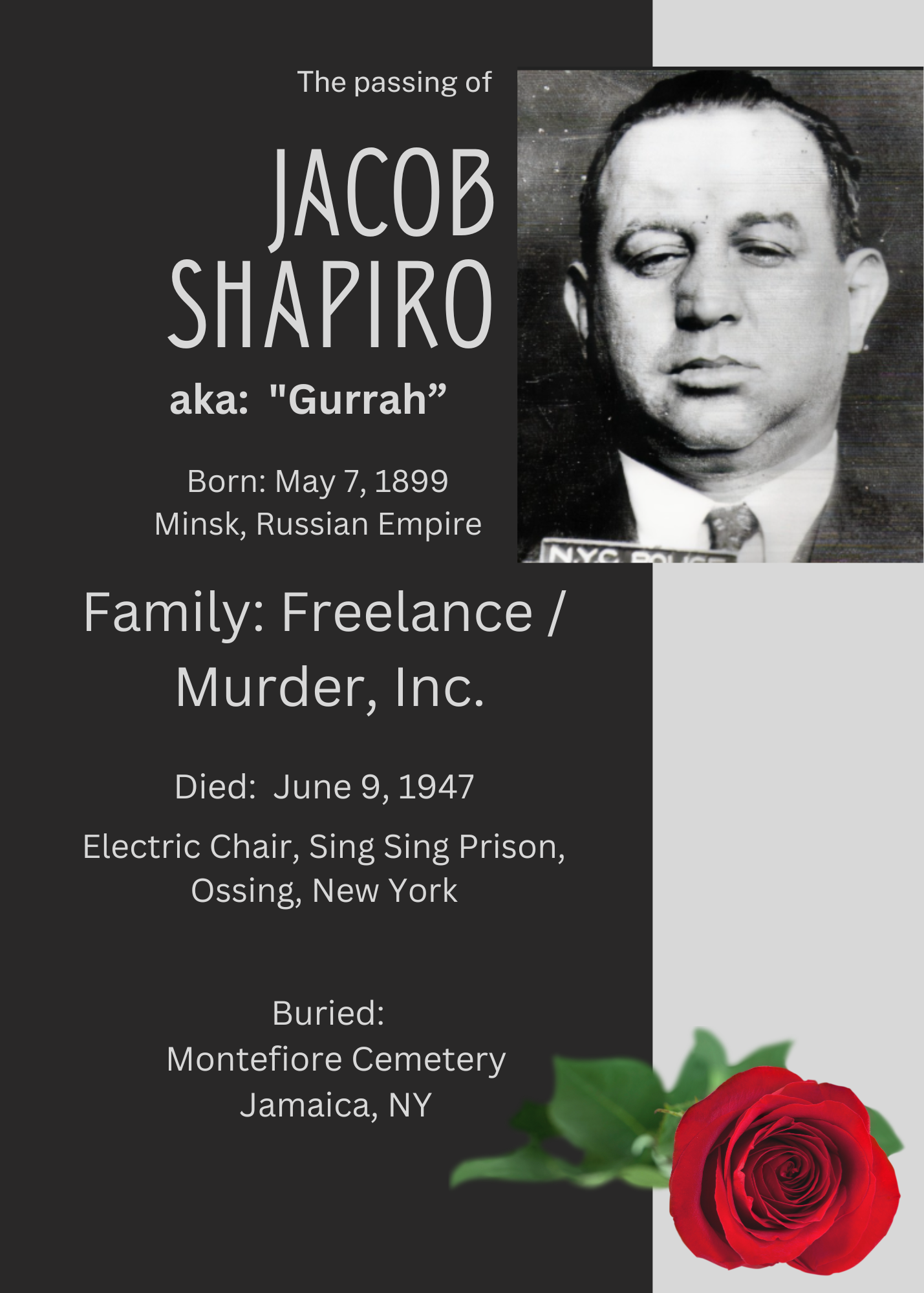
He suffered from serious medical problems and gradually withdrew from the active criminal world. Unlike some of his contemporaries, he did not live to see the full development of Murder, Inc. or the enormous criminal empires that would emerge after Prohibition. Jacob “Gurrah” Shapiro died in 1947 at the age of forty-eight.
The man who had once helped terrorize New York’s garment industry was gone, but the criminal model he helped develop survived.
The Legacy of Jacob “Gurrah” Shapiro
Shapiro is often overshadowed by more famous gangsters, yet his importance in organized crime history is difficult to ignore. He belonged to an earlier generation that helped establish the relationship between criminal organizations and organized labor.
Men such as Shapiro understood something that would become fundamental to American organized crime: controlling an industry could be far more profitable than stealing from it.
That realization transformed the underworld.
The garment district became a laboratory for labor racketeering. Unions became sources of power. Violence became a mechanism for enforcing economic control. And men like Shapiro became the bridge between street gangs and the sophisticated criminal organizations that followed.
His story also provides an important link between the early Jewish-American underworld and the later Mafia syndicates. The criminal world was changing rapidly during Shapiro’s lifetime, but the methods remained remarkably consistent—intimidation, corruption, labor control, and the quiet threat of violence.
The Ghost in the Garment District
In noir terms, Jacob “Gurrah” Shapiro belongs to the generation that learned how to turn the sweatshop into a gold mine. He understood that a needle, a sewing machine, and a union card could generate more money than a stickup if the right man controlled the machinery behind them.
He didn’t need a machine gun on every corner. He needed frightened workers, nervous manufacturers, and officials who understood exactly what might happen if they refused.
The garment district eventually changed. The gangs disappeared, the factories moved, and the old criminal empires faded into history. But the lesson Shapiro helped establish remained embedded in organized crime for generations. The gangster didn’t always have to own the business.
Sometimes, all he had to own was the fear surrounding it.
Buried at: Montefiore Cemetery, Jamaica, NY