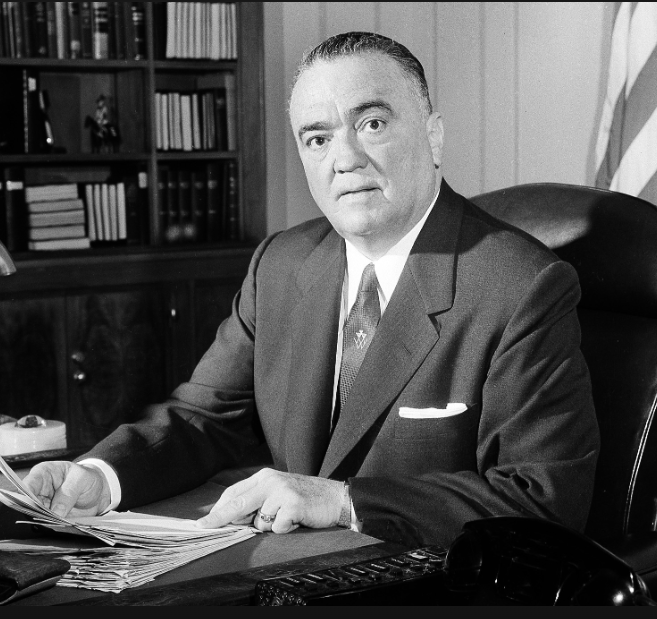
Power, in Washington, has always worn a clean suit and a dirty conscience. And for nearly half a century, no man embodied that contradiction more completely than J. Edgar Hoover—the immovable director of the Federal Bureau of Investigation, a man who built dossiers like weapons and ruled through secrets whispered in the dark.
But beneath the polished image of the incorruptible G-man, another story flickers in the shadows. It’s a story soaked in rumor, fueled by fear, and sharpened by one chilling question:
What if the man who blackmailed America… was himself being blackmailed?
The Man Who Knew Too Much
Hoover’s empire wasn’t built on brute force—it was built on information. He collected secrets the way others collected stamps: meticulously, obsessively, and with quiet purpose. Politicians, celebrities, activists—no one was beyond his reach.
He kept files. Not just criminal files, but personal ones—sexual indiscretions, whispered affairs, private humiliations. The kind of information that could end careers or reshape elections.
And Hoover didn’t just collect it—he used it.
Historians widely acknowledge that Hoover maintained extensive files on the private lives of powerful figures and leveraged that knowledge for influence. His reach was so pervasive that even presidents reportedly feared what he might have on them.
But power like that creates enemies. And enemies, in Hoover’s world, didn’t always fight clean.
The Rumor That Wouldn’t Die
For decades, whispers followed Hoover like a shadow he couldn’t outrun.
He never married. He lived much of his life under the watchful eye of his mother. And for over 40 years, he maintained an intensely close relationship with his deputy, Clyde Tolson—a companionship so constant it blurred the line between professional and personal.
They dined together. Vacationed together. Attended nightclubs together. And when Hoover died, Tolson inherited his estate.
To some, it was devotion. To others, it was something more.
The rumors of Hoover’s sexuality—never proven, endlessly debated—became a kind of political folklore. Some biographers and journalists suggested they were credible; others dismissed them as gossip, innuendo, or character assassination.
But in the world Hoover operated in, perception mattered just as much as truth.
Because perception could be weaponized.
Enter the Underworld
If Hoover dealt in secrets, the Mafia dealt in leverage.
Figures like Meyer Lansky and Frank Costello understood power in its rawest form—not in laws or institutions, but in pressure points. Find a man’s weakness, and you own him.
According to one of the most explosive—and controversial—claims in organized crime lore, the mob believed it had found Hoover’s.
Biographer Anthony Summers alleged that organized crime figures obtained compromising photographs of Hoover engaged in homosexual activity, possibly with Tolson. These images, according to the claim, were used as blackmail to ensure that the FBI would not aggressively pursue the Mafia.
It’s a story that has been repeated for decades.
And never definitively proven.
The Photographs: Fact, Fiction, or Weaponized Myth
The alleged photographs sit at the center of the storm—a ghostly piece of evidence that no one has ever publicly produced, yet everyone seems to know about.
Some accounts trace them back to high-level social circles involving political fixer Roy Cohn and wealthy businessman Lewis Rosenstiel, where parties blurred into something more illicit. Others claim the material passed through the hands of mob-connected figures, eventually landing in the orbit of Lansky himself.
But here’s where the story fractures.
Many historians argue there is no verified proof that such photographs ever existed. The most detailed allegations come from secondary sources, contested testimonies, and sensational biographies—particularly Summers’s Official and Confidential.
Critics point out inconsistencies, unreliable witnesses, and a lack of corroborating documentation. Some dismiss the entire narrative as rumor layered on speculation.
Yet even skeptics admit one thing: the story refuses to die.
And in the underworld, persistence often signals utility.
Why the Mafia Would Want Hoover Neutralized
Whether or not the photographs existed, the logic behind the theory is brutally simple.
For years, Hoover publicly downplayed the existence of a national organized crime syndicate. While local law enforcement battled syndicates in cities like New York and Chicago, the FBI remained strangely disengaged.
It wasn’t until the early 1960s—under pressure from Robert F. Kennedy—that the Bureau began treating the Mafia as a serious national threat.
To critics, that delay looked suspicious.
To conspiracy theorists, it looked like compliance.
If the Mafia had leverage over Hoover, the argument goes, it wouldn’t need to control him completely. It would only need to slow him down—to redirect attention, to prioritize other enemies, to look the other way at critical moments.
And Hoover had plenty of other enemies.
Communists. Civil rights leaders. Political dissidents. Anyone he deemed a threat to the American order—or his version of it.
The Irony of Hoover’s Own Methods
There’s a dark symmetry to the entire story.
Hoover built his career on the premise that secrets equal power. He surveilled, recorded, and cataloged the private lives of others—sometimes crossing ethical lines that still spark controversy today.
He reportedly kept collections of explicit materials and information on public figures, sometimes for potential leverage.
In that sense, the blackmail theory isn’t just plausible—it’s poetic.
The master of secrets undone by a secret of his own.
But irony doesn’t equal evidence.
And history demands more than symmetry.
Historians vs. Mythmakers
Modern historians tend to approach the Hoover blackmail story with caution.
Some acknowledge that Hoover’s behavior—his reluctance to prioritize organized crime, his obsession with secrecy, his sensitivity to rumors about his personal life—creates fertile ground for speculation.
Others argue the opposite: that Hoover’s personality makes the blackmail theory unlikely. He was notoriously cautious, deeply paranoid, and obsessed with control. Engaging in behavior that could expose him to such leverage would have been out of character.
Most importantly, no definitive proof has surfaced.
No authenticated photographs. No verified chain of custody. No smoking gun.
Instead, what exists is a layered narrative—part biography, part rumor, part cultural myth.
A story told and retold because it feels true, even when it can’t be proven.
Power, Perception, and the Fog of History
In the end, the question isn’t just whether the Mafia had compromising photographs of Hoover.
It’s whether they needed them.
Hoover ruled through fear—the fear that he knew everything. But that same fear worked in reverse. The mere possibility that someone knew something about him could have been enough to shape behavior, influence priorities, or plant hesitation where there should have been action.
In that sense, the legend of Hoover’s blackmail may have been as powerful as any photograph.
Because in the world of shadows—where the Mafia thrived and Hoover reigned—truth was often less important than belief.
And belief, once planted, is nearly impossible to kill.
References
- Summers, Anthony. Official and Confidential: The Secret Life of J. Edgar Hoover. Open Road Media, 1993.
- Los Angeles Times. “J. Edgar Hoover Was Homosexual, Blackmailed by Mob, Book Says.” February 6, 1993.
- Fulsom, Don. “J. Edgar Hoover: Blackmailed by the Mafia?” Crime Magazine, 2009.
- Federal Bureau of Investigation historical summaries and biographies.
- Factually. “What proof is there that J. Edgar Hoover was homosexual?” 2025.
- Cox, John Stuart, and Athan G. Theoharis. The Boss: J. Edgar Hoover and the Great American Inquisition. Temple University Press.
- Johnson, David K. The Lavender Scare: The Cold War Persecution of Gays and Lesbians in the Federal Government. University of Chicago Press.