The Mafia’s Favorite President? Richard Nixon and the Politics of Enemies: The ‘Enemies List’ and the IRS
The Underworld & the White House
There are many ways to make an enemy. You can beat him at the polls. You can outspend him. You can bury him in bad publicity. You can wait until the next election and settle the score in the old-fashioned way—with votes.
Richard Nixon had other ideas.
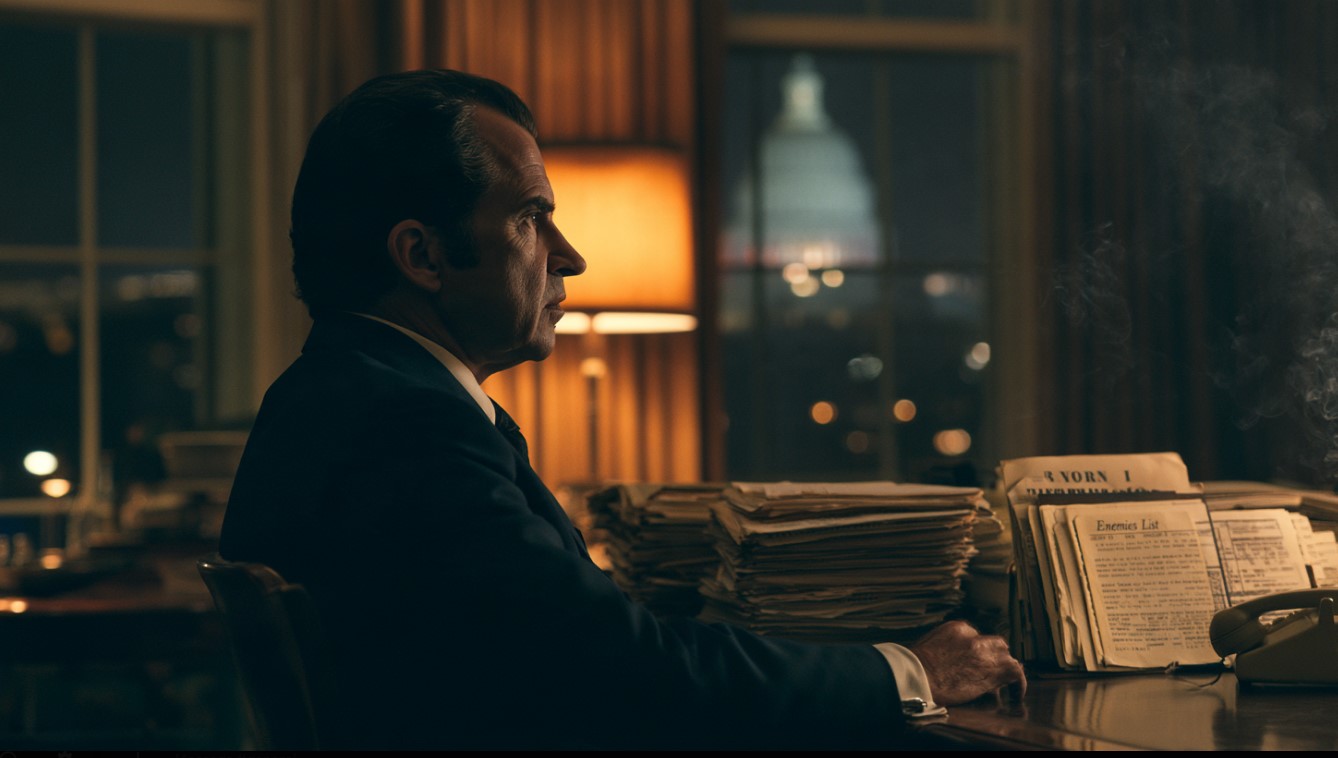
Inside the White House, political opponents were being catalogued, studied and discussed. Names accumulated. Journalists, politicians, activists, businessmen and organizations appeared on lists maintained by presidential aides. Some were famous. Others were obscure. What mattered was that someone in the Nixon White House considered them a problem.
Then there was the Internal Revenue Service.
The IRS possessed something far more useful than a nasty newspaper story or a campaign speech. It had files. It had tax returns. It had the authority to examine financial records and initiate audits. It could make a person’s life very uncomfortable without firing a shot or breaking down a door.
And that was precisely what made the idea so dangerous.
The Nixon administration did not merely discuss political enemies in the abstract. White House officials repeatedly sought information from the IRS and pressed the agency to investigate or audit people considered political opponents. In 1971 and 1972, the White House went so far as to provide lists of political opponents to IRS Commissioner Johnnie M. Walters.
Walters and Treasury Secretary George P. Shultz resisted the effort. The machinery was there. The president wanted it used. But some of the men standing between the White House and the machinery refused to turn the key.
That story begins with a list.
A List of Enemies
The phrase “Enemies List” has become almost shorthand for the Nixon presidency. The list itself, however, was not illegal. Presidents have political opponents. Campaign organizations keep opposition files. Political operatives track journalists, donors, activists and rival politicians. There is nothing inherently unlawful about knowing who is working against you.
What made Nixon’s list different was what some people inside the administration wanted to do with the names.
In 1971, White House counsel John Dean helped compile a list of people regarded as political enemies or potential political problems. A September 1971 list included figures such as journalist Mary McGrory, broadcaster Daniel Schorr, conductor Leonard Bernstein, businessman Thomas J. Watson Jr., and former Defense Secretary Clark Clifford.
The list would eventually grow dramatically. It became a catalog of people the White House considered hostile, troublesome or politically dangerous. And the question inside the administration was not simply, Who are these people?
It was:
What can we do about them?
The answer increasingly involved the federal government.
The Tax Man Enters the Room
The IRS was an especially tempting instrument. Taxes are complicated. Financial records are extensive. Businesses, charitable organizations and wealthy individuals can generate enormous amounts of paperwork. A legitimate tax examination can be routine.
An aggressive or politically motivated examination is something else entirely.
The Senate Finance Committee later documented repeated efforts by the Nixon White House between 1969 and 1973 to pressure the IRS into using its powers against political opponents. The requests included efforts involving prominent Democrats, political organizations and people appearing on White House enemies lists.
The pressure did not begin with the famous 1971 list. In fact, the administration had already been thinking about how to make the IRS more politically responsive.
A November 1971 White House document complained that Republican appointees were not doing enough with the IRS to advance political objectives. Among the complaints was the inability to obtain information concerning political enemies and the failure to stimulate audits of people the White House believed should be audited.
That was a remarkable proposition. The IRS was supposed to enforce the tax laws. The White House wanted it to become more responsive to political needs.
The difference between those two ideas was the difference between government and political machinery.
Nixon’s Own History With the IRS
There was another layer to Nixon’s hostility. Nixon himself had experienced repeated IRS audits during the 1960s. According to records preserved by the National Archives, Nixon was audited every year from 1961 through 1968. The experience contributed to his suspicion that the IRS could be used politically.
That history matters because it provides context for Nixon’s attitude toward the agency. He knew what an IRS examination could feel like. He also believed that previous Democratic administrations had used the agency against political opponents.
In Nixon’s mind, the political playing field was already dirty. His answer was not necessarily to clean it up. It was to make sure his side could play the same game.
The Lawrence O’Brien Affair
One of the clearest examples involved Lawrence F. O’Brien. O’Brien was not an obscure target.
He had been a prominent Democratic political operative, a former postmaster general, and chairman of the Democratic National Committee. He was also a central figure in Democratic presidential politics.
And Nixon wanted the IRS to investigate him. The issue involved money associated with billionaire Howard Hughes. The White House became intensely interested in whether O’Brien had received money from Hughes and whether that money had been properly reported for tax purposes.
On August 9, 1972, Nixon dictated an action memorandum directing John Ehrlichman to make the IRS matter involving O’Brien a “highest priority.” The president wanted the IRS to move quickly.
The language of the request is revealing because Nixon’s objective was not merely to establish whether a tax violation had occurred.
He wanted potentially damaging information. The IRS investigation ultimately produced little useful material for the White House. O’Brien had properly reported the Hughes money that became the focus of the inquiry.
The political weapon had been loaded. But when the trigger was pulled, there was no bullet.
Johnnie Walters Says No
This is where the story becomes particularly interesting. Johnnie M. Walters had become IRS commissioner in 1971. He was not eager to turn the agency into an arm of the Nixon political operation.
When the White House pushed for action against O’Brien, Walters and his staff resisted requests that would have taken the agency beyond its normal role. The resistance continued.
In 1972, White House counsel John Dean presented Walters with a much larger list of people whom the White House wanted investigated or audited.
The list contained hundreds of names. Walters did not simply obey. Instead, he consulted Treasury Secretary George P. Shultz. Shultz’s response was blunt: do nothing.
He told Walters that if Dean objected, Walters could explain that the resistance came from the Treasury secretary himself.
For a White House accustomed to getting its way, this was a serious obstacle. The president could ask. The White House could pressure.
But the IRS still had officials who could say no.
The 500 Names
The story did not end with a short list of sixteen names. By 1972, the White House had developed a much larger list of political opponents. Archival records contain references to an “Enemies List-500” as well as a separate list of 216 opponents.
The names were not all alike. Some were prominent political figures. Others were journalists, activists, organizations and individuals whose political activities had attracted White House attention.
That matters. This wasn’t simply a list of criminals. It was a list of people considered politically inconvenient. And the proposed response was not simply political criticism. The White House was attempting to connect those names with the federal tax-collection machinery.
That is where the story moves from political nastiness into something much more serious.
The Men Who Refused
History often remembers presidents. It sometimes forgets bureaucrats. But in the Nixon-IRS story, the bureaucrats matter. Johnnie Walters did not simply become an obedient instrument of the White House. George Shultz did not tell him to proceed.
They resisted.
The National Archives records specifically note that Walters and Shultz refused to launch the broad political audits because they believed the proposed action represented an improper use of the IRS.
That refusal is one of the most important details in the entire story. The Nixon administration had enormous power. But government power is not one giant switch controlled by the president.
There are people between the Oval Office and the machinery. Sometimes those people matter.
The IRS Was Not Completely Untouched
There is an important qualification. It would be misleading to say that nothing happened because Walters and Shultz resisted the broad enemies-list audit program.
The Senate Finance Committee documented other instances in which the Nixon administration sought IRS action against political opponents and organizations. Certain enforcement actions did occur during the period.
One notable example involved the Center for Corporate Responsibility, a public-interest organization associated with Ralph Nader. The organization was denied tax-exempt status after the administration had shown interest in political and tax-exempt groups it regarded as hostile.
The archival record also contains extensive material concerning investigations involving Lawrence O’Brien and other individuals and organizations. So the accurate picture is more complicated than either extreme.
It was not:
“Nixon ordered the IRS to destroy his enemies and the IRS obeyed.”
Nor was it:
“Nixon merely talked about it and nothing happened.”
The record shows repeated White House pressure, requests for information and audits, resistance by senior Treasury and IRS officials, and instances in which IRS enforcement actions nevertheless became entangled with political interests.
That distinction is crucial.
The House Judiciary Committee Takes Notice
By 1974, Watergate had transformed the IRS controversy from an ugly political story into part of a constitutional crisis. The House Judiciary Committee investigated Nixon’s use of presidential power.
One of the articles of impeachment adopted by the committee, Article II, charged Nixon with abuse of power.
Among the conduct cited was his effort to obtain confidential IRS information concerning political opponents and his attempts to cause tax investigations or audits of individuals because of their political affiliations or activities.
The language was not merely about bad judgment. The committee concluded that Nixon had used the powers of his office in ways that violated constitutional rights. That distinction is important when discussing whether Nixon’s actions were “legal” or “illegal.”
Keeping an enemies list was not illegal. Political opposition research was not illegal. Being angry with journalists was not illegal. But using the machinery of the federal government to punish political opponents raised an entirely different set of constitutional and legal questions.
The House Judiciary Committee regarded Nixon’s conduct as an abuse of presidential power serious enough to support impeachment.
The List Was Only the Beginning
The IRS story makes more sense when viewed against the larger Nixon landscape.
The administration had created the Plumbers to deal with leaks. It pursued Daniel Ellsberg. Operatives broke into the office of Ellsberg’s psychiatrist. The White House became obsessed with intelligence, surveillance and political threats.
Then came Watergate.
The Democratic National Committee was burglarized in June 1972. The investigation eventually exposed connections between the burglars and Nixon’s reelection organization. Nixon’s secret recordings later became crucial evidence concerning the administration’s efforts to conceal its involvement.
The IRS affair was not Watergate. No one should collapse the two into one event. But they belong in the same historical landscape. Both reveal a White House increasingly willing to view political opposition as something to be neutralized rather than merely defeated.
One involved tax records. Another involved burglary. Another involved secret intelligence operations. The machinery changed. The obsession remained.
| How ’bout a Perdon, Mr. President? |
The Dark Lesson of the IRS
There is something especially sinister about using taxes as a political weapon. A political campaign can be answered. A newspaper editorial can be ignored. A protest can be endured.
But an IRS audit arrives with the authority of the government behind it.
There is no Tommy gun on the desk. No trench-coated gangster waiting outside. Just a letter. A request for records. A demand for documentation. A government envelope sitting on the kitchen table. That can be enough.
It is perhaps the most noir element of the entire story: the weapon doesn’t have to look like a weapon.
The Nixon administration understood the power hidden inside government institutions. The question was whether those institutions would become political weapons. Some officials refused. Others did not always refuse.
And the resulting scandal helped produce reforms intended to protect taxpayers from precisely this kind of political misuse.
| Sanctified by Proximity: Billy Graham, Richard Nixon, and the Dangerous Seduction of the Oval Office |
After Nixon
The Watergate era produced a series of reforms designed to make it harder for presidents and political officials to obtain and misuse confidential taxpayer information.
Congress strengthened taxpayer privacy protections in the years following Nixon’s resignation. Section 6103 of the Internal Revenue Code established strict rules governing the disclosure of tax-return information.
The reason was straightforward. Tax records contain intensely private information. They should be used to administer the tax laws—not to settle political scores. The reforms were a direct product of a lesson Washington had learned the hard way.
The tax collector cannot become the president’s enforcer.
The Question Behind the List
Richard Nixon’s enemies list has survived as one of the most memorable artifacts of twentieth-century American political history. But the list itself wasn’t the crime.
The danger was what people in power wanted to do with it. Names became targets. Targets became files. Files became requests. Requests moved through government agencies. And suddenly a political grudge could acquire the weight of federal authority.
The broad IRS audit campaign sought by the Nixon White House was resisted by Commissioner Johnnie Walters and Treasury Secretary George Shultz. That resistance prevented the administration from carrying out the sweeping program it wanted.
But the fact that the effort was made—and that other politically connected IRS actions occurred—is what makes the episode important.
It was a warning about power. And about the people who stand between power and its misuse. The Mafia didn’t need to break a door down when a government agency could send a letter.
That was the darker lesson. In the Nixon White House, the enemy list had names. The IRS had files.
And for a time, the distance between the two became dangerously small.
References:
- National Archives and Records Administration. “Misuse of IRS.” Watergate Special Prosecution Force Records, National Archives. Records concerning the Enemies List, IRS investigations, Lawrence O’Brien, White House requests, and related investigations.
- National Archives and Records Administration. “Nixon Enemies List.” Watergate Materials, National Archives. Records concerning John Dean’s September 1971 list, Nixon’s assent to its use with the IRS, and the subsequent list provided to IRS Commissioner Johnnie M. Walters.
- U.S. Senate Committee on Finance. Investigation of the Internal Revenue Service, Volume 1. 94th Cong., 1st sess., 1975. Congressional hearing and investigative record concerning the political use of the IRS during the Nixon administration.
- U.S. House of Representatives, Committee on the Judiciary. Articles of Impeachment Adopted by the Committee on the Judiciary. 93rd Cong., 2nd sess., 1974. Article II, concerning abuse of presidential power and the use of federal agencies against political opponents.
- U.S. House of Representatives, Committee on the Judiciary. Comparison of White House and Judiciary Committee Transcripts of Eight Recorded Presidential Conversations. 93rd Cong., 2nd sess., 1974. Congressional hearings concerning presidential conversations and the evidence considered during the impeachment investigation.
- U.S. Senate, Select Committee on Presidential Campaign Activities. Final Report of the Select Committee on Presidential Campaign Activities. 93rd Cong., 2nd sess., 1974. Investigation of the Watergate affair and related abuses of presidential and campaign power.
- Naftali, Timothy. Testimony before the U.S. Senate Committee on the Judiciary, September 24, 2024. Discussion of the Nixon administration’s use and attempted use of the IRS against political opponents, including Lawrence O’Brien and the larger opponents list.
- Internal Revenue Code, 26 U.S.C. § 6103. Provisions governing the confidentiality and disclosure of federal tax-return information.