Frank “The Dasher” Abbandando: Murder, Speed, and the Machinery of Murder, Inc.
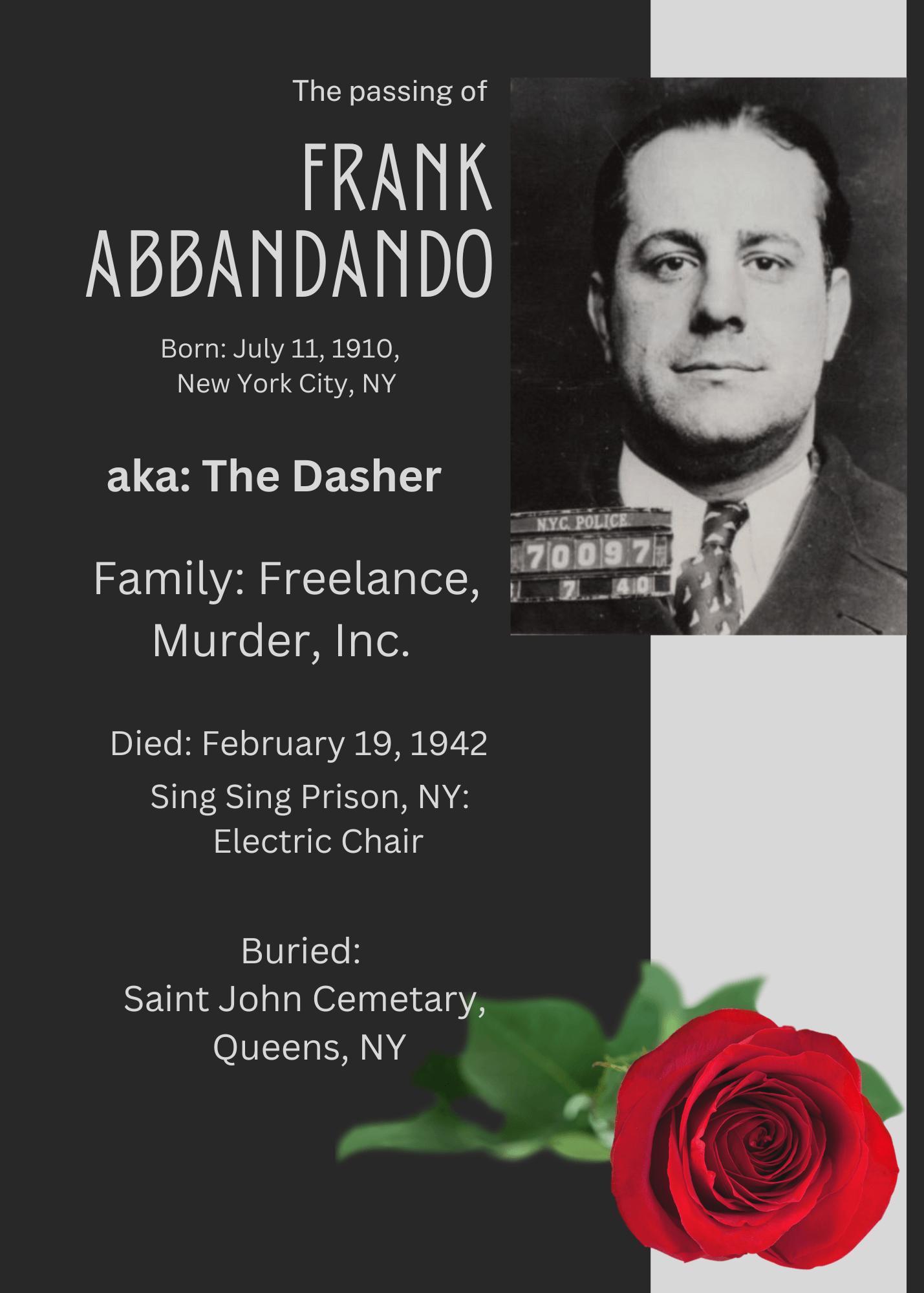
Frank “The Dasher” Abbandando looked like the kind of man who enjoyed violence.
That terrified people.
He was handsome in a cold, dangerous way—sharp features, slicked hair, expensive suits, and the restless energy of someone perpetually moving toward trouble. Unlike old-world Mafia bosses who wrapped brutality beneath ritual and business etiquette, Abbandando belonged to a younger generation of gangsters shaped by street gangs, fast money, and casual murder.
He killed quickly. Hence the nickname.
“The Dasher” reportedly came from his speed—both physically and in the way he carried out violence. In Brooklyn’s underworld during the 1930s and 1940s, speed mattered. Hesitation got people arrested or buried. Abbandando developed a reputation as a man who could walk into a room smiling and leave behind a corpse before witnesses fully understood what had happened.
For a time, that reputation made him valuable. Then it made him dangerous even to his own allies.
Brooklyn Streets and the Rise of a Killer
Frank Abbandando was born in Brooklyn in 1910 and grew up in one of New York’s hardest criminal environments during the early twentieth century.
Brooklyn’s waterfront neighborhoods bred gangsters the way factories produced steel.
Street gangs battled constantly over territory tied to gambling, labor rackets, extortion, trucking routes, and political influence. Young men growing up there learned quickly that violence created opportunity. Organized crime offered money, status, and survival in neighborhoods where legitimate advancement often felt painfully distant.
Abbandando entered gang life early.
By his teens and early twenties, he had become associated with criminal crews involved in robbery, extortion, loansharking, and enforcement work. But unlike smoother operators who specialized in negotiation or political influence, Abbandando excelled at intimidation and direct violence.
People feared his temper. They feared his unpredictability more.
Murder, Inc.
Abbandando’s name became permanently tied to one of the most infamous criminal organizations in American history: Murder, Inc.
The group operated during the 1930s and early 1940s as a loosely organized enforcement arm connected to national organized crime networks. Based largely in Brooklyn neighborhoods like Brownsville and East New York, Murder, Inc. supplied contract killings for Mafia bosses and syndicate leaders seeking deniable violence.
If someone needed to disappear quietly, men like Abbandando often handled it. The organization allegedly operated under figures including Louis Buchalter and Albert Anastasia. The arrangement changed organized crime itself.
Instead of local bosses personally organizing every assassination, violence became systematized and outsourced. Professional killers traveled between cities carrying out executions for criminal syndicates nationwide.
Abbandando became one of the organization’s most feared shooters.
A Killer’s Reputation
Stories surrounding Abbandando spread constantly through the underworld. Some were exaggerated. Many probably were not.
Associates described him as impulsive, sadistic, and disturbingly comfortable with murder. Witness testimony and later investigations linked him to numerous killings connected to organized crime enforcement operations. Prosecutors and journalists later portrayed him as one of Murder, Inc.’s most violent participants.
Violence became performance for him.
That distinguished Abbandando from colder Mafia strategists who treated murder strictly as business necessity. He reportedly enjoyed the fear his reputation generated. Intimidation itself became a form of power.
But uncontrolled violence creates instability. And organized crime ultimately values stability above almost everything else.
Dutch Schultz and Underworld Politics
Abbandando operated within a turbulent criminal landscape shaped by powerful figures like Dutch Schultz, Luciano, Anastasia, and Lepke Buchalter.
The underworld during the 1930s increasingly evolved into a national syndicate emphasizing coordination and profit management. Yet violence remained central beneath the surface. Enforcement crews like Murder, Inc. existed precisely because criminal organizations still required intimidation and assassination to maintain order.
Abbandando thrived inside that machinery.
He reportedly participated in hits tied to labor racketeering disputes, internal betrayals, gambling conflicts, and organized crime discipline. Witnesses later described murders carried out with chilling efficiency.
The killings blurred together over time. One body after another. Brooklyn alleys. Apartment hallways. Darkened cars. Restaurant back rooms. The city itself seemed built partly atop gunfire.
The Problem with Psychopaths
Eventually, even organized crime leaders began viewing Abbandando as unstable.
That happens often with violent enforcers.
At first, brutality appears useful. But men who enjoy violence too openly become liabilities because they attract attention, create enemies, and behave unpredictably under pressure.
Abbandando reportedly developed growing tensions with other gangsters connected to Murder, Inc. Some accounts suggested he became arrogant and difficult to control. Others indicated he feared being eliminated himself as law enforcement investigations intensified around organized crime murders nationwide.
The pressure worsened after authorities began dismantling Murder, Inc. through informants and prosecutions during the early 1940s. One witness changed everything.
Abe Reles Talks
Abe Reles became the government’s most devastating witness against Murder, Inc.
Reles had participated directly in organized crime violence before turning informant under enormous legal pressure. His testimony exposed extensive details about contract killings, criminal structures, and individual gangsters connected to the organization.
Suddenly, men like Abbandando faced catastrophe. The silence protecting Murder, Inc. began collapsing.
Prosecutors now possessed insider testimony linking gangsters to murders previously hidden behind fear and secrecy. Organized crime’s invisible enforcement arm became front-page national news.
And Abbandando’s name appeared repeatedly.
Conviction and Death
Abbandando was eventually arrested, prosecuted, and convicted for murder based largely on testimony connected to the Murder, Inc. investigations.
The myth of invincibility disappeared quickly once the courts secured cooperative witnesses.
In 1942, Frank Abbandando was executed in the electric chair at Sing Sing Correctional Facility.
He was thirty-one years old. Thirty-one.
For all the fear he generated, all the killings attached to his name, and all the mythology surrounding Murder, Inc., his life ended with shocking speed.
That irony fits organized crime history almost perfectly. The fast killers often die fastest.
Murder, Inc. and the American Nightmare
Abbandando’s life revealed something darker about organized crime during the mid-twentieth century:
Murder had become industrialized.
Violence no longer existed merely as neighborhood revenge or personal vendetta. Syndicates increasingly treated killing as operational necessity carried out by specialized crews capable of traveling city to city on assignment.
Men like Abbandando became weapons inside larger criminal systems. Disposable weapons.
Once law enforcement pressure intensified and informants began cooperating, the organization sacrificed violent enforcers quickly to protect higher leadership structures.
The killers rarely retire peacefully.
The Legacy of Frank “The Dasher” Abbandando
Frank Abbandando remains one of the most frightening figures connected to Murder, Inc. because he represented organized crime stripped of glamour.
No political sophistication. No celebrity mystique. No careful public image. Just violence.
Fast, efficient, and terrifyingly casual violence.
Unlike bosses such as Frank Costello or strategic empire-builders like Carlo Gambino, Abbandando operated at the lowest and bloodiest level of organized crime’s machinery.
He was what happened after the orders traveled downward. The trigger-puller. The enforcer.
The smiling young gangster walking quickly toward someone else’s death through rain-soaked Brooklyn streets beneath dim city lights.
And eventually, the machinery consumed him too.
Buried at:
| St. Johns Cemetery (Queens, NY) |