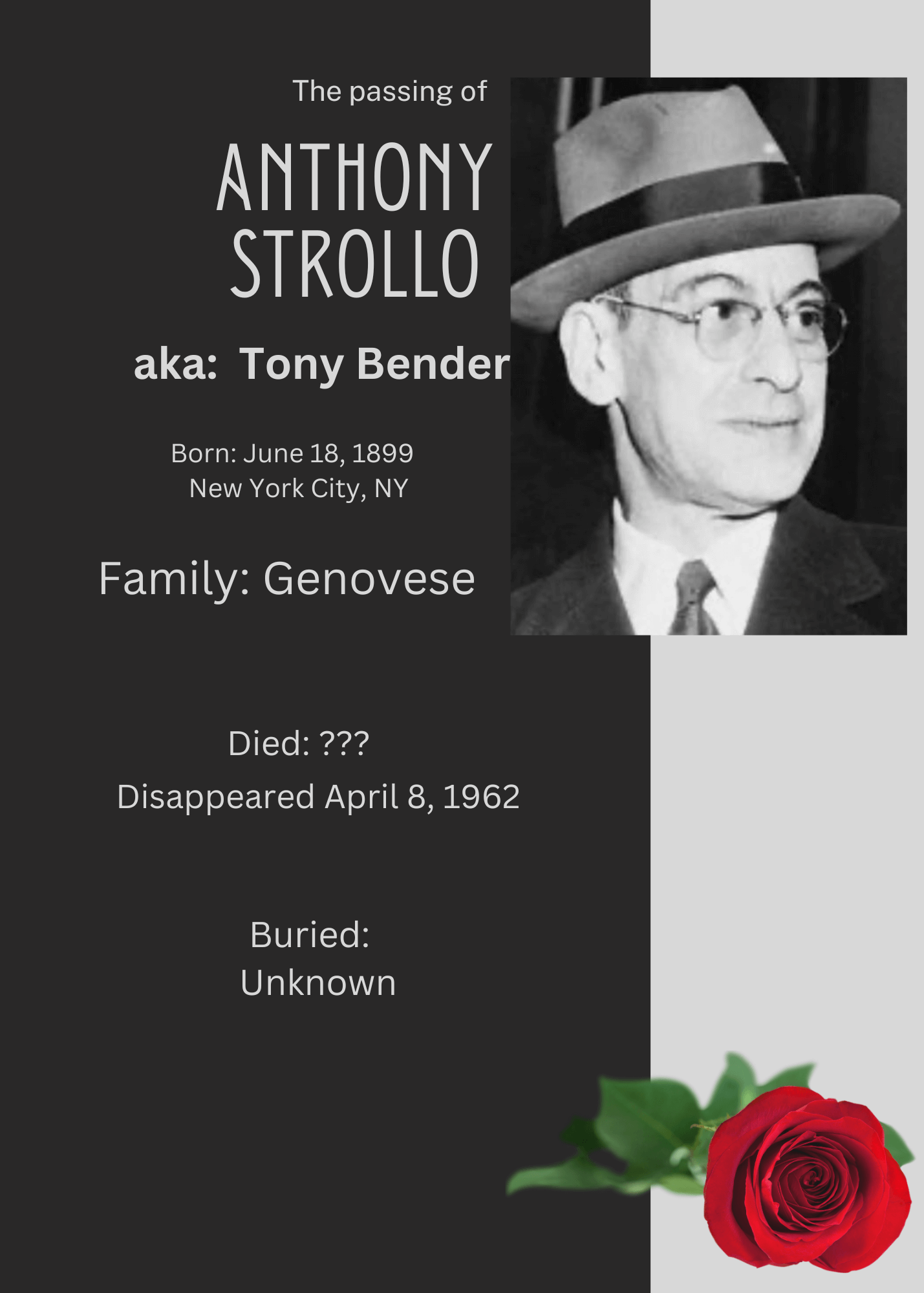
Anthony Strollo: The Smiling Traitor Who Vanished Into the Night
Anthony “Tony Bender” Strollo smiled like a man who knew secrets.
And he knew plenty.
In the smoky back rooms of New York’s underworld, Strollo built a reputation as a charming, intelligent, sharply dressed gangster who preferred manipulation over brute force. Unlike the unpredictable killers of Murder, Inc. or the theatrical celebrity bosses who later dominated headlines, Tony Bender operated quietly through relationships, strategy, and betrayal.
Especially betrayal. That became the defining theme of his life.
For decades, Strollo moved through the upper levels of organized crime alongside some of the most dangerous men in America, including Vito Genovese, Frank Costello, and Vincent Gigante.
He survived gang wars, political upheaval, federal investigations, and Mafia power struggles.
Then one day he disappeared completely. No body. No funeral. No confirmed grave. Just whispers.
In organized crime, that usually means only one thing.
The Streets That Built Him
Anthony Strollo was born in New York City in 1899 to Italian immigrant parents during the period when organized crime was evolving from neighborhood gangs into structured criminal enterprises.
The city shaped men quickly in those years.
Immigrant neighborhoods overflowed with political corruption, labor exploitation, gambling operations, bootlegging networks, and ethnic gang rivalries. Criminal organizations often functioned as parallel governments offering protection, employment, and power outside legitimate institutions.
Strollo adapted naturally.
Unlike heavily publicized gangsters who relied on intimidation theatrics, Strollo cultivated something subtler:
Trust. People liked him. That made him dangerous.
Why “Tony Bender”?
The nickname “Tony Bender” reportedly came from his habit of moving between different criminal factions and relationships fluidly, “bending” situations to his advantage through negotiation and manipulation.
He was not a headline gunman. He was a connector.
Men like Strollo often become far more influential than street-level killers because they manage information, alliances, and access. Organized crime depends heavily on relationships—who speaks to whom, who trusts whom, who owes favors, who can broker peace before violence becomes expensive. Strollo excelled at that invisible work.
He became deeply connected to the Luciano-Genovese organization during the rise of the modern American Mafia.
Luciano’s Underworld
The reorganization of organized crime under Charles “Lucky” Luciano during the 1930s created opportunities for intelligent operators like Strollo.
The old Mafia structure based purely on territorial dictatorship and Sicilian factionalism gradually evolved into a national syndicate emphasizing cooperation, profit management, and strategic alliances. The new underworld needed administrators, diplomats, labor racketeers, and financial managers alongside killers.
Strollo fit perfectly.
He reportedly became a trusted figure within the organization that later evolved into the Genovese crime family. Over time, he gained influence through gambling operations, labor racketeering, loansharking, and underworld political relationships.
He was respected. But organized crime respect is always conditional.
Vito Genovese and Dangerous Loyalty
One of the most important relationships in Strollo’s life involved Vito Genovese.
Genovese was brilliant, paranoid, ambitious, and extraordinarily dangerous. Men close to him often rose quickly. They also risked sudden destruction if loyalty ever came into question.
Strollo operated within Genovese’s orbit during some of the Mafia’s most unstable years. Power struggles between Frank Costello and Genovese fractured the Luciano family internally during the 1950s as competing factions maneuvered for control.
The conflict eventually exploded publicly. And Strollo allegedly played a role in one of the most famous Mafia assassination attempts ever.
The Costello Shooting
In 1957, gunman Vincent Gigante attempted to assassinate Frank Costello outside Costello’s Manhattan apartment building. Costello survived miraculously.
The failed hit became legendary within organized crime history because it signaled Genovese’s aggressive move toward power.
Authorities and organized crime sources later linked Strollo to the conspiracy surrounding the assassination attempt. Though details remain debated, many believed Strollo helped arrange or facilitate aspects of the operation on Genovese’s behalf.
If true, the move revealed his willingness to shift loyalties strategically when power changed direction.
That skill can elevate a gangster. It can also destroy him eventually.
Underboss of the Genovese Family
After Genovese consolidated control, Strollo reportedly rose to underboss within the organization.
That position carried enormous influence.
The underboss manages operational control beneath the boss himself—settling disputes, overseeing rackets, managing captains, and maintaining organizational discipline. It requires intelligence, diplomacy, and political instinct.
Strollo possessed all three.
Yet the Mafia rewards strength while simultaneously punishing anyone perceived as too ambitious or unreliable. The closer a man stands to power, the more dangerous every conversation becomes.
Especially around paranoid bosses.
The Apalachin Disaster
In 1957, the infamous Apalachin Meeting changed organized crime history permanently.
High-ranking Mafia figures gathered in rural New York for a major national meeting intended to discuss criminal business and organizational issues. Law enforcement unexpectedly raided the summit, exposing the existence of a coordinated national Mafia structure publicly for the first time. The disaster enraged Mafia leadership nationwide.
Genovese reportedly blamed multiple people internally for security failures and growing law enforcement attention. One of those people may have been Tony Bender.
The Disappearance
In 1962, Anthony Strollo vanished. Completely. No verified sightings followed. No confirmed remains were ever found. No public explanation emerged.
Inside organized crime culture, disappearance often functions as its own message. Bodies can create investigations. Missing men create fear.
Most historians and law enforcement officials believe Strollo was murdered on Genovese’s orders after suspicions emerged that he was cooperating with authorities or becoming politically unreliable.
Whether those suspicions were true may no longer matter. In the Mafia, suspicion alone can become a death sentence.
Especially when powerful paranoid men start calculating risks.
The Ghost Without a Grave
Strollo’s disappearance became part of Mafia folklore precisely because it lacked closure.
No gunfire headline. No public execution. No dramatic police photographs. Just absence.
That absence fits his personality strangely well.
Tony Bender spent his life operating between conversations, loyalties, and invisible arrangements behind organized crime’s public mythology. In the end, he disappeared the same way he lived:
Quietly.
The Legacy of Tony Bender
Anthony Strollo represents one of the most important types of organized crime figures often overlooked by popular history.
He was not primarily a killer. Not a celebrity. Not a screaming street boss. He was a political gangster. A negotiator. A manipulator of relationships.
Men like Strollo helped organized crime function internally by managing the fragile human systems beneath the violence. They brokered alliances, facilitated transitions, and navigated dangerous personalities while staying largely outside public attention.
Until the system decided they themselves had become dangerous.
Unlike flamboyant figures such as John Gotti or openly terrifying enforcers like Harry Strauss, Strollo operated in the quieter shadows where trust and betrayal become almost indistinguishable.
In noir terms, Tony Bender was the smiling man in the expensive suit leaning across the restaurant table promising loyalty while already calculating who would disappear next.
Eventually, the calculation reached him too.
Buried at: UNKNOWN