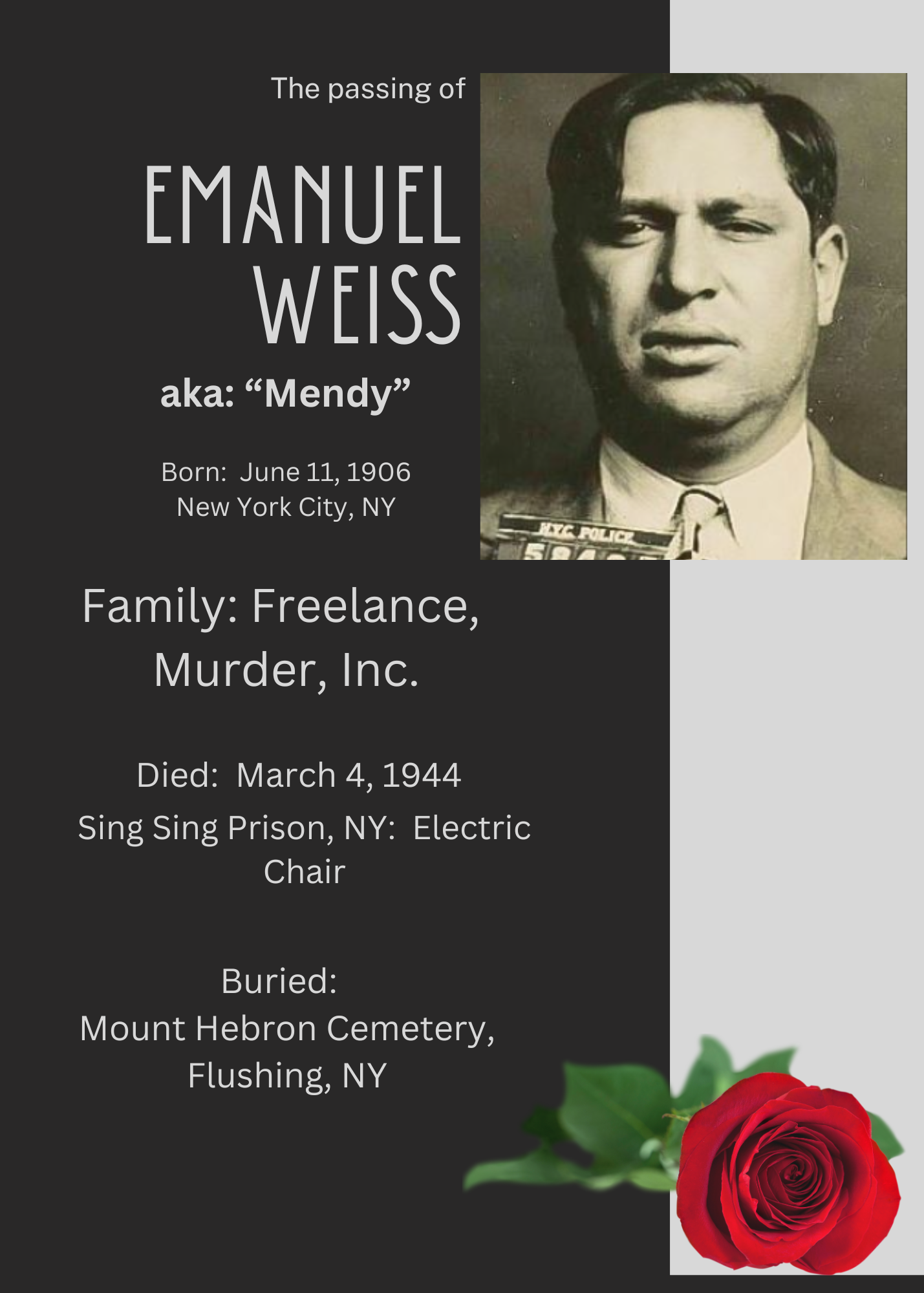
Emanuel “Mendy” Weiss: The Quiet Butcher of Murder, Inc.
Emanuel “Mendy” Weiss did not look frightening.
That made him frightening.
He appeared soft-spoken, almost forgettable at times—a stocky man with heavy features and the demeanor of someone who could disappear easily into a crowded Brooklyn street. Unlike louder gangsters who cultivated reputations through swagger and spectacle, Weiss preferred silence. He avoided unnecessary attention and rarely sought publicity.
But inside Murder, Inc., silence often meant something dangerous.
The men who talked the least were frequently the ones capable of the worst things.
Weiss became one of the most important figures tied to organized crime’s national killing apparatus during the 1930s and early 1940s, operating alongside killers, labor racketeers, and syndicate bosses who transformed murder into coordinated business infrastructure.
He was not merely a gangster. He was part of the machinery. And eventually, the machinery consumed him too.
Brooklyn’s Violent Underworld
Emanuel Weiss was born in Brooklyn in 1906 into the same brutal environment that produced many future Murder, Inc. figures.
Brooklyn’s working-class immigrant neighborhoods during the early twentieth century overflowed with gangs, labor disputes, extortion operations, political corruption, and organized criminal networks competing for territory and influence. Poverty sharpened violence. Street gangs evolved gradually into more sophisticated racketeering systems connected to gambling, unions, loansharking, and bootlegging.
Weiss adapted naturally.
He became associated with criminal crews tied to the broader organized crime networks emerging throughout New York. Eventually, he entered the orbit of powerful underworld figures connected to labor racketeering and enforcement operations. That path led directly toward Murder, Inc.
The Murder Machine
Murder, Inc. functioned as organized crime’s enforcement arm during the syndicate era.
Though never an official corporation, the organization operated as a loosely coordinated network of killers and facilitators connected to national Mafia leadership. Underworld figures such as Louis Buchalter and Albert Anastasia allegedly used Murder, Inc. crews to carry out executions involving informants, disloyal associates, labor enemies, debt disputes, and criminal discipline.
The arrangement professionalized violence. Killers traveled city to city. Orders flowed downward quietly. Bodies disappeared efficiently. Weiss became one of the organization’s trusted operators.
Not because he craved attention. Because he followed instructions.
Loyalty to Lepke Buchalter
One of Weiss’s most important relationships involved Louis “Lepke” Buchalter, the powerful labor racketeer and organized crime leader widely considered a central architect of Murder, Inc.
Weiss reportedly served as one of Lepke’s loyal associates and enforcers. That loyalty mattered enormously.
The syndicate depended on reliable men capable of carrying out dangerous assignments without hesitation or public recklessness. Weiss developed a reputation for discipline and obedience inside criminal circles. Unlike unstable killers such as Harry Strauss, Weiss appeared controlled.
Cold rather than chaotic.
That distinction allowed him to operate deeper inside organized crime’s structure.
Labor Racketeering and Enforcement
Like many Murder, Inc. figures, Weiss existed at the intersection of labor corruption and organized violence.
During the 1930s, unions became major targets for organized crime infiltration because control over labor created enormous leverage across transportation, manufacturing, construction, and commercial industries. Strikes could be manipulated. Contracts could be controlled. Businesses could be extorted.
Violence enforced compliance.
Murder, Inc. often handled the enforcement side of those operations, eliminating troublesome individuals or intimidating opponents tied to labor disputes and racketeering schemes.
Weiss reportedly participated in several such operations while remaining closely aligned with Buchalter’s criminal organization.
The underworld increasingly resembled a hidden corporate structure.
And Weiss was one of its employees.
The Murder of Joseph Rosen
The crime most associated with Weiss involved the murder of Joseph Rosen in 1936.
Rosen allegedly possessed information dangerous to organized crime interests connected to labor racketeering and trucking operations. Syndicate leaders feared he might cooperate with authorities.
That fear sealed his fate.
Prosecutors later argued that Weiss participated in the conspiracy surrounding Rosen’s assassination alongside Buchalter and other Murder, Inc. figures.
For years, organized crime murders remained difficult to prosecute because witnesses feared retaliation and juries often remained intimidated. Murder, Inc. thrived inside that silence.
Then came Abe Reles.
Abe Reles Sings
Abe Reles shattered organized crime’s secrecy by becoming a government witness.
Reles possessed intimate knowledge of Murder, Inc.’s operations, murders, and personnel. Once he began cooperating, prosecutors suddenly gained direct insider testimony describing how the organization functioned.
Weiss became one of the major targets.
Reles connected him and others to murder conspiracies previously hidden behind layers of fear and silence. Newspapers exploded with stories detailing contract killings, organized executions, and syndicate enforcement operations stretching across the country.
America discovered Murder, Inc. existed. And men like Weiss suddenly faced something they rarely encountered: Public exposure.
Trial and Conviction
Weiss stood trial alongside Buchalter and other organized crime figures connected to the Rosen murder conspiracy.
The proceedings exposed horrifying details about organized criminal violence during the syndicate era. Prosecutors described murders carried out with calculated efficiency while informants outlined the hidden structure supporting organized executions nationwide.
Weiss reportedly remained composed throughout much of the trial.
But the evidence proved devastating. Especially combined with insider testimony.
The state intended not merely to convict individual gangsters but to demonstrate that organized crime itself could be penetrated and dismantled. For Murder, Inc., the trials represented catastrophic collapse.
The Electric Chair
In 1944, Emanuel Weiss was executed at Sing Sing Correctional Facility alongside Louis Buchalter and Louis Capone.
The executions carried enormous symbolic importance.
For years, organized crime leadership believed layers of secrecy and delegated violence insulated them from accountability. Murder, Inc. existed partly to shield higher-ranking bosses from direct prosecution.
But now the state had reached into the machinery itself. The electric chair became the final answer to the syndicate’s industrialized violence.
The Invisible Men of Organized Crime
Weiss represents a type of gangster often overshadowed by more flamboyant criminal personalities.
He was not a celebrity. Not a screaming street boss. Not a media figure.
He belonged to the quieter class of organized crime operators who kept the system functioning through obedience, enforcement, and disciplined silence. Men like Weiss made organized crime sustainable.
That may be more disturbing than the mythology surrounding famous gangsters.
Because systems survive not through charismatic leaders alone, but through reliable participants willing to carry out ugly work without asking questions.
The Legacy of Emanuel “Mendy” Weiss
Emanuel Weiss remains historically important because he embodied Murder, Inc.’s transformation of violence into organized procedure. He was not chaotic like Harry Strauss. Not glamorous like Bugsy Siegel.
Not politically sophisticated like Frank Costello. He was something colder: Dependable.
A dependable killer inside a dependable system of organized criminal violence.
In noir terms, Emanuel “Mendy” Weiss was the quiet man sitting motionless in the back booth while everyone else laughed too loudly—waiting for instructions that usually ended with somebody never coming home again.
Buried at:
| Mount Hebron Cemetery (Flushing, NY) |