Where the Dream Died, the Money Finally Started Flowing
The desert remembers everything. It remembers the men who arrived with suitcases full of cash and left with ledgers full of lies. It remembers ambition dressed up as vision, and violence disguised as business decisions. Most of all, it remembers the night the dreamer died.
Because Las Vegas wasn’t built by dreamers. It was built by survivors. And Bugsy Siegel was neither.
A Vision Too Expensive to Fail
When Siegel pushed into Las Vegas in the mid-1940s, the city was still a half-formed promise—legal gambling, cheap land, and just enough distance from scrutiny to make things interesting. Most mob figures saw it as a side operation, a place to park money and extract steady returns.
Siegel saw something else.
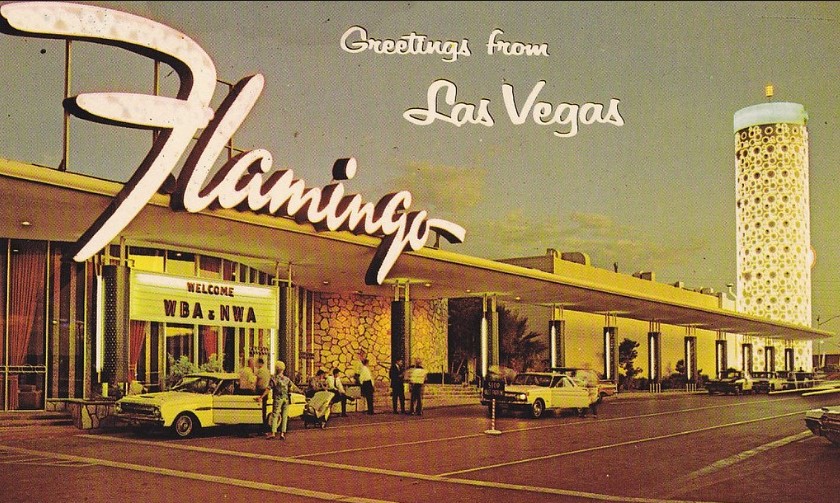
He envisioned glamour. Imported sophistication. A desert resort that could rival Hollywood, not just serve gamblers passing through. The Flamingo Hotel would be his monument—a place where money didn’t just circulate, it performed.
It would also become his liability.
Construction spiraled out of control almost immediately. Costs doubled, then tripled. Materials vanished. Contractors inflated invoices. Cash moved through too many hands, and not all of them were honest. Behind the scenes, syndicate investors—men accustomed to predictable returns—began to notice.
They didn’t mind spending money. They minded losing control of it.
The Syndicate Watches
The Flamingo wasn’t just Siegel’s project. It was financed by a network of organized crime figures who expected discipline, not extravagance. Among them was Meyer Lansky, the quiet strategist who understood both the potential and the risk.
Lansky believed in Las Vegas. He did not necessarily believe in Siegel. There’s a difference.
While Siegel entertained movie stars and chased perfection, Lansky tracked numbers. He saw delays, cost overruns, and a pattern that looked dangerously like mismanagement—or worse, skimming from the skim. Whether Siegel was stealing or simply losing control remains debated, but in the mob world, perception often matters more than truth.
And the perception was turning.
Far away, in exile but still influential, Lucky Luciano had a stake in the broader vision. Luciano understood that Las Vegas could become a central hub for organized crime finances, a place where illicit cash could be legitimized through casinos.
But that only worked if the operation was stable. Siegel’s Flamingo didn’t look stable.
| Operation Strawman. The Mob’s Paper Empire crumbles in Las Vegas |
Opening Night, Closing Patience
The Flamingo opened in December 1946, and the timing couldn’t have been worse. Weather disrupted travel. The hotel wasn’t fully finished. Supplies ran short. High-end gamblers—the kind Siegel needed—stayed away. The opening hemorrhaged money.
Within weeks, the Flamingo shut down temporarily to regroup. It would reopen stronger, more complete, and ultimately more successful. But the damage had already been done. Investors had lost confidence. Rumors spread. Numbers didn’t add up.
In legitimate business, failure invites restructuring. In organized crime, it invites something else.
The Night the Vision Ended
On June 20, 1947, Bugsy Siegel sat in a Beverly Hills living room, flipping through a newspaper. Outside, the night was quiet. Inside, the future was already closing in. The gunfire came through the window. Fast. Precise. Final.
Siegel died instantly, a man who had imagined a city larger than the one he inherited, cut down before he could see it realized. Officially, the case was never solved. Unofficially, few doubted the source. The decision had been made somewhere between disappointment and necessity.
The Flamingo would continue. Siegel would not.
| Sin City’s Hidden Hand: How the Mob Secretely Ran Las Vegas in the 1950s and 60s |
The Immediate Transfer of Power
If Siegel’s death was chaotic, what followed was anything but.
Within hours—hours—the Flamingo was under new management. Control shifted seamlessly, as if contingency plans had been waiting for the right moment. The casino floor didn’t close. The money didn’t stop moving. The system absorbed the shock and continued operating.
That kind of transition doesn’t happen by accident. It happens when the outcome is anticipated.
Lansky’s role in the aftermath remains one of the great quiet stories of Las Vegas history. He didn’t celebrate Siegel’s death. By most accounts, the two were close. But Lansky was a pragmatist. Once Siegel was gone, the priority wasn’t grief. It was stabilization.
The Ghost Ledger
The Flamingo’s books told one story. The real story lived elsewhere.
After Siegel’s death, the casino became what it was always meant to be: a disciplined financial instrument. Costs were controlled. Operations tightened. The glamour remained, but it was now backed by something colder—efficiency.
And beneath it all, the skim.
Money flowed through the casino in torrents—chips exchanged, bets placed, winnings paid out. Before it reached official accounting, a portion disappeared into the shadows. Counting rooms processed cash with clinical precision, separating what would be reported from what would not.
The ghost ledger recorded everything that mattered. It didn’t exist on paper. But it balanced perfectly.
Who Really Benefited
Siegel built the Flamingo, but he never saw its true profitability. That distinction belongs to the men who followed him—the ones who inherited a functioning system without bearing the cost of its creation.
Lansky emerged as a central figure, not as a public owner, but as a financial architect. He ensured that the casino operated within the parameters necessary to maximize both legitimate and hidden profits. His genius wasn’t in building the dream.
It was in monetizing it.
Luciano, though physically distant, remained tied to the broader network. The success of Las Vegas casinos reinforced the syndicate’s financial model, providing a reliable mechanism for laundering money and generating income. The Flamingo became proof of concept.
Other power brokers—less famous, more cautious—also stepped in. Front men, silent partners, and corporate shells took ownership positions that masked the true distribution of control. The casino appeared legitimate, even respectable.
Behind the scenes, it was anything but.
| Five Families: Blood, Power, and the Empire Beneath New York |
From Chaos to System
Siegel’s Flamingo was driven by personality. The post-Siegel Flamingo was driven by structure.
That shift defined the next phase of Las Vegas. The city moved away from volatile, high-risk leadership toward something more sustainable. Organized crime didn’t disappear—it refined itself. Operations became more discreet, more calculated, less dependent on individual charisma.
Violence didn’t vanish, but it became less visible. Profit became the only language that mattered.
The Flamingo, once a symbol of excess, became a template. Other casinos followed, built or financed by similar networks, each one contributing to a system that transformed Las Vegas into a financial engine.
The Illusion of Legitimacy
To the public, the Flamingo was a success story. A glamorous resort that overcame early struggles to become a cornerstone of the Strip. Tourists arrived, celebrities performed, and the money flowed openly.
Taxes were paid. Jobs were created. Everything looked clean.
That was the final layer of the illusion. The casino’s legitimacy wasn’t false—it was incomplete. The visible profits were real, but they were only part of the picture. The hidden profits, the skimmed cash, the unreported revenue—those were the true rewards.
And they belonged to men who never appeared in brochures or advertisements.
The Cost of Vision
Bugsy Siegel’s legacy is complicated. He was reckless, extravagant, and often difficult to control. He alienated partners, ignored budgets, and pushed the Flamingo to the brink of collapse. He also changed everything.
Without Siegel, Las Vegas might have remained a regional gambling town, profitable but limited. His insistence on luxury, on spectacle, on creating a destination rather than a stopover—that reshaped the city’s trajectory.
But vision in the mob world comes with a condition. You have to survive long enough to profit from it. Siegel didn’t.
The Desert Keeps the Books
The Flamingo still stands, though much of its original form has been absorbed into newer structures. Tourists walk its floors without thinking about the men who built it or the system that sustained it. The past has been polished, repackaged, and sold as nostalgia.
But the desert keeps its own records.
It remembers the money that flowed in from distant cities, the deals made in quiet rooms, the decisions that turned ambition into execution. It remembers the moment when a dream became a business, and a business became a machine.
Somewhere in that memory is a ledger. Not written, not visible, but perfectly balanced. Bugsy Siegel’s name is on the first page. The profits, however, were claimed by others.
References:
Lacey, Robert. Little Man: Meyer Lansky and the Gangster Life. Little, Brown and Company, 1991.
Jennings, Dean. We Only Kill Each Other: The Life and Bad Times of Bugsy Siegel. Prentice-Hall, 1967.
Perry, Thomas. The Silent Syndicate: The Inside Story of Organized Crime in America. G.P. Putnam’s Sons, 1968.
United States Senate. Organized Crime and Illicit Traffic in Narcotics (Kefauver Committee Hearings), 1950–1951.
United States Senate. Investigation of Organized Crime in Interstate Commerce (McClellan Committee Hearings), 1957–1960.
Green, Jonathon. All Dressed Up and Nowhere to Go: The Rise and Fall of Las Vegas Casinos. University Press, 2002.