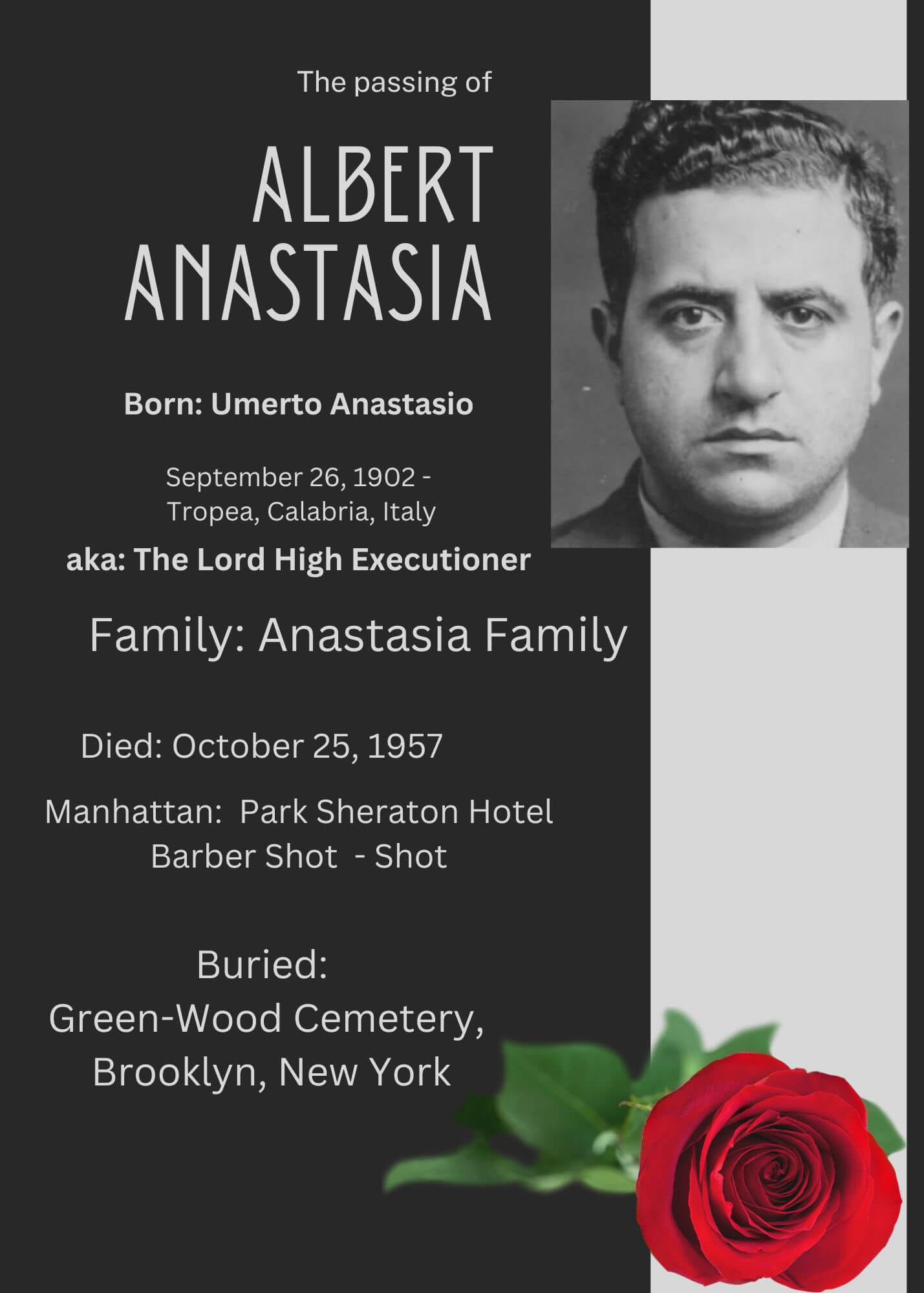
Albert Anastasia: The Lord High Executioner of Murder Incorporated
Albert Anastasia terrified other gangsters.
That alone says something.
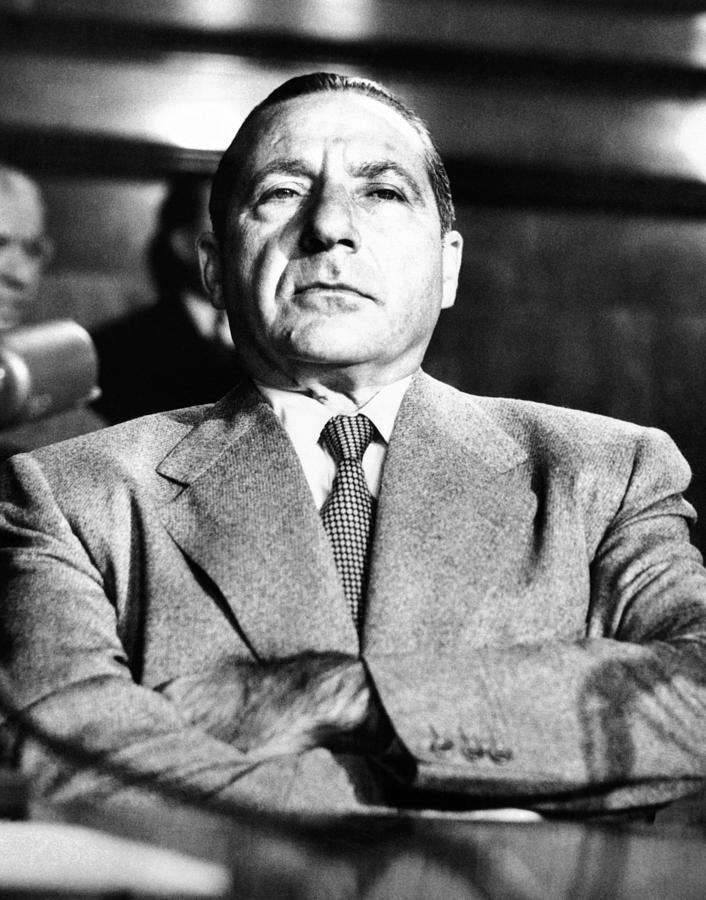
The Mafia during the mid-twentieth century was filled with violent men—killers, extortionists, bootleggers, and war-hardened street predators who viewed murder as part of business. Yet even among those men, Anastasia carried a darker reputation. Associates described him as fearless, explosive, and frighteningly comfortable with violence. Law enforcement officials believed he helped oversee one of the deadliest murder networks in organized crime history.
The newspapers eventually called him “The Mad Hatter.”
The nickname fit because there seemed to be something unstable simmering beneath the surface. Anastasia could be charming one moment and terrifying the next. He laughed loudly, dressed elegantly, and socialized comfortably in expensive Manhattan restaurants, but stories followed him everywhere—stories about executions, disappearances, butchered rivals, and men who simply stopped existing after crossing him.
Whether every story was true hardly mattered.
Fear built its own mythology around Albert Anastasia.
And in the Mafia world, mythology itself was power.
From Calabria to Brooklyn
Albert Anastasia was born Umberto Anastasio in Calabria, Italy, in 1902. His family came from a harsh southern Italian environment shaped by poverty, violence, and rigid codes of honor. Like many future Mafia figures, he immigrated to the United States as a teenager, arriving in New York during a period when immigrant neighborhoods functioned almost like independent worlds.
Brooklyn became his proving ground.
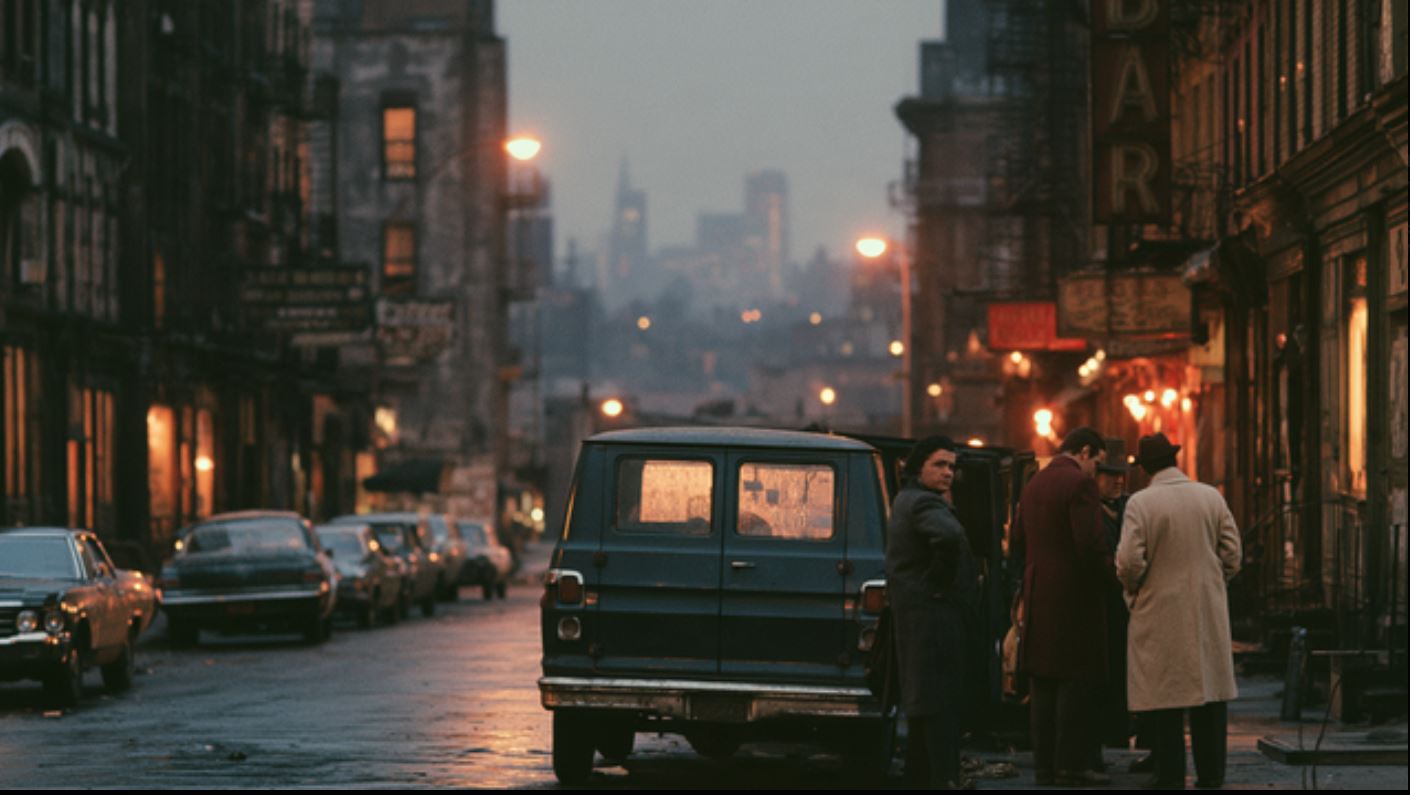
The waterfront docks offered enormous criminal opportunity. Cargo theft, labor racketeering, extortion, and union corruption flourished along the Brooklyn piers, where longshoremen worked under brutal conditions while gangsters controlled access to jobs and shipments.
Anastasia entered that environment violently and quickly.
In 1921, he was convicted of murdering a dockworker during a labor dispute. The conviction seemed certain to destroy his future. Then witnesses disappeared before retrial proceedings, and Anastasia walked free.
It became an early lesson in how organized crime survived.
Fear silenced people.
By the late 1920s, Anastasia had become deeply connected to rising Mafia operations in New York, especially those linked to Charles “Lucky” Luciano.
The timing mattered.
America was entering Prohibition.
Prohibition and the Business of Killing
The prohibition of alcohol transformed organized crime from local street rackets into massive national enterprises. Bootlegging generated fortunes almost overnight, but those fortunes came soaked in violence.
Rival gangs fought constantly over liquor routes, gambling operations, and political influence. Murders became routine. The underworld needed men capable of enforcing decisions ruthlessly.
Albert Anastasia excelled at enforcement.
He became closely associated with a feared network later labeled “Murder Incorporated,” the loose collection of contract killers linked to national organized crime during the 1930s and 1940s. While historians debate the exact structure and hierarchy of Murder Inc., Anastasia’s name became inseparable from it.
Law enforcement officials believed he functioned as one of its major overseers.
The organization allegedly carried out executions for Mafia leaders across the country, eliminating informants, rivals, disloyal associates, and troublesome figures with industrial efficiency. Victims were shot, strangled, stabbed, or vanished entirely.
Anastasia reportedly approved killings with chilling calm.
He treated murder as administration.
That reputation elevated him rapidly within organized crime. Gangsters respected money, but they feared violence more. Anastasia embodied the terrifying enforcement power behind the emerging national syndicate created by Luciano and other Mafia leaders after the Castellammarese War.
He became one of the men nobody wanted as an enemy.
The Rise to Power
During the 1930s and 1940s, Anastasia aligned himself with powerful Mafia figures including Luciano and later Frank Costello.
Unlike more political bosses who preferred diplomacy, Anastasia represented raw force within organized crime leadership. He controlled labor rackets along the Brooklyn waterfront, extortion operations, gambling interests, and union influence tied to shipping industries.
The docks became his kingdom.
Longshoremen understood the system clearly: jobs, protection, and safety depended on organized crime relationships. Anastasia’s influence over waterfront unions and cargo operations generated enormous profits while also providing strategic control over shipping activity entering New York.
His power expanded dramatically after the murder of Vincent Mangano in 1951.
Mangano disappeared under mysterious circumstances, and shortly afterward Anastasia assumed control of the family, which later evolved into the Gambino crime family.
Many believed Anastasia himself orchestrated the takeover.
In the Mafia world, suspicion often mattered more than proof.
Violence and Paranoia
By the 1950s, Anastasia had become one of the most feared Mafia bosses in America.
He was also becoming increasingly unstable.
Associates described violent mood swings, impulsive decisions, and growing paranoia. Anastasia allegedly authorized murders too casually, creating anxiety among other Mafia leaders who worried that his recklessness attracted dangerous law enforcement attention.
Unlike quieter bosses such as Carlo Gambino, Anastasia often appeared openly aggressive and unpredictable.
That unpredictability became a problem.
Organized crime depended on violence, but successful bosses usually balanced brutality with discipline. Anastasia’s reputation suggested he enjoyed intimidation personally rather than treating it merely as business.
Even powerful gangsters began viewing him as dangerous to the stability of the syndicate itself.
And in organized crime, instability invites conspiracy.
The Gambino Conspiracy
By 1957, tensions inside the Mafia had reached dangerous levels.
Powerful figures including Carlo Gambino and Vito Genovese allegedly aligned against Anastasia.
The reasons were both political and personal.
Anastasia’s violence created problems. His independence frustrated rivals. His loyalty to Frank Costello placed him on the wrong side of shifting Mafia alliances as Genovese fought to consolidate greater power nationally.
The decision was made quietly. Albert Anastasia had to die.
The Barbershop Murder
On October 25, 1957, Anastasia entered the Park Sheraton Hotel in Manhattan and sat down in a barbershop chair for a shave.
Moments later, gunmen burst into the room.
Anastasia reportedly tried fighting back instinctively, lunging toward what he believed were attackers reflected in the mirror. In reality, he was charging his own reflection while bullets tore through him.
The killers escaped immediately.
The assassination became one of the most famous murders in Mafia history.
The image itself felt cinematic: a feared Mafia executioner dying beneath fluorescent lights in a luxury hotel barbershop, collapsing across white towels and mirrors while stunned barbers fled in terror.
No one was ever convicted.
Few doubted the meaning.
Albert Anastasia, the man linked for decades to organized crime executions, had himself become another execution.
The Legacy of the Mad Hatter
Albert Anastasia remains one of the darkest figures in American organized crime history.
Unlike more polished gangsters such as Frank Costello or strategic operators like Meyer Lansky, Anastasia represented the terrifying enforcement machinery beneath the Mafia’s corporate structure.
He was violence institutionalized.
The stories surrounding him—many exaggerated, some likely true—created a mythology of almost supernatural brutality. Murder Inc., contract killings, dockside disappearances, barbershop assassinations: Anastasia became woven permanently into the noir imagination of American organized crime.
Yet his downfall also revealed an important truth about the Mafia.
No amount of fear guarantees safety forever.
In the underworld, power constantly shifts. The men who order executions eventually become targets themselves. Anastasia ruled through intimidation so effectively that even fellow gangsters feared him.
Eventually, they feared him too much to let him live.
Buried at: Green-wood Cemetery, Brooklyn, NY