There is a certain kind of man who flourishes in the shadows—not because he understands darkness better than everyone else, but because he convinces himself he owns it.
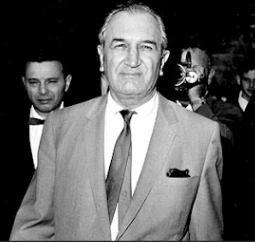
Joseph Bonanno built an empire in those shadows. While other Mafia bosses cultivated fear through violence and spectacle, Bonanno preferred something quieter. He valued patience over impulse, whispers over gunfire, and strategy over theatrics. He carried himself less like a street boss and more like an aristocrat who had wandered into organized crime.
For years, that image worked. His reputation grew. His family prospered. His influence stretched far beyond Brooklyn. In a world crowded with volatile personalities, Bonanno appeared disciplined, thoughtful, and controlled.
Yet buried beneath that restraint was a belief that would ultimately destroy him. Bonanno did not simply see himself as successful. He came to see himself as superior. Not merely another Mafia boss, but a more enlightened version of one.
The trouble with that kind of confidence is that it rarely announces itself. It grows quietly until it hardens into certainty. And certainty has a way of blinding even the most intelligent men.
The Boss Who Thought Differently
During the early decades of his reign, Bonanno’s leadership was widely regarded as effective. He avoided unnecessary attention and rarely indulged in the public displays of power that attracted law enforcement scrutiny. While others became prisoners of their own egos, Bonanno projected calm and stability.
His approach brought results.
The Bonanno family expanded steadily, and his standing within the Mafia’s upper ranks remained strong. Associates admired his patience. Rivals respected his judgment. He understood alliances, timing, and the value of restraint. Most importantly, he understood that power often belonged to the man willing to wait.
But success carries its own dangers.
Over time, Bonanno stopped viewing himself as one player in a delicate balance of competing interests. Instead, he began to see himself as intellectually above the system itself. Other bosses, in his view, lacked his sophistication. They were operators; he was a strategist. They reacted; he anticipated.
That subtle shift changed everything.
The moment a leader believes he is the smartest man in the room is often the moment he stops listening to anyone else inside it.
The Commission Was Bigger Than Any Boss
The American Mafia has often been portrayed as chaos wrapped in violence, but the reality was more complicated. Behind the murders and betrayals existed a structure designed to prevent open warfare. At the center of that structure sat the Commission.
Created after the rise of men like Charles ‘Lucky’ Luciano, the Commission served as a governing body intended to balance power among the major families. It was imperfect, but it worked. It prevented conflicts from escalating into full-scale disasters and reminded every boss that survival depended upon cooperation as much as strength.
Most leaders understood this.
Bonanno eventually did not.
As the years passed, he increasingly viewed the Commission as an obstacle rather than a necessity. The men seated around the table were no longer partners in a delicate arrangement. In his mind, they became lesser figures standing in the way of greater ambitions.
That was a dangerous misunderstanding.
The Commission was never about determining who was smartest. It existed because every family possessed enough power to damage every other family. The system survived because no single boss could dominate it without provoking resistance from all sides.
Bonanno either failed to recognize that reality or convinced himself he could overcome it.
The Plot That Changed Everything
In the early 1960s, Bonanno made the most consequential gamble of his career.
Working alongside Joseph Magliocco, he became involved in a plan to eliminate rival bosses and reshape the Mafia hierarchy. It was an audacious strategy built upon assumptions that proved disastrously wrong.
The plot depended on secrecy. It depended on loyalty. It depended on the belief that opponents could be caught unaware.
None of those assumptions survived contact with reality.
As often happens in organized crime, word spread. Information leaked through channels invisible to outsiders but familiar to anyone who understood the underworld. Intended targets learned of the conspiracy. Alliances shifted. Men who might have remained neutral suddenly found themselves choosing sides.
What had been conceived as a masterstroke quickly became an exposure of intent.
And intent, within the Mafia, can be more dangerous than action itself.
The failed conspiracy shattered trust and accelerated tensions that would erupt into what became known as the Banana War. Instead of strengthening Bonanno’s position, it revealed vulnerabilities he had spent decades hiding.
For the first time, many within the Mafia saw not a master strategist, but a boss capable of catastrophic miscalculation.
The Vanishing Don
Then came the event that transformed uncertainty into crisis.
In 1964, Joseph Bonanno disappeared.
He later maintained that he had been kidnapped. Supporters repeated the claim. Critics dismissed it. To this day, debate remains over exactly what happened during his absence.
Inside the Mafia, however, facts mattered less than appearances.
A missing boss creates instability. A prolonged absence creates opportunity.
While Bonanno remained out of sight, ambitious capos began maneuvering for influence. Long-simmering rivalries surfaced. Soldiers and lieutenants evaluated where their loyalties truly belonged. The organization Bonanno had once controlled with quiet authority began fracturing into competing camps.
His disappearance did not freeze events.
It accelerated them.
Power vacuums are among the most dangerous forces in organized crime. Once created, they rarely remain empty for long.
A Family Turns Against Itself
The conflict that followed was not a dramatic street war filled with headlines and public bloodshed. It was something more destructive.
The Bonanno family entered a prolonged period of internal warfare marked by shifting loyalties, secret negotiations, betrayals, and political maneuvering. Men who had spent years supporting Bonanno began questioning his judgment. Others openly opposed him.
Their motives were not always ambition.
Many simply believed he had become a liability.
Leadership in organized crime depends upon predictability. A boss must be feared, respected, and trusted to maintain stability. Once that stability disappears, confidence evaporates quickly.
Bonanno had lost the balance that once defined him. His actions introduced uncertainty into a system that prized order above almost everything else.
As trust weakened, so did his authority.
The Quiet Power of the Commission
Hollywood teaches audiences to expect dramatic endings. The Mafia often prefers administrative ones.
There was no grand execution. No climactic showdown.
Instead, the Commission responded in the way it had been designed to respond. Bonanno was marginalized, isolated, and gradually stripped of meaningful influence. The process lacked drama but possessed enormous effectiveness.
The very institution he believed he could outmaneuver ultimately reasserted its authority.
It was a reminder that the structure mattered more than any individual, regardless of reputation, intelligence, or history.
Even a boss who considered himself exceptional could be corrected.
The Long Exile
Unlike many Mafia leaders, Bonanno survived.
He lived long enough to reflect upon his rise and fall, to write about his experiences, and to shape his own version of events. Yet longevity is not the same as victory.
The empire he once commanded continued without him. Others stabilized the turmoil that had consumed his family. The machinery of organized crime moved forward while Bonanno watched from a distance.
His legacy became complicated.
Part of it belonged to the disciplined and calculating leader who built one of America’s most powerful crime families. Another part belonged to the aging boss whose confidence gradually transformed into overconfidence.
The contrast between those two men remains one of the most fascinating stories in Mafia history.
Confidence Without Correction
What makes Bonanno’s downfall so compelling is that it was not driven by recklessness in the traditional sense.
He did not lose control in a fit of rage. He did not gamble away power through impulsive decisions. Every major move was calculated—or at least believed to be.
That was precisely the problem.
Bonanno trusted his own judgment so completely that he stopped recognizing its limitations. Success convinced him that his instincts were superior. Past victories became evidence that future victories were inevitable.
The warning signs were there. The cracks appeared gradually. But confidence can be remarkably effective at silencing doubt.
He mistook experience for invulnerability and intelligence for exemption from the rules governing everyone else.
In doing so, he underestimated the most dangerous force in organized crime: a system designed to resist any one man’s dominance.
The End of the Illusion
The story of Joseph Bonanno extends far beyond the Mafia.
At its core, it is a story about leadership, ambition, and self-deception. It is about what happens when success evolves into certainty and certainty evolves into arrogance.
Bonanno did not fall because he lacked intelligence.
He fell because he believed his intelligence placed him above the system that had helped him succeed.
There was no dramatic final collapse. No singular moment when everything came crashing down.
Instead, there was erosion.
Slow. Relentless. Almost invisible at first.
An empire that had taken decades to build unraveled thread by thread, alliance by alliance, decision by decision, until the illusion finally disappeared.
And when it did, Joseph Bonanno was left facing a truth that has humbled powerful men throughout history:
No one is above the game for long.
References
Bonanno, Joseph. A Man of Honor: The Autobiography of Joseph Bonanno. St. Martin’s Press, 1983.
Raab, Selwyn. Five Families: The Rise, Decline, and Resurgence of America’s Most Powerful Mafia Empires. Thomas Dunne Books, 2005.
Critchley, David. The Origin of Organized Crime in America: The New York City Mafia, 1891–1931. Routledge, 2008.
Jacobs, James B. Gotham Unbound: How New York City Was Liberated from the Grip of Organized Crime. NYU Press, 1999.
Federal Bureau of Investigation. Records concerning the Bonanno Family conflicts and Commission proceedings, 1960s.
New York Times Archives. Coverage of Joseph Bonanno’s disappearance and internal Mafia conflicts, 1964–1968.