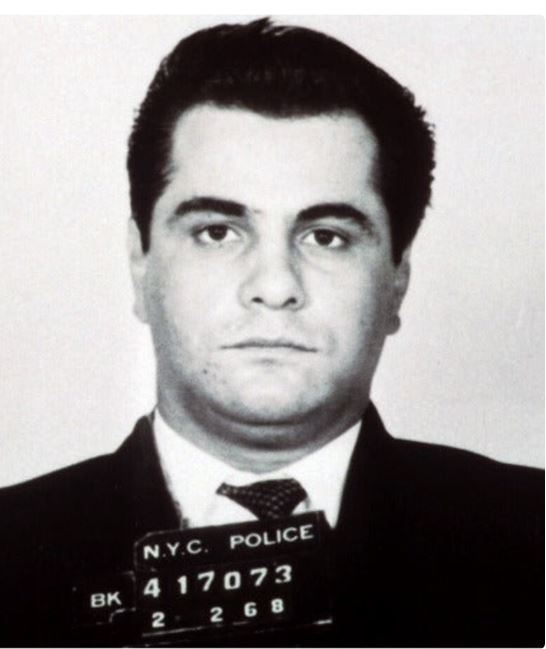
In the underworld, power isn’t just enforced—it’s performed. And no one performed it louder, flashier, or more recklessly than John Gotti. Tailored suits, silk ties, and a permanent smirk turned him into a media creation—the “Dapper Don,” a gangster who didn’t hide in the shadows but dared the spotlight to blink first. He won acquittals, charmed cameras, and carried himself like a man immune to consequences.
But behind the tailored image was something far more dangerous than ambition or ego. It was a habit. A reflex. A weakness disguised as strength: the need to talk, to mock, to diminish the men beneath him—and sometimes beside him.
In a world where respect is oxygen, Gotti had a habit of cutting off the air supply.
A Boss Built on Image
Gotti’s rise wasn’t quiet. When he orchestrated the assassination of Paul Castellano outside Sparks Steak House in 1985, it wasn’t just a power grab—it was a spectacle. The message was unmistakable: the old rules were dead, and Gotti was the new author.
But the problem with ruling through spectacle is that you have to keep performing. And Gotti did. Constantly.
He held court in social clubs, surrounded by captains and soldiers who laughed when he laughed and nodded when he spoke. But beneath the laughter was tension. Gotti didn’t just command loyalty—he demanded attention, affirmation, and, at times, submission in the form of humiliation.
He mocked earners. He questioned competence. He reminded men—sometimes publicly—that they were beneath him.
For a while, it worked. Fear and charisma can look a lot like leadership when the money is flowing and the indictments don’t stick.
But that kind of leadership carries a quiet cost. It accumulates in glances, in silence, in things left unsaid.
And eventually, it looks for a way out.
Sammy the Bull: The Man Who Listened
Sammy Gravano wasn’t a fragile man. He was a killer, a strategist, and one of the most efficient earners the Gambino family had ever seen. By the time he became underboss, he had already survived the kind of life that chews through weaker men.
He didn’t need praise. But like anyone operating in a hierarchy built on reputation, he expected a baseline of respect.
At first, Gotti gave him that—or at least the appearance of it. Gravano was trusted, elevated, and placed close to the center of power. But proximity to Gotti came with a cost. The closer you stood, the more you heard.
And Gotti talked.
He talked in clubs. He talked in cars. He talked in places he believed were safe, insulated from consequence. But the late 1980s and early 1990s weren’t the old days. The government had adapted. Surveillance was no longer crude—it was patient, precise, and relentless.
Wiretaps began to capture not just business—but personality.
And what they captured was devastating.
The Sound of Disrespect
On those tapes, Gotti wasn’t the composed, calculated boss he projected in public. He was cutting. Dismissive. Suspicious.
He questioned Gravano’s loyalty. He criticized his decisions. He minimized his contributions. Sometimes it sounded like frustration. Other times, like contempt.
This wasn’t strategic discipline handed down through proper channels. It wasn’t a boss correcting a subordinate. It was something looser, sloppier, and far more corrosive: casual disrespect.
In organized crime, words carry weight. Not just because of what they mean—but because of who hears them, and when.
Gravano heard them eventually. Not directly, not in the moment—but through the government’s case, through discovery, through the slow unveiling of what his boss really thought of him when he wasn’t in the room.
That’s when the equation changed.
The Breaking Point
Loyalty in the Mafia is often described as absolute. But history tells a different story. Loyalty is conditional—built on mutual benefit, reinforced by fear, and sustained by respect.
Take one of those away, and the structure weakens.
Take two away, and it starts to collapse.
By the time Gravano was facing federal charges tied to racketeering and murder, the pressure was already immense. The case against the Gambino leadership was strong, built on surveillance, informants, and years of investigation.
But pressure alone doesn’t always flip a man like Gravano.
Disillusionment does.
Hearing your boss question your loyalty while you’re risking your life for the organization doesn’t just sting—it reframes everything. It turns sacrifice into foolishness. It turns obedience into exploitation.
And it forces a question that no Mafia boss ever wants his inner circle asking:
Why am I loyal to someone who isn’t loyal to me?
Gravano made his decision. He cooperated with the government, becoming one of the highest-ranking members of organized crime to turn state’s evidence.
The damage was catastrophic.
Collapse in Real Time
Gravano’s testimony didn’t just strengthen the case—it completed it. He provided structure, context, and firsthand confirmation of crimes that might have otherwise remained tangled in ambiguity.
In 1992, Gotti was convicted on multiple charges, including murder and racketeering. The “Teflon Don,” once untouchable, was sentenced to life in prison without the possibility of parole.
He died behind bars in 2002.
The myth didn’t survive the man.
And neither did the illusion that fear and charisma could replace discipline and restraint.
The Strategic Failure
Gotti’s mistake wasn’t just that he talked too much. It was what he chose to say—and about whom.
Leadership in organized crime has always required a careful balance. Fear keeps people in line. But respect keeps them invested.
Bosses like Carlo Gambino understood this. They kept their voices low, their criticisms controlled, and their internal disputes contained. They didn’t humiliate their top earners—not because they were kind, but because they were pragmatic.
Gotti broke that pattern.
He treated reputation like a personal weapon rather than a shared asset. He forgot that every insult, every complaint, every careless remark had the potential to travel—through wires, through whispers, through the slow machinery of federal prosecution.
And once those words left his mouth, they were no longer his to control.
The Lesson in the Ruins
There’s a tendency to romanticize Gotti—to see him as the last great showman of the Mafia, a man who defied the system until the system finally caught up.
But that version of the story misses something essential.
He wasn’t undone by bad luck. He wasn’t even undone solely by law enforcement.
He was undone by erosion from within.
By the time the verdict came down, the damage had already been done in back rooms and recorded conversations, in moments where a boss chose ego over discipline, impulse over strategy.
In that sense, Gotti didn’t just lose his freedom.
He lost control of the one thing that mattered most: the loyalty of the man standing closest to him.
References
Capeci, Jerry. The Complete Idiot’s Guide to the Mafia. Alpha Books, 2002.
Maas, Peter. Underboss: Sammy the Bull Gravano’s Story of Life in the Mafia. HarperCollins, 1997.
Raab, Selwyn. Five Families: The Rise, Decline, and Resurgence of America’s Most Powerful Mafia Empires. Thomas Dunne Books, 2005.
United States v. Gotti, 1992 (Federal Court Case Records, Southern District of New York).
Anastasia, George. Gotti’s Rules: The Story of John Alite, Junior Gotti, and the Demise of the American Mafia. Dey Street Books, 2015.