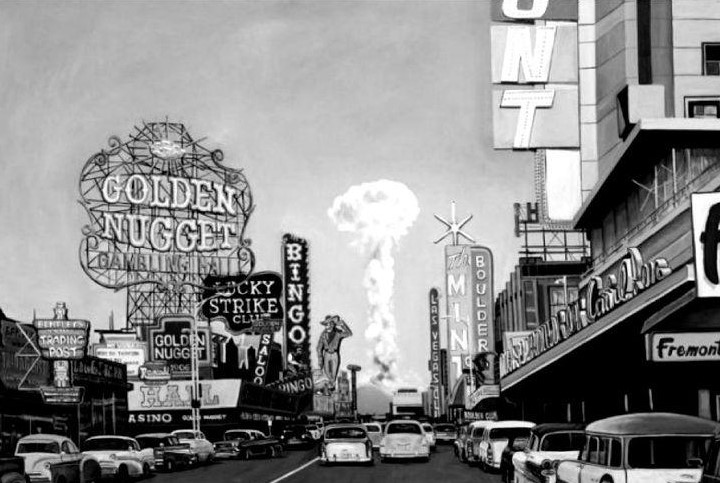
The desert has always been a place for experiments—some scientific, others financial, and in mid-century Las Vegas, the two collided with unsettling precision. In the 1950s, the Nevada sky became a stage for nuclear detonations, and the Strip became the front row. Tourists didn’t just come to gamble; they came to witness the apocalypse in controlled bursts of light. What should have been terrifying was repackaged as entertainment, and what was entertainment became a reliable stream of cash.
It wasn’t subtle. It wasn’t hidden. It was marketed.
And behind it all, the money moved exactly where it was supposed to.
The Bomb as Spectacle
In 1951, the federal government began nuclear testing at the Nevada Test Site, a remote stretch of desert not far from Las Vegas. The official purpose was national defense, part of an escalating Cold War that demanded constant demonstration of power. But geography turned strategy into spectacle. The detonations—blinding flashes followed by towering mushroom clouds—were visible from the city.
Las Vegas didn’t recoil from the proximity.
It leaned into it.
Hotels and casinos quickly realized that the tests could be transformed into attractions. They advertised viewing parties timed with scheduled detonations, encouraging guests to wake before dawn and gather with cocktails in hand. Rooftops filled with spectators dressed for evening rather than evacuation, watching the horizon ignite as if it were part of a carefully scripted show.
The bomb became a draw.
Desert Laundromat: How Mob Money Became Legis in Las Vegas
Selling the End of the World
Casino promotions during this period blurred the line between fascination and absurdity. “Atomic cocktails” appeared on menus, often glowing in unnatural colors. Beauty queens posed in costumes inspired by mushroom clouds. Souvenirs referenced radiation with a wink, turning something invisible and dangerous into a novelty item.
The tone was unmistakable: this was not a warning—it was an experience.
Las Vegas understood something essential about its audience. People didn’t come to the desert for caution; they came for excess. The atomic tests fit perfectly into that psychology, offering a thrill that no roulette wheel could match. The promise wasn’t just entertainment. It was proximity to something larger, something forbidden, something that hinted at destruction without delivering it.
And like everything else in Las Vegas, that promise came with a price.
The Mob Follows the Crowd
By the time nuclear tourism took hold, organized crime was already deeply embedded in the city’s casinos. Figures like Meyer Lansky had helped shape the financial architecture of Las Vegas, turning casinos into engines capable of both generating and laundering money. The system relied on volume—on a constant influx of gamblers feeding cash into the operation.
Atomic tourism increased that volume.
More visitors meant more hotel bookings, more meals, more drinks, and most importantly, more gambling. The spectacle of the bomb drew crowds that might not have otherwise made the trip, and once they arrived, they became part of the machine. Chips changed hands, bets were placed, and losses accumulated in ways that felt incidental to the larger experience.
For the mob, the attraction didn’t need to be understood.
It only needed to be profitable.
Sin City’s Hidden Hand: How the Mob Secretly Ran Las Vegas in the 1950s and 60s
The Business Behind the Glow
While tourists watched the sky, the real work took place out of sight. Casinos operated with a dual reality: the visible front of games, lights, and hospitality, and the hidden mechanics that determined where the money actually went. Central to that system was the skim—the quiet removal of cash before it entered official accounting.
The influx of atomic tourists created spikes in revenue that moved through the casino floors and into counting rooms. There, under controlled conditions, cash was sorted and divided. A portion would be recorded, taxed, and presented as legitimate income. Another portion would disappear into unreported channels, destined for syndicate figures who maintained their distance from the daily operations.
The bomb didn’t change how the system worked.
It amplified it.
A Culture Built on Contradiction
Las Vegas in the 1950s thrived on contradiction. It was a place where danger was repackaged as glamour and where risk was not just accepted but celebrated. The presence of nuclear testing sites nearby should have cast a shadow over the city. Instead, it became part of the allure.
This was a culture that embraced extremes. Tourists could witness a weapon capable of unimaginable destruction in the morning and spend the evening at a blackjack table, chasing a different kind of risk. The psychological leap required to make that transition wasn’t as large as it might seem. Both experiences relied on a willingness to flirt with uncertainty, to stand close to the edge without fully acknowledging the drop.
The mob didn’t create that mindset, but it exploited it with precision.
Operation Strawman. The Mob’s Paper Empire crumbles in Las Vegas
Government Intent, Private Profit
There was no formal alliance between the federal government and organized crime, but their activities intersected in ways that proved mutually beneficial. The government conducted its tests with little regard for how they might be perceived beyond military objectives. Las Vegas, operating under its own logic, transformed those tests into a commercial opportunity.
Organized crime ensured that the financial benefits of that opportunity were maximized.
This convergence wasn’t coordinated, but it didn’t need to be. Each party acted in its own interest, and the overlap created a system where nuclear spectacle fed directly into casino profits. The absence of strict regulatory oversight allowed the arrangement to continue with minimal interference, at least for a time.
The result was a strange equilibrium.
Destruction fueled entertainment, and entertainment fueled revenue.
The Shift in Perception
By the late 1950s, the novelty began to wear thin. Reports of radiation exposure and health risks started to circulate, particularly among communities downwind of the test site. The carefree attitude that had defined atomic tourism gave way to a more cautious awareness of its consequences.
The government responded by moving many tests underground, reducing the visible spectacle that had drawn tourists in the first place. Without the dramatic visuals, the promotional value diminished. Casinos quietly shifted their focus back to more traditional attractions, leaving behind the atomic theme as a relic of a more reckless era.
But the underlying system remained intact.
The Legacy of the Atomic Era
The period of nuclear tourism in Las Vegas was relatively brief, but its impact was significant. It demonstrated the city’s ability to commodify virtually anything, no matter how dangerous or abstract. It also reinforced the effectiveness of the financial structures that organized crime had put in place.
Casinos didn’t need mushroom clouds to generate profit.
They needed attention, volume, and a steady flow of cash.
The atomic era provided all three in concentrated form, accelerating the growth of Las Vegas and solidifying its reputation as a place where normal rules didn’t apply. Once that reputation was established, it became self-sustaining.
The spectacle could fade.
The business would continue.
The Afterimage
Looking back, the image is almost surreal: well-dressed tourists gathered on casino rooftops, drinks in hand, watching a nuclear explosion bloom in the distance. It feels like something constructed for fiction, too exaggerated to be real. But it happened, and it happened repeatedly, normalized by a culture that prioritized experience over caution.
For organized crime, it was never about the spectacle itself.
It was about what the spectacle brought in.
Every visitor drawn by the promise of witnessing history became part of a larger equation, one that converted curiosity into cash and cash into influence. The system didn’t need to understand the meaning of the bomb. It only needed to capture its economic impact.
The Final Calculation
Las Vegas has always been a place where reality is adjusted to fit the narrative. During the atomic era, that narrative suggested that even the most destructive force ever created could be reframed as entertainment. The city sold the experience, the casinos captured the revenue, and the mob ensured that a significant portion of that revenue never appeared on any official ledger.
The mushroom clouds eventually disappeared from view, but their financial aftereffects lingered. They helped build a model that would sustain Las Vegas for decades—a model based on spectacle, volume, and the careful management of what is seen versus what is hidden.
In the end, the atomic age didn’t change Las Vegas.
It revealed it.
A place where even the end of the world could be packaged, priced, and quietly counted behind closed doors.
References
United States Department of Energy. Nevada Test Site Historical Overview. U.S. Government Printing Office.
Allen, Gary. The Las Vegas Story: Atomic Tourism and the Rise of the Strip. University of Nevada Press, 2005.
Lacey, Robert. Little Man: Meyer Lansky and the Gangster Life. Little, Brown and Company, 1991.
Skolnick, Jerome H. House of Cards: Legalization and Control of Casino Gambling. Little, Brown and Company, 1978.
United States Senate. Organized Crime and Illicit Traffic in Narcotics (Kefauver Committee Hearings), 1950–1951.
United States Senate. Improper Activities in the Labor or Management Field (McClellan Committee Hearings), 1957–1960.
www.CrimeAndCocktails.net