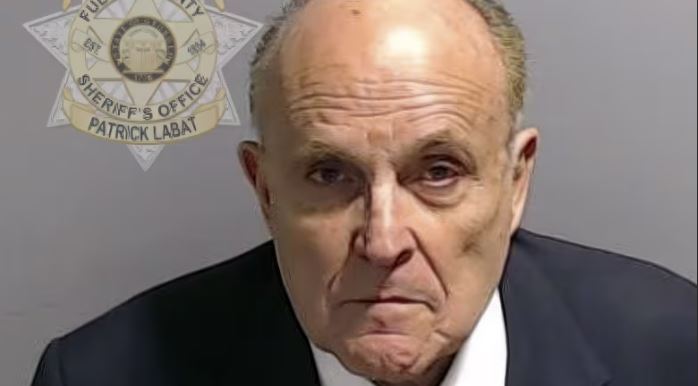
Rudy Giuliani has spent decades polishing a legend — the fearless prosecutor who smashed New York’s Mafia in the 1980s, the righteous hammer of justice who dragged La Cosa Nostra’s bosses into the light. It’s the story he clings to even now, long after the shine has worn off and long after the contradictions in his origin story have been exposed. But like every good myth, Giuliani’s triumph over the mob becomes harder to admire the closer you get to the truth.
Because for all his theatrics in the courtroom, for all his swagger in front of cameras, Giuliani grew up surrounded not by law-abiding saints but by men who walked comfortably in the shadows of organized crime. The mob wasn’t an enemy he discovered in adulthood — it was a presence in his own family, dining at his kitchen table, drinking in the bars where his father worked, and teaching lessons far more ambiguous than the moral purity Giuliani later claimed to embody.
The irony is obvious, but Giuliani never acknowledges it. He built a career pointing outward at criminals while refusing to look inward at the criminality woven into his own bloodline.
The Public Crusader and the Private Fog
When Giuliani became U.S. Attorney for the Southern District of New York in 1983, he found himself armed with one of the most powerful tools in federal law — the RICO Act. And he used it like a man desperate to prove something. He staged raids like theatrical productions. He marched mobsters in front of photographers. He delivered indictments with the cadence of a man auditioning for sainthood.
These were not just prosecutions; they were performances.
The Commission Trial of the mid-1980s became Giuliani’s personal drama, his attempt to portray himself as the lone hero standing against generations of organized crime. The headlines adored him. The public drank it in. Giuliani basked in it.
But even then, the shine was artificial. Prosecutors before him had gone after the mob for decades. Giuliani simply weaponized media attention more aggressively than any of his predecessors. He crafted the image of a one-man war — when in reality, he was the carefully groomed frontman for a much larger institutional effort already decades in motion.
He wasn’t the mob’s grim reaper. He was its most enthusiastic narrator.
The Family Business No One in the Giuliani Camp Wants to Discuss
Scratch the surface of Giuliani’s moral crusade and the entire story grows darker — and more hypocritical.
Because Giuliani’s war on the mob is not the story of a man standing against the world he grew up in. It is the story of a man pretending he never came from that world at all.
His father, Harold Giuliani, didn’t just have a minor scrape with the law. He was arrested in 1934 for an armed robbery and served time in Sing Sing. When he got out, he didn’t become a model citizen. According to multiple biographical investigations, he worked as an enforcer in a Brooklyn bar that doubled as a hangout and business hub for mob-connected figures. He collected debts. He carried weapons. He hurt people when necessary.
Then there was Leo D’Avanzo, Rudy’s uncle, who ran a loan-sharking and gambling operation tied directly to organized crime activity in Brooklyn. This wasn’t distant or abstract — this was family. Giuliani spent holidays with these men. Their stories were his stories. Their moral landscape was his upbringing.
And the darkest figure of all was Lewis D’Avanzo, Rudy’s cousin — a man the FBI described as a professional burglar, suspected killer, and major player in a sprawling stolen-car ring. He was shot dead by federal agents during a raid in 1977.
This wasn’t some distant relative Giuliani barely knew. This was a blood cousin. A D’Avanzo. A man who lived the criminal life Giuliani would later claim to despise with righteous fury.
Yet when confronted about these histories, Giuliani’s reaction was always the same: deny, deflect, refuse to discuss.
He wanted the glory of fighting the mob, not the shame of being raised among men who were part of it.
A Morality Built on Convenience, Not Conviction
Giuliani’s defenders often argue that a man should not be judged by the actions of his relatives. Fair enough. But Giuliani didn’t simply distance himself from the crimes of his family — he erased them from his public story while portraying himself as a moral crusader uniquely qualified to fight criminal corruption.
He weaponized morality while editing his own biography beyond recognition.
The contradictions in his upbringing left a mark that even his closest associates noticed. Former aides described Giuliani as a man obsessed with loyalty — absolute, unquestioning loyalty — a value that sounds suspiciously like the code of silence found in the very crime families he prosecuted.
This is not coincidence. Family loyalty was the cornerstone of his childhood lessons. Morality was conditional. Rules were flexible. Loyalty was everything.
In adulthood, Giuliani simply repurposed these values into politics — surrounding himself with loyalists, demanding obedience, and punishing dissent with vindictive zeal.
The mob calls it omertà. Giuliani called it leadership.
The resemblance was never lost on those who worked with him.
Cracks in the Armor
Giuliani’s myth endured for decades — through the 1980s, through his tenure as mayor, through the post-9/11 canonization that briefly made him a symbol of American resilience.
But the myth has been crumbling for years.
Outside the narrative he built for himself, Giuliani’s life reads like a long, slow unraveling. Ethics investigations. Questionable alliances. Unhinged public tirades. Legal troubles. A revolving door of allies who once supported him, then fled from the wreckage.
The mob-buster who once claimed the moral high ground now spends his final political years defending behaviors that would once have landed his enemies in handcuffs.
His fall from grace is not a surprise to those who saw past the myth. It is the inevitable collapse of a story that was always built on contradictions, on bravado, and on a refusal to confront his own roots.
Giuliani wasn’t a man who transcended the shadow of organized crime. He was a man shaped by it — hardened by it, inspired by it, and forever intertwined with it.
And ultimately undone by the same hunger for power and loyalty that defined the world he claimed to destroy.
The Truth Behind the Two Faces
Rudy Giuliani always insisted that he was the hero in his own story — a righteous warrior standing against corruption.
But the truth is simpler, sadder, and much darker.
Giuliani didn’t escape the mob.
He didn’t rise above it.
He didn’t defeat it in some mythic moral sense.
He mirrored it.
The tactics.
The swagger.
The loyalty tests.
The moral relativism.
The obsession with power.
He tore down the mob with one hand while repeating its patterns with the other. He built a legacy on the idea of righteousness while burying every uncomfortable truth about his own family’s ties to the underworld.
Rudy Giuliani isn’t two-faced because he hides one side of himself.
He’s two-faced because both sides are true.
And that is what makes his story not heroic — but tragic.
References
- Giuliani’s family ties to mob figures and his father and uncle’s criminal past, including loan-sharking and shooting incidents. https://www.cleveland19.com+1
- Biography details on Harold Giuliani’s past and Rudy’s upbringing. Biography
- Giuliani’s unverified response to revelations about his family history. NNBW
- RICO prosecutions and mob-busting career in the 1980s. The Hatch Institute
- Analysis of family moral ambiguity and loyalty dynamics. The New Republic+1