There is a particular kind of man who thrives in the shadows—not because he understands them, but because he believes he controls them.
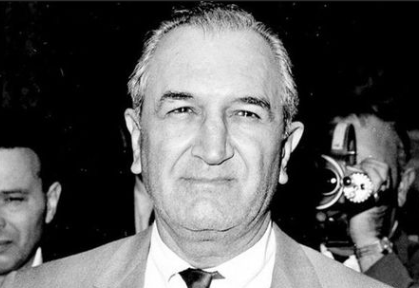
Joseph Bonanno built his empire in those shadows. He cultivated silence the way others cultivated fear. He preferred whispers over gunfire, patience over chaos, calculation over spectacle. In a world defined by brutality, he styled himself as something different. Something elevated.
He wasn’t just a boss.
He believed he was a better kind of boss.
And that belief—quiet at first, almost invisible—would metastasize into something far more dangerous than any rival with a gun.
A Different Kind of Don—or So He Thought
Bonanno’s early reign over the Bonanno crime family was, by most accounts, disciplined and effective. He wasn’t reckless. He didn’t chase headlines. While other bosses indulged in public displays of power or drowned in their own excess, Bonanno maintained a controlled, almost aristocratic posture.
He believed in order. In structure. In restraint.
And for a time, that worked.
His family prospered. His influence expanded. His reputation hardened into something formidable—not through violence alone, but through consistency. He understood timing. He understood alliances. He understood when not to move.
But understanding the game is not the same as being above it.
Somewhere along the line, Bonanno stopped seeing himself as a participant in a delicate system and began to view himself as its natural superior. Not equal to the other bosses—but intellectually beyond them.
It’s a subtle shift, but a fatal one.
Because once a man believes he is the smartest in the room, he stops listening to anyone else in it.
The Commission Was Not Optional
The American Mafia was not chaos. It was structure masquerading as chaos. At the top of that structure sat the Commission—a governing body designed to prevent exactly the kind of instability Bonanno would later unleash.
To most bosses, the Commission was necessity. A balancing act. A system that ensured survival through mutual restraint.
To Bonanno, it became something else.
An obstacle.
He began to see the other members—men who had built their own empires through blood and calculation—as crude operators. Predictable. Shortsighted. Inferior in ways that couldn’t be corrected.
It wasn’t just arrogance. It was strategic blindness.
Because the Commission wasn’t about intelligence. It was about equilibrium. It didn’t matter who was smarter. What mattered was that everyone had enough power to destroy everyone else.
Bonanno either didn’t understand that—or believed he could outmaneuver it.
The Fatal Miscalculation
In the early 1960s, Bonanno made his move.
He aligned himself with Joseph Magliocco, a man with his own ambitions, and together they entertained a plan that crossed an unspoken line. The idea was simple in theory and catastrophic in execution: remove rival bosses, consolidate power, and reshape the hierarchy.
It was a gamble built on assumptions.
That their enemies were vulnerable.
That loyalty could be controlled.
That secrecy would hold.
It didn’t.
The plan unraveled before it could fully take shape. Word spread—as it always does in a world where survival depends on knowing what others don’t want known. Targets became aware. Alliances shifted. What was meant to be a decisive power play became a glaring exposure of intent.
And intent, in that world, is everything.
The fallout fed directly into what would become known as the Banana War—a prolonged period of internal conflict that would tear the Bonanno family apart from the inside.
Bonanno had not just failed.
He had revealed himself.
The Disappearance That Undermined Everything
Then came the moment that turned suspicion into certainty.
In 1964, Bonanno vanished.
He would later claim he had been kidnapped. That he was a victim of forces aligned against him. That his absence was not a retreat, but a circumstance beyond his control.
But in the Mafia, perception matters more than truth.
And the perception was devastating.
A boss who disappears—whether by force or by choice—creates a vacuum. And vacuums in organized crime do not remain empty. They are filled quickly, violently, and without sentiment.
Capos began to maneuver. Soldiers chose sides. Trust fractured along invisible fault lines that had been forming for years. The family Bonanno had once controlled with quiet authority began to splinter into competing factions.
His absence didn’t pause the game.
It accelerated it.
A Family at War With Itself
What followed was not a clean overthrow, but something messier.
The Bonanno family descended into internal conflict that blurred the lines between loyalty and survival. This was not the kind of war fought in headlines. It was quieter. More insidious. A series of shifting allegiances, backroom decisions, and calculated betrayals.
Men who had once followed Bonanno without question began to doubt him. Then they began to oppose him.
Not because they were more ambitious.
Because he had become a liability.
Leadership in that world is not about being admired. It’s about being stable. Predictable in the ways that matter. Dangerous enough to command respect, but controlled enough to avoid unnecessary chaos.
Bonanno had lost that balance.
And once a boss loses balance, he loses everything else soon after.
The Commission Responds—Without Drama
There was no grand showdown. No theatrical execution.
The Commission didn’t need spectacle to assert authority. It simply acted.
Bonanno was effectively removed from power. Isolated. Marginalized. His influence stripped not through violence, but through consensus. The very system he believed he could outthink reasserted itself with quiet efficiency.
It was a surgical correction.
A reminder that the structure mattered more than any individual within it.
Even one who believed himself exceptional.
Exile Without Closure
Bonanno didn’t die in the chaos he helped create. He lived long enough to reflect on it, to write about it, to attempt—on some level—to shape how history would remember him.
But survival is not the same as victory.
He spent his later years removed from the machinery of power, watching from a distance as others stabilized what he had destabilized. His story became something complicated—a blend of early discipline and later miscalculation.
A man who once prided himself on control reduced to observing the consequences of losing it.
The Psychology of Collapse
What makes Bonanno’s fall so compelling isn’t just what he did.
It’s why he did it.
He wasn’t reckless in the traditional sense. He didn’t lash out blindly. His decisions were calculated—at least in his own mind. That’s what makes them so dangerous. He believed in them. Trusted them. Doubled down on them even as the cracks began to show.
This wasn’t chaos.
It was confidence without correction.
He mistook past success for permanent superiority. He assumed that because his methods had worked before, they would continue to work—regardless of changing circumstances. He underestimated how quickly alliances could shift when trust eroded.
And perhaps most critically, he overestimated his ability to control outcomes in a system designed to resist control.
A Lesson Written in Smoke and Silence
The story of Bonanno isn’t confined to the Mafia. It doesn’t belong solely to the history of organized crime.
It’s a case study in something far more universal.
The danger of believing your own narrative.
The moment a leader stops questioning himself is the moment he becomes most vulnerable. Not to his enemies—but to his own misjudgment. To the blind spots that grow larger the more they are ignored.
Bonanno didn’t fall because he lacked intelligence.
He fell because he believed his intelligence exempted him from the rules that governed everyone else.
The End of the Illusion
In the end, there was no dramatic final act. No single moment where everything collapsed.
Just erosion.
Slow. Relentless. Inevitable.
The empire he built didn’t explode—it unraveled. Thread by thread. Decision by decision. Miscalculation by miscalculation.
Until there was nothing left to hold it together.
And the man who once believed he stood above it all was left with the realization that he had never been above it to begin with.
References
- Bonanno, Joseph. A Man of Honor: The Autobiography of Joseph Bonanno. St. Martin’s Press, 1983.
- Raab, Selwyn. Five Families: The Rise, Decline, and Resurgence of America’s Most Powerful Mafia Empires. Thomas Dunne Books, 2005.
- Critchley, David. The Origin of Organized Crime in America: The New York City Mafia, 1891–1931. Routledge, 2008.
- Jacobs, James B. Gotham Unbound: How New York City Was Liberated from the Grip of Organized Crime. NYU Press, 1999.
- FBI Records on the Bonanno Family conflicts and Commission proceedings (1960s)
- New York Times Archives, reporting on Joseph Bonanno’s disappearance and internal Mafia conflicts (1964–1968)