Power, in the underworld, is often misunderstood. It’s mistaken for noise—gunshots in the night, headlines screaming names, bodies stacked like warnings. But the men who built lasting empires in the American Mafia knew something colder, something far more effective: the loudest man in the room is rarely the one in control.
Real power moves quietly. It negotiates. It outlasts.
From the ashes of chaos in the early 1930s to the tightening federal grip of the late 1950s, no family embodied that philosophy more completely than the Genovese crime family. Their dominance wasn’t built on numbers or spectacle. It was constructed through patience, political instinct, and a mastery of influence that turned enemies into partners and partners into dependents.
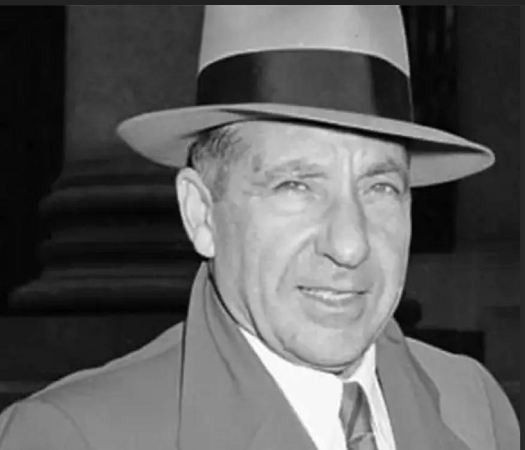
And at the center of that evolution—often overlooked in favor of louder names—stood a man who understood power better than most: Frank Costello.
The End of Chaos, The Beginning of Control
The American Mafia nearly destroyed itself during the Castellammarese War, a brutal struggle that exposed the weakness of tradition without structure. Old-world bosses clung to rigid hierarchies, personal loyalties, and vendettas that bled into open warfare.
Then came Charles “Lucky” Luciano—a man who saw the inefficiency in all that bloodshed. Luciano didn’t just win the war. He rewrote the rules that caused it.
He created the Commission, a governing body meant to regulate disputes, distribute power, and ensure that no single family could drag the others into chaos again. It was a system designed for balance.
But balance, in the hands of the right strategist, can be shaped.
And when Luciano was sent to prison in 1936, the question wasn’t whether his system would survive.
It was who would learn to control it best.
The Prime Minister of the Underworld
That answer, for nearly two decades, was Frank Costello.
Costello didn’t look like a traditional mob boss. He wasn’t a street enforcer. He wasn’t known for brutality. He rarely needed to raise his voice, let alone a gun. But what he possessed was far more valuable—political intelligence and a deep understanding of how power actually worked in America.
While others built their strength through rackets and violence, Costello built his through connections.
Judges, politicians, law enforcement, business leaders—he cultivated them all. He didn’t just bribe them; he made himself useful to them. Information flowed through him. Favors passed through him. Influence concentrated around him.
He became known, not without reason, as the “Prime Minister” of the Mafia.
And during the late 1930s through the 1950s, he was the true center of gravity within what would become the Genovese family.
Control Without Declaring It
Costello understood something fundamental: power doesn’t need to be announced to be effective.
While other families chased dominance through visibility, he operated through access. He sat at the table where decisions were made—both within the Mafia and outside of it—and ensured that outcomes aligned with his interests.
The Commission, theoretically a council of equals, became a stage where Costello’s influence quietly shaped results. Disputes were resolved in ways that preserved stability. Ambitious moves were softened or redirected. Conflicts that could have escalated into war were diffused before they ignited.
He didn’t need to outgun the other families.
He needed them to need him.
And they did.
The Return of a Rival
But power built on diplomacy carries a unique vulnerability: it can be mistaken for weakness.
When Vito Genovese returned from Italy after World War II, he brought with him a very different philosophy. Genovese believed in control through dominance, through asserting authority rather than negotiating it.
To him, Costello’s style wasn’t strength. It was hesitation.
What followed wasn’t an immediate war, but a slow tightening of pressure. Alliances shifted. Loyalties were tested. The quiet balance Costello had maintained for years began to strain under Genovese’s ambition.
Still, Costello held on—not through force, but through the very network he had spent decades building.
Until the moment violence finally broke through.
The Shot That Changed Everything
In 1957, a gunman sent by forces aligned with Vito Genovese approached Costello in the lobby of his Manhattan apartment building and pulled the trigger.
The bullet grazed his head.
It should have been a death sentence. Instead, it became a turning point.
Costello survived. And in surviving, he made a decision that defined his legacy.
He stepped back.
Not out of fear, but out of calculation. He understood that the kind of war Genovese was willing to wage would bring heat—law enforcement attention, internal instability, unnecessary risk. Costello had spent his career avoiding exactly that kind of exposure.
So he relinquished formal power, allowing Genovese to take the title.
But titles, in that world, don’t always reflect reality.
Costello remained respected, connected, and influential long after he stepped aside. The system he built didn’t vanish. It lingered, embedded in the relationships and structures that continued to shape the family’s operations.
The Difference Between Force and Control
Genovese would go on to lead the family that would bear his name, but his reign came with consequences. His more aggressive approach drew attention. Law enforcement pressure intensified. The very visibility he embraced became a liability.
In contrast, Costello’s era—stretching from Luciano’s imprisonment through the late 1950s—represented something rarer in organized crime: sustained control without sustained war.
It wasn’t glamorous. It didn’t produce dramatic headlines.
But it worked.
While other families, like the Bonanno crime family, fractured under internal conflict, or navigated cycles of instability, Costello maintained equilibrium. He managed egos, balanced interests, and ensured that the system functioned.
That’s a different kind of strength.
Diplomacy as Domination
What the Genovese family mastered during this period—especially under Costello—was the art of turning diplomacy into a weapon.
Negotiation wasn’t about compromise for its own sake. It was about shaping outcomes in ways that appeared fair while subtly reinforcing their own position.
They understood timing. They understood leverage. They understood that letting another man believe he had won could be more valuable than defeating him outright.
And most importantly, they understood restraint.
Because every war avoided was a business preserved.
Every conflict defused was profit protected.
Every quiet agreement was another thread in a web that grew stronger with time.
The Enduring Lesson
There is always a temptation, in any arena of power, to equate strength with spectacle—to believe that the biggest force, the loudest claim, the most visible assertion of dominance will carry the day.
But history, and the Mafia in particular, tells a more complicated story.
The Genovese family, through men like Charles “Lucky” Luciano, Frank Costello, and even Vito Genovese, demonstrated that real control often comes from something less obvious.
It comes from understanding the system better than anyone else.
From knowing when to push and when to step back.
From recognizing that power is not just about what you can take—but what you can shape without taking.
Costello, more than most, grasped that truth.
He didn’t need to declare himself the strongest.
For nearly twenty years, he didn’t have to.
References
- Raab, Selwyn. Five Families: The Rise, Decline, and Resurgence of America’s Most Powerful Mafia Empires. New York: Thomas Dunne Books, 2005.
- Critchley, David. The Origin of Organized Crime in America: The New York City Mafia, 1891–1931. New York: Routledge, 2009.
- Dash, Mike. The First Family: Terror, Extortion, Revenge, Murder and the Birth of the American Mafia. New York: Random House, 2009.
- Abadinsky, Howard. Organized Crime. 10th ed. Belmont, CA: Wadsworth, 2012.
- United States Senate. Organized Crime in Interstate Commerce (Kefauver Committee Hearings). Washington, D.C.: U.S. Government Printing Office, 1950–1951.
- Federal Bureau of Investigation. “Italian Organized Crime.” FBI.gov.
- The Valachi Papers, by Peter Maas.