Article 1 of “The Big Lies of the Mafia: Stories They Wanted You to Believe” series
The courtroom was never just a room.
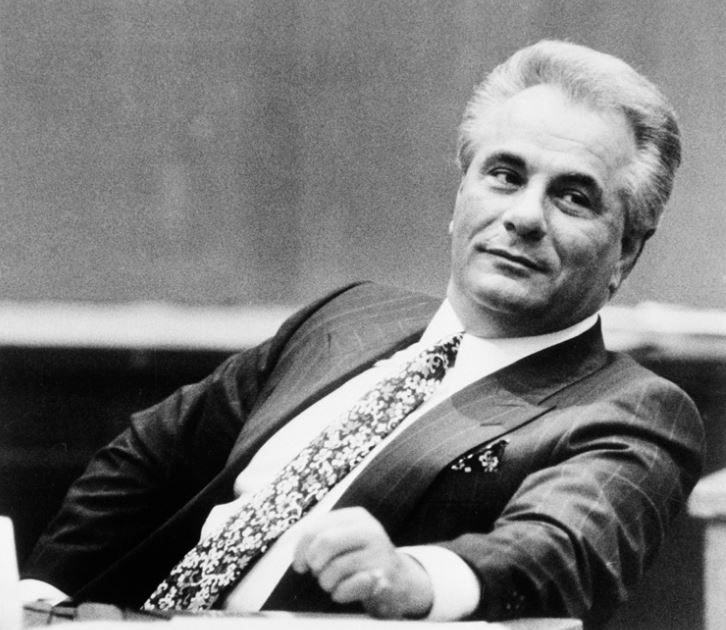
It was a stage dressed up as justice—polished mahogany catching the light, flags standing like silent witnesses, and a judge elevated just enough to suggest authority without ever quite proving it. Every trial follows the same choreography: the careful selection of jurors, the ritual of opening statements, the illusion that what happens inside those four walls is insulated from everything beyond them. But when John Gotti took his seat at the defense table, the performance took on a different tone. He didn’t look like a man fighting for his freedom. He looked like a man already familiar with the ending.
Outside, the cameras flashed relentlessly, feeding a public appetite that blurred the line between crime and celebrity. Reporters spoke of him with a strange mix of fascination and disbelief, as if they were covering not a criminal defendant but a figure who had somehow gamed the system into submission. They called him The Teflon Don, a nickname that stuck because nothing else seemed to. Charges came and went, cases collapsed, and juries returned verdicts that reinforced a growing narrative: that Gotti was untouchable, not because he was powerful, but because he was innocent—or at least innocent enough that the government couldn’t prove otherwise.
That narrative, repeated often enough, hardened into something resembling truth.
The Illusion of the Clean Acquittal
In theory, an acquittal is the purest expression of justice—a declaration that the state has failed to meet its burden, that doubt remains where certainty is required. In practice, especially in the world Gotti inhabited, it can be something far murkier. His early courtroom victories were presented as failures of prosecution, examples of overreach by a government desperate to bring down a high-profile figure. But beneath that surface, the mechanics of those outcomes told a different story, one that had little to do with innocence and everything to do with influence.
Jurors are meant to be neutral, insulated from outside pressure, guided only by evidence presented in court. That’s the theory. In reality, jurors are people—people with families, routines, vulnerabilities, and fears that do not disappear simply because they’ve been sworn in. Gotti’s organization understood this with a clarity that prosecutors struggled to counter. It didn’t require overt threats delivered in dark alleys; often, the suggestion of exposure, the implication that someone was paying attention, was enough to tilt the balance. A single compromised juror could introduce doubt into deliberations, could slow momentum, could shift the tone just enough that a guilty verdict became unreachable.
And so, verdicts that appeared clean on paper carried the fingerprints of something else entirely.
A System Built on Assumptions
The American legal system rests on a fragile set of assumptions—that witnesses will testify truthfully without fear, that jurors will deliberate without outside influence, and that evidence will be evaluated in a vacuum untouched by intimidation or corruption. Organized crime, by its very nature, exists to exploit those assumptions, to find the seams and apply pressure until the structure bends.
For prosecutors pursuing Gotti, the problem was never simply building a case; it was maintaining the integrity of that case from indictment to verdict. Witnesses who initially cooperated would grow hesitant, their confidence eroded by the realization that cooperation came with consequences that extended far beyond the courtroom. Some recanted. Others suddenly remembered less. A few disappeared from the narrative altogether, their absence as telling as any testimony they might have given.
This wasn’t coincidence. It was design.
The code often romanticized as Omertà was less about honor than it was about control, a system that ensured silence through a combination of loyalty, fear, and the understanding that breaking it carried a price few were willing to pay. In that environment, the truth didn’t just struggle to emerge—it was actively suppressed, buried under layers of pressure that never appeared in official transcripts.
The Making of a Myth
As the acquittals mounted, something else began to take shape—not just a legal pattern, but a cultural one. Gotti’s image evolved from defendant to icon, from accused criminal to a symbol of defiance against a system many already distrusted. He dressed the part, moving through public spaces with a confidence that suggested control rather than vulnerability, turning courthouse steps into something resembling a runway. The media, knowingly or not, amplified this transformation, framing each legal victory as evidence of a man who couldn’t be pinned down.
Myths don’t require accuracy; they require repetition.
The more often the story was told—that prosecutors couldn’t make anything stick, that Gotti was somehow beating the odds—the more it settled into public consciousness. It became easier to believe that the system was failing than to consider that it was being manipulated, easier to accept the spectacle than to examine the machinery behind it. In that sense, the myth served a purpose. It distracted from the underlying reality, redirecting attention away from the uncomfortable question of how these outcomes were being achieved.
When Cases Collapse
One of the most revealing moments came during the mid-1980s, when a major racketeering case against Gotti unraveled in a way that, at the time, seemed almost inexplicable. On the surface, it was another prosecutorial failure, another instance of insufficient evidence and reasonable doubt. But later revelations painted a far more troubling picture, one in which at least one juror had been influenced in a manner that compromised the entire process.
It didn’t take a sweeping conspiracy to alter the outcome. It took access, timing, and a willingness to exploit the system’s blind spots. A single voice in the jury room, leaning just enough in the right direction, could shift the dynamics of deliberation, introducing hesitation where there might otherwise have been consensus. Doubt, once seeded, has a way of spreading, particularly in an environment where certainty is already difficult to achieve.
The verdict, when it came, was legally sound.
But legality and legitimacy are not always the same thing.
Changing the Rules Without Changing the Law
By the late 1980s, it had become clear that conventional strategies were not enough. The government wasn’t just losing cases; it was losing control of the narrative, watching as each acquittal reinforced the image of a man beyond the reach of justice. What followed was not a change in the law, but a shift in approach, driven in large part by figures like Rudolph Giuliani, who recognized that relying on vulnerable witnesses in a climate of intimidation was a losing proposition.
The solution was to build a case that didn’t depend on memory, courage, or willingness to testify, but on something far less negotiable: recorded reality. Surveillance operations expanded, and with them came a new kind of evidence—conversations captured without performance, without the filtering effect of a courtroom. In places like the Ravenite Social Club, microphones picked up the unguarded voice of Gotti, revealing a version of the man that stood in stark contrast to his public persona.
Here, there was no jury to impress, no cameras to play to—only the raw mechanics of power, laid bare in words that could not be retracted.
The Insider Who Confirmed Everything
Even with recordings, there remained a gap—context, interpretation, the connective tissue that turns fragments into a coherent narrative. That gap was filled by Sammy Gravano, whose decision to cooperate marked a turning point not just in the case against Gotti, but in the broader fight against organized crime.
Gravano’s significance wasn’t merely in what he said, but in where he stood within the organization. As underboss, he operated at a level where decisions were made, where strategy and execution intersected. His testimony provided a framework through which the recordings could be understood, aligning words with actions, intentions with outcomes. It was, in many ways, the missing piece—a perspective from within that validated what the government had been building.
For the first time, the jury wasn’t being asked to infer.
They were being shown.
The Verdict That Couldn’t Be Bent
When the 1992 trial concluded, the outcome felt less like a dramatic reversal and more like the resolution of a long-delayed process. The same courtroom setting, the same procedural rituals, but a fundamentally different foundation—one that had been constructed carefully enough to withstand the pressures that had undone previous cases.
The guilty verdicts, delivered across multiple counts, including murder and racketeering, marked the end of Gotti’s reign as a free man. The sentence—life without the possibility of parole—was definitive, leaving no room for the kind of ambiguity that had characterized earlier outcomes. For once, the system had held, not because it had changed its principles, but because it had adapted its methods.
And in doing so, it exposed the illusion that had sustained Gotti for so long.
The Persistence of a Lie
Yet even after the conviction, the narrative of innocence did not disappear. For some, it evolved, shifting from the idea that Gotti was unjustly accused to the belief that he had finally been brought down by a system unwilling to tolerate further losses. It’s a subtle distinction, but an important one, because it preserves the core of the myth—the notion that earlier acquittals were legitimate reflections of innocence rather than products of a compromised process.
This is the nature of a well-constructed lie. It doesn’t collapse under the weight of contradictory evidence; it adapts, reshapes itself, and continues to offer a version of events that feels plausible enough to accept. In Gotti’s case, the lie was never just about whether he committed the crimes he was accused of. It was about how those accusations were resolved, about the belief that the courtroom functioned as an isolated arena where truth inevitably prevailed.
The reality is less comforting.
What the Trials Really Revealed
The story of John Gotti is not one of wrongful persecution, nor is it simply a tale of a criminal eventually brought to justice. It is, instead, a case study in how systems can be manipulated without being overtly broken, how outcomes can be shaped long before they are formally decided. The trials that ended in acquittal were not evidence of innocence; they were evidence of interference, of pressures applied in ways that left little trace but had profound effects.
What 1992 demonstrated was not a sudden emergence of truth, but the culmination of a strategy that finally accounted for those pressures, that built a case resilient enough to survive them. It wasn’t that the system had failed before and succeeded later; it was that it had been outmatched, and then, eventually, it wasn’t.
Final Pour
The legend of the Teflon Don endures because it speaks to something people want to believe—that a single man can outmaneuver an entire system, that charisma and confidence can substitute for innocence, that the spectacle of repeated acquittals must mean something more than coincidence.
But beneath that legend lies a far less romantic reality, one in which justice was delayed not by lack of evidence, but by the presence of influence, by a network capable of bending outcomes without ever appearing in the official record. Gotti didn’t walk free because he was innocent. He walked free because, for a time, the system allowed itself to be shaped by forces it couldn’t fully control.
And when it finally adapted—when it closed those gaps and removed those pressures—the result wasn’t surprising.
It was overdue.
References
- Federal Bureau of Investigation – Investigative summaries on the Gambino crime family and John Gotti
- United States Department of Justice – United States v. John Gotti (1992) trial records and RICO case materials
- Capeci, Jerry. The Complete Idiot’s Guide to the Mafia (2002)
- Raab, Selwyn. Five Families: The Rise, Decline, and Resurgence of America’s Most Powerful Mafia Empires (2005)
- Maas, Peter. Underboss: Sammy the Bull Gravano’s Story of Life in the Mafia (1997)
- Jacobs, James B. Mobsters, Unions, and Feds: The Mafia and the American Labor Movement (2006)
- New York Times Archives (1980s–1992 coverage of John Gotti trials and conviction)
All Five articles of “The Big Lies of the Mafia: Stories They Wanted You to Believe” series
1. “John Gotti Was Innocent” — The Teflon Illusion
2. “The Mafia Doesn’t Exist” — The Code of Denial
3. “Omertà Is About Honor” — The Silence That Protected Predators
4. “Al Capone Was Just a Bootlegger” — The Tax Evasion Smokescreen