4rd article in the “No, the Boss Ain’t Ill” series
In the Mafia, absence is louder than words. A boss who fades into the shadows invites speculation. A boss who vanishes invites rebellion. And a boss who disappears under the pretext of strategy—or sickness—invites chaos.
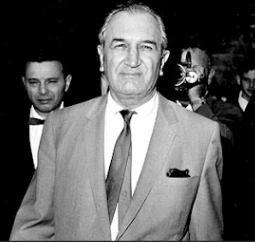
Joseph Bonanno, known as “Joe Bananas,” learned this lesson the hard way. By the early 1960s, Bonanno’s health was deteriorating. Heart problems, stress-induced fatigue, and years of relentless paranoia began to take their toll. Yet he refused to relinquish control. Instead, he disappeared—not from the radar of rivals and the press, but from the streets, from public meetings, from the very people who relied on him for direction.
What followed was a masterclass in secrecy, misdirection, and the lethal consequences of concealed weakness. In Bonanno’s world, illness was both shield and trap, and those closest to him had to navigate a tightrope between loyalty and survival.
Illness Equals Vulnerability
Mafia culture treats weakness as contagion. A sick boss invites doubt. Doubt invites ambition. Ambition invites violence.
For decades, Bonanno had ruled his family with ruthless efficiency. Yet when his body began to fail, he faced a paradox: appearing weak risked immediate revolt; appearing strong risked collapse under the strain.
By the late 1950s, Bonanno had survived assassination plots, rival factions, and intense scrutiny from law enforcement. His mind was sharp, his instincts lethal, but his body began to falter. Heart issues and the effects of stress compounded his physical limitations. In Mafia terms, he was a ticking clock—and the clock was invisible to almost everyone.
The Vanishing Act
Bonanno’s response was audacious. He disappeared.
In 1964, during the height of what would become known as the “Banana War,” he left New York under mysterious circumstances. Some say he fled the city to avoid assassination; others claim he sought medical treatment abroad. Whatever the reason, the absence was interpreted in multiple ways: strategy, weakness, or betrayal.
Behind the scenes, Bonanno’s loyalists managed the family. They maintained communications, relayed orders, and suppressed rumors of his illness. Soldiers and captains were instructed that the boss was merely “taking time to plan,” never ill. The lie was simple but powerful: as long as Bonanno’s hand guided the family, the myth of control remained intact.
The result was a paradoxical balance: the Don was absent but still omnipotent.
Underlings as Stewards of Secrecy
The men closest to Bonanno became both protectors and governors. They controlled access, filtered information, and interpreted his commands. They ensured the illusion of authority remained intact.
This concentration of power carried a dual advantage. First, it shielded Bonanno from exposure, keeping rivals from exploiting his weakness. Second, it empowered his intermediaries. They became the unseen hands that ran day-to-day operations, effectively acting as surrogate bosses while claiming to operate under Bonanno’s instructions.
Illness, in this way, became a currency. It was traded quietly, shaping influence and alliances without a single gunshot fired. The more Bonanno’s condition was concealed, the more the intermediaries flourished. But the lie also planted seeds of instability, as competing factions began to interpret absence and secrecy as opportunity.
The Banana War
The concealment of Bonanno’s illness did not prevent internal conflict—it arguably fueled it. While he was away, factions within the family maneuvered for influence. Leaders loyal to Bonanno clashed with captains hungry for autonomy.
The conflict escalated into what historians call the “Banana War,” a bitter internal struggle marked by attempted assassinations, disappearances, and covert negotiations. Bonanno’s absence amplified uncertainty. His intermediaries could maintain the illusion of stability, but the streets did not obey myths—they obeyed power.
In the Mafia, perception can be manipulated, but fear cannot be faked indefinitely. Bonanno’s secret illness became a silent accelerant to the civil war within his family.
Return and Reinvention
Bonanno eventually resurfaced, but the world he returned to was not the one he had left. The illusion of control had fractured. Allies had shifted, rivals had entrenched themselves, and the family was weaker for it.
Even in later years, Bonanno’s health problems persisted. He remained cautious, orchestrating operations from behind a curtain of secrecy. The lesson was clear: conceal illness to maintain authority, but the longer the deception continues, the harder it is to retain loyalty and coherence.
Lessons from Joe Bananas
Joseph Bonanno’s story illuminates the paradox of illness in Mafia culture. Concealing frailty can preserve power, delay succession disputes, and protect the family from immediate collapse. But secrecy is a double-edged sword.
Underlings benefit from a boss’s hidden illness—they gain influence, autonomy, and operational control. Yet the same concealment breeds speculation, paranoia, and, ultimately, internal conflict. For Bonanno, secrecy was both armor and tinder: it protected him from rivals but ignited civil war within his own ranks.
The Don’s experience underscores a harsh truth: in the Mafia, no illusion lasts forever. Absence and secrecy may delay the inevitable, but they cannot prevent it. Power without presence is a fragile thing, and illness—even when hidden—reshapes the balance of loyalty, fear, and authority.
The Final Reflection
Illness in the Mafia is more than a medical condition—it is a weapon, a mask, and a test. Joseph “Joe Bananas” Bonanno mastered concealment, using his underlings to maintain the illusion of control even as his body betrayed him.
Yet his story also serves as a warning: concealment can stabilize, but it can also destabilize. Power is maintained not just by reputation or fear, but by visibility. A boss who disappears—ill or otherwise—must trust that those around him will preserve the myth without exploiting it. Bonanno’s life shows that even a legend can be undone by absence and the subtle calculus of ambition.
In the end, Joe Bananas vanished, returned, and faded again—not because he lacked cunning, but because illness, secrecy, and the perception of weakness intersected to create both protection and peril. His tale is a study in the dark arithmetic of Mafia power, where invisibility is both a shield and a trap, and survival depends on how skillfully the body’s betrayal can be hidden from the eyes of the ambitious.
References
- Bonanno, Joseph. A Man of Honor: The Autobiography of Joseph Bonanno. St. Martin’s Press, 1983.
- Raab, Selwyn. Five Families: The Rise, Decline, and Resurgence of America’s Most Powerful Mafia Empires. W.W. Norton & Company, 2005.
- Davis, John H. Mafia Dynasty: The Rise and Fall of the Gambino Crime Family. HarperCollins, 1993.
- Capeci, Jerry. The Complete Idiot’s Guide to the Mafia. Alpha Books, 2005.
- Federal Bureau of Investigation. Joseph Bonanno Files (FOIA-released summaries).
- Jacobs, James B. The Mafia and the Machine: The Story of the Kansas City Mob. University of Illinois Press, 2000.
Links to all of the “No, The Boss Ain’t Ill” Series
1 Carlo Gambino: The Invisible Boss
2. Vito Genovese Power Through Denial
3. Paul Castellano: The Sick Boss Nobody Wanted to Admit
4 Joseph “Joe Bananas” Bonanno: The Disappearing Don
5 Vincent “Chin” Gigante: The Oddfather Who Weaponized Weakness