
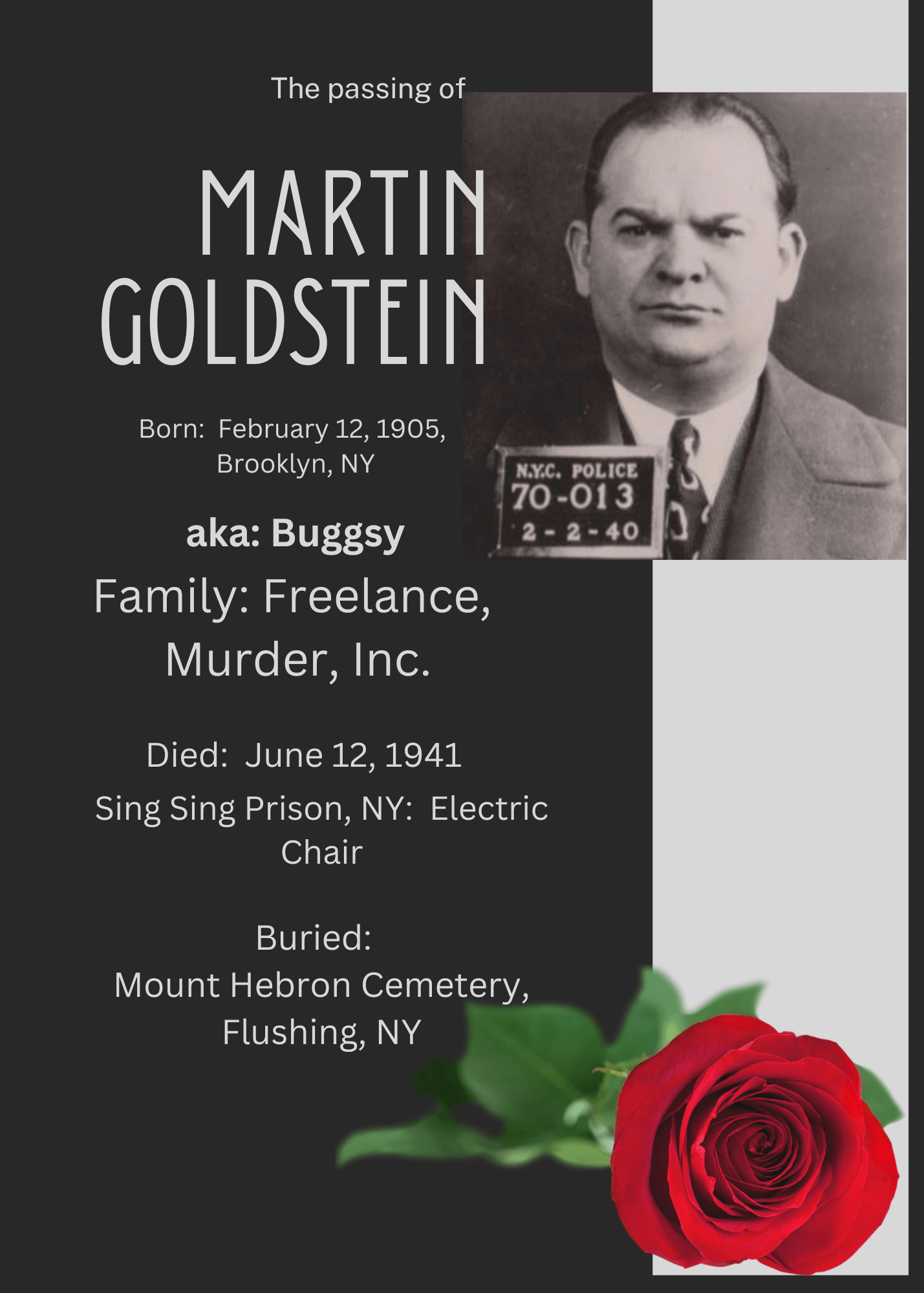
Martin “Buggsy” Goldstein: The Quiet Killer of Murder, Inc.
The most dangerous gangsters are not always the loudest men in the room. Some command attention with flashy suits, expensive cars, and headlines splashed across the front pages of newspapers. Others prefer the shadows, allowing their reputations to travel ahead of them while they remain almost invisible.
Martin “Buggsy” Goldstein belonged firmly to the second category.
He was not a celebrity gangster like Bugsy Siegel. He did not command a crime family like Lucky Luciano. He never became a household name. Yet for nearly a decade, Goldstein served as one of the most trusted killers connected to Murder, Inc., the feared enforcement arm of the National Crime Syndicate. When mob bosses needed a witness silenced, a rival eliminated, or a problem permanently removed, men like Goldstein were often called upon to do the work.
His story is a reminder that organized crime was built not only by powerful bosses but also by disciplined soldiers willing to carry out orders without hesitation. Goldstein rarely sought recognition. He simply performed his role with an efficiency that eventually made him one of the most feared men in the underworld.
That same efficiency would ultimately send him to the electric chair.
Brooklyn’s Streets and the Road to Crime
Martin Goldstein was born in Brooklyn in 1905, during a period when New York City’s immigrant neighborhoods were rapidly becoming fertile ground for organized crime. Poverty, overcrowding, and limited economic opportunities created an environment where criminal organizations often appeared to offer a faster path to success than legitimate employment.
The streets taught harsh lessons. Young men learned early that power came from money, connections, and the willingness to use violence when necessary. Gambling parlors operated openly. Protection rackets flourished. Labor disputes frequently turned bloody. Criminal organizations became woven into the fabric of everyday life.
Goldstein drifted naturally into that world. Unlike many gangsters who cultivated oversized personalities, he developed a reputation for restraint. He spoke less than others, attracted little attention, and preferred to remain in the background. Those qualities made him valuable. In organized crime, the men who attract headlines often become liabilities. The men who remain unnoticed frequently survive longer.
At least for a while.
The Rise of Murder, Inc.
By the 1930s, organized crime in America was evolving. The old neighborhood gangs were increasingly being absorbed into larger criminal enterprises that stretched across state lines. Powerful figures sought ways to enforce discipline and settle disputes without exposing themselves directly to risk.
Out of that environment emerged Murder, Inc., a loosely organized group of professional killers linked to the National Crime Syndicate. Prosecutors later described it as an enforcement division that carried out contract murders on behalf of organized crime leaders throughout the country. The organization allegedly answered to powerful underworld figures such as Louis “Lepke” Buchalter and Albert Anastasia, men who understood that fear was often more effective than persuasion.
Goldstein became one of the organization’s most trusted operators.
His calm demeanor and reliability made him particularly useful. While some gangsters acted impulsively, Goldstein was known for carrying out assignments methodically. He treated violence as a job rather than an emotional act. That professional detachment allowed him to function in an environment where hesitation could be fatal.
A Reputation Built on Silence
Witnesses who encountered Goldstein often described a man who looked more like a businessman than a killer. He dressed well, spoke politely, and projected an image of quiet confidence that rarely attracted suspicion. That image concealed a far darker reality.
According to prosecutors and later testimony, Goldstein participated in numerous murders connected to organized crime interests. Rivals disappeared. Witnesses vanished. Informants were silenced before they could testify. The killings were not random acts of violence but calculated efforts to protect criminal enterprises worth millions of dollars.
The public often imagines gangland murder as chaotic and emotional. Murder, Inc. operated differently. Its members viewed violence as a service provided to clients. A problem emerged, an order was issued, and a solution followed.
Goldstein excelled in that environment because he understood the importance of discipline. He was not interested in fame or status. He was interested in completing assignments and maintaining the trust of the men above him.
Loyalty to Lepke Buchalter
Among the most influential figures in Goldstein’s life was Louis “Lepke” Buchalter, one of the most powerful labor racketeers in America and a central figure in the Murder, Inc. organization.
Buchalter relied heavily on trusted associates who could handle sensitive matters without creating unnecessary attention. Goldstein quickly became one of those men. The relationship benefited both sides. Buchalter gained a dependable operative, while Goldstein gained protection, status, and access to lucrative criminal opportunities.
Within organized crime, loyalty often matters more than talent. Many gangsters possess the ability to intimidate or kill. Far fewer demonstrate the discipline necessary to follow orders consistently without allowing personal ambition to interfere.
Goldstein’s loyalty helped him rise through the ranks of Murder, Inc., but it also tied his fate to an organization that was becoming increasingly vulnerable to law enforcement scrutiny.
The Murder of Joseph Rosen
One of the most significant cases connected to Goldstein involved the murder of Joseph Rosen, a Brooklyn candy store owner whose name would later become central to the government’s efforts against Murder, Inc.
Prosecutors alleged that Rosen possessed information capable of damaging important criminal operations. In the underworld, even the possibility that someone might cooperate with authorities could be enough to trigger a death sentence. Organized crime depended on silence, and anyone threatening that silence became a target.
The Rosen murder initially appeared destined to remain unsolved, joining the long list of gangland killings that disappeared into the fog of fear and intimidation. Witnesses remained silent, evidence was limited, and few people were willing to challenge the criminal organizations involved.
Then everything changed.
Abe Reles Breaks the Code
The downfall of Murder, Inc. began when Abe Reles decided to cooperate with authorities.
Reles possessed intimate knowledge of the organization’s operations, personnel, and methods. Once he began talking, investigators gained access to information they had spent years trying to uncover. Murders that once seemed impossible to solve suddenly had witnesses. Names emerged. Conspiracies became visible.
Goldstein’s role within the organization was exposed through testimony that painted a devastating picture of organized, systematic violence. The revelations shocked the public and generated headlines across the country. Americans who had previously viewed organized crime as a collection of independent gangs were confronted with evidence of a sophisticated network capable of carrying out murders on a national scale.
For Goldstein, the walls were closing in.
Trial, Conviction, and Execution
The prosecutions that followed marked one of the most significant victories law enforcement had ever achieved against organized crime. Goldstein faced charges connected to the Rosen murder and other criminal conspiracies tied to Murder, Inc.
The testimony against him proved overwhelming. Witnesses described how murders were planned, approved, and executed. Jurors heard details about a criminal enterprise that treated human beings as obstacles to be removed whenever they threatened profits or power.
Goldstein denied wrongdoing, but the jury was unconvinced. His conviction sealed his fate.
On March 4, 1941, Martin “Buggsy” Goldstein was executed in the electric chair at Sing Sing Prison. He was thirty-five years old. The execution represented another major blow to Murder, Inc. and demonstrated that even the most feared underworld figures could be brought down when insiders abandoned the code of silence.
The Legacy of Martin “Buggsy” Goldstein
Martin Goldstein never achieved the fame of the gangsters whose names still dominate books and films. He left behind no empire, no family dynasty, and no public persona capable of capturing the imagination of future generations.
What he left behind was something far darker.
Goldstein represented the machinery of organized crime at its most efficient. He was the dependable employee who helped transform violence into a business process. While powerful bosses made decisions from smoke-filled offices, men like Goldstein carried those decisions into the streets and ensured they were enforced.
His story strips away much of the mythology surrounding organized crime. There is no glamour in it. No romance. No grand vision of power or success. There is only a man who became exceptionally skilled at serving an organization built on fear and murder.
In noir terms, Martin “Buggsy” Goldstein was the quiet figure sitting in the corner of the nightclub while everyone else watched the performers. He rarely spoke, never sought attention, and seemed almost forgettable. The people who understood the underworld knew better. They recognized that the most dangerous man in the room was often the one nobody noticed until it was too late.
Buried at:
| Mount Hebron Cemetery (Flushing, NY) |