Louis “Little New York” Campagna: Chicago’s Quiet Executioner
Louis Campagna never needed headlines. That was one of the reasons he lasted so long.
While louder gangsters turned themselves into newspaper legends through gun battles, flashy suits, and public bravado, Campagna operated differently. He preferred quiet restaurants, union offices, backroom meetings, and whispered conversations where power moved invisibly beneath ordinary life. He projected calm discipline instead of theatrical menace.
But beneath that restraint stood one of the most influential and feared figures connected to the Chicago Outfit.
For decades, Louis “Little New York” Campagna helped enforce and expand organized crime operations across Chicago during the Outfit’s most powerful years. He moved through labor racketeering, extortion, gambling, political corruption, and murder conspiracies with the cold professionalism of a man who understood that the modern underworld depended less on chaos than organization.
Campagna represented the Mafia after it matured. Less street gang. More shadow government. And that evolution made men like him extremely dangerous.
From Brooklyn to Chicago
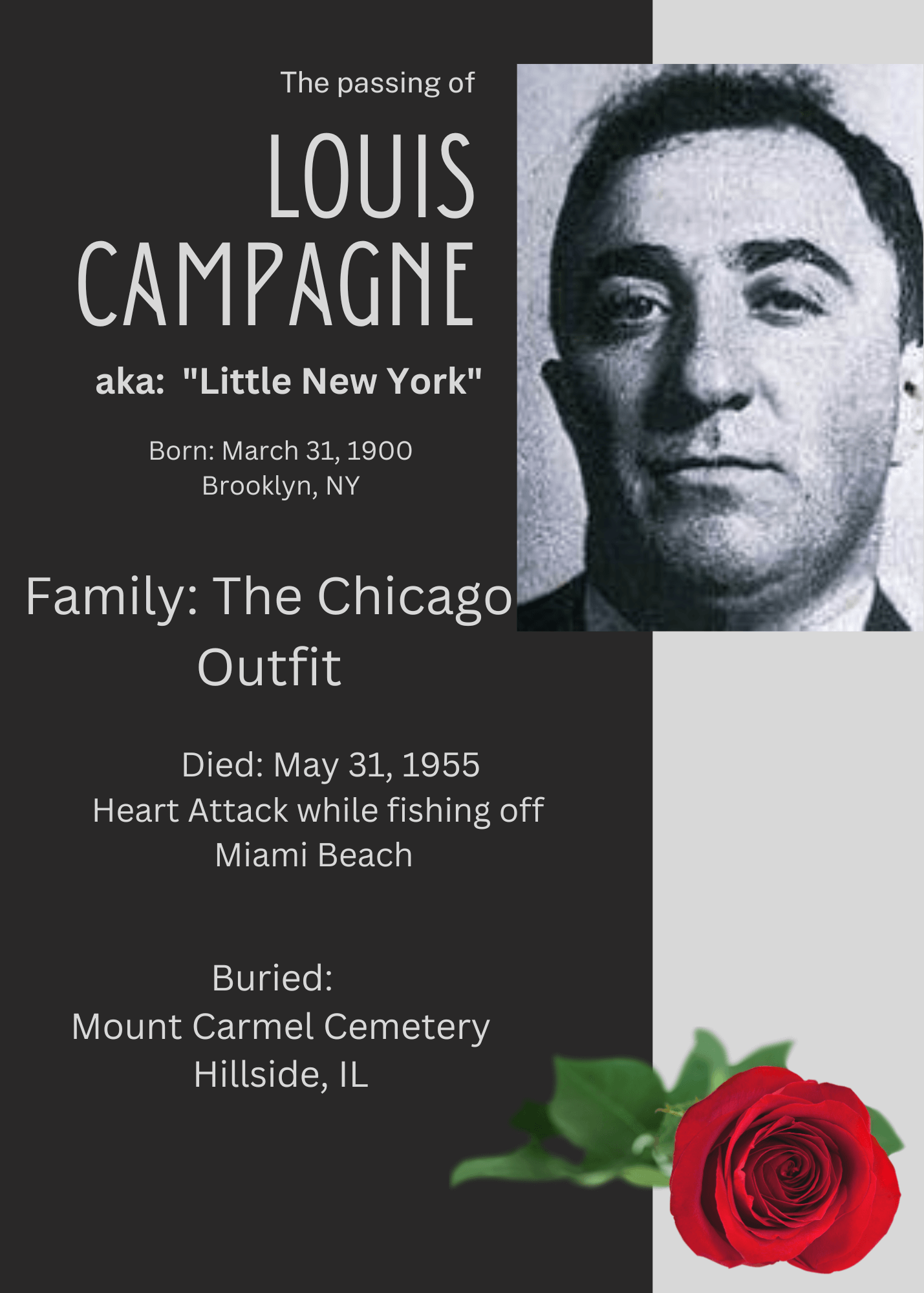
Louis Campagna was born in Brooklyn in 1896 to Italian immigrant parents before eventually relocating to Chicago.
His nickname—“Little New York”—came partly from those eastern roots and partly from the perception that he carried New York-style underworld sophistication into Chicago’s criminal environment. Chicago during the early twentieth century was rapidly transforming into one of America’s most corrupt and violent cities, where politics, labor battles, Prohibition profits, and organized crime collided constantly.
The streets rewarded ambitious men quickly.
Campagna entered criminal life early through theft, extortion, gambling, and gang associations tied to emerging Italian organized crime networks. He gradually became connected to the expanding Outfit structure rising beneath powerful figures like Johnny Torrio and later Al Capone.
Unlike impulsive street shooters, Campagna possessed discipline. That quality elevated him.
The Outfit Years
The Chicago Outfit differed from many traditional Mafia organizations.
While New York families often remained deeply tied to Sicilian hierarchy and ritual, the Outfit evolved more aggressively into a diversified criminal corporation built around gambling, labor control, extortion, political influence, and large-scale business infiltration.
Campagna thrived inside that environment.
By the Prohibition era, he had become an important Outfit figure involved in enforcement operations, labor racketeering, and organizational management. Federal investigators and journalists increasingly connected him to high-level criminal activity throughout Chicago.
He developed a reputation for reliability.
In organized crime, reliability matters more than charisma. Bosses need men who follow instructions quietly and efficiently without creating unnecessary attention. Campagna became exactly that type of operator.
Al Capone’s Chicago
During the 1920s and early 1930s, Chicago became synonymous with organized crime violence.
Machine guns. Bootlegging wars. Corrupt politicians. Bombings. Police bribery.
Gangsters moved openly through nightclubs and restaurants while newspapers transformed criminals into national celebrities. Capone dominated headlines, but behind the spectacle stood disciplined administrators and enforcers maintaining the Outfit’s enormous criminal infrastructure.
Campagna operated within that machinery.
Unlike Capone, he avoided publicity obsessively. He preferred influence without fame. While celebrities and reporters crowded around Capone, Campagna worked more quietly through labor unions, extortion systems, and internal organizational enforcement.
He understood something crucial: The men behind the curtain often survive longer than the men on stage.
Labor Racketeering and Invisible Power
Campagna became especially influential in labor racketeering operations.
Mid-century organized crime recognized unions as extraordinary sources of money and leverage. Control labor leadership, and criminals could manipulate industries, construction projects, transportation systems, and business contracts across entire cities.
Chicago’s labor environment proved ideal for infiltration.
Campagna reportedly exercised influence through unions connected to trucking, service industries, and commercial operations where organized crime extracted profits through extortion, kickbacks, and intimidation.
This was organized crime evolving into infrastructure.
The violence remained real.
But now it operated beneath contracts, negotiations, and political relationships rather than constant public gunfire.
Campagna excelled in that quieter world.
Murder, Inc. and National Syndicate Connections
Federal authorities eventually linked Campagna to broader national organized crime operations connected to Murder, Inc. and syndicate-level enforcement activities.
The national syndicate increasingly relied on cooperation between major criminal organizations in cities like New York, Chicago, Cleveland, and Detroit. Gambling profits, labor corruption, narcotics trafficking, and enforcement systems crossed state lines regularly.
Campagna reportedly maintained relationships with influential underworld figures beyond Chicago, helping coordinate operations tied to the Outfit’s expanding national interests.
His name surfaced repeatedly during federal organized crime investigations throughout the 1940s. Especially during one explosive case.
The Hollywood Extortion Case
One of Campagna’s most famous legal troubles involved the Hollywood extortion investigations of the 1940s.
Federal prosecutors accused Chicago Outfit figures of using labor unions to extort movie studios through threats of strikes and production disruption. The case exposed the growing intersection between organized crime, entertainment industries, and union power in America.
Campagna became one of the defendants.
The allegations painted a disturbing picture of organized crime manipulating Hollywood itself through labor intimidation and corruption. The mob no longer merely operated gambling dens and bootlegging routes.
It had infiltrated legitimate national industries.
Campagna’s conviction demonstrated that federal authorities increasingly understood how organized crime actually functioned—not merely as isolated gang violence but as economic infiltration. That realization changed law enforcement strategy permanently.
Prison and Survival
Campagna served prison time following federal convictions connected to extortion and racketeering conspiracies.
Yet unlike many gangsters destroyed completely by incarceration, he retained substantial underworld respect and influence afterward. His reputation for discipline, silence, and organizational loyalty protected him within criminal circles.
He was not flashy enough to become a media obsession. Not reckless enough to provoke constant warfare. And not weak enough to be ignored.
Those qualities allowed him to survive while many contemporaries vanished through assassination, betrayal, or legal collapse.
The Outfit’s Silent Generation
Campagna belonged to an important generation of organized crime figures often overshadowed by more famous personalities. Men like Capone captured public imagination.
But men like Campagna kept the criminal systems functioning. They managed labor influence. They enforced discipline. They maintained relationships. They stabilized profits.
Without quiet administrators and disciplined enforcers, organized crime empires collapse into chaos quickly.
Campagna understood structure better than spectacle. That made him valuable for decades.
Death and Legacy
Louis Campagna died in 1955.
By then, the underworld itself had changed dramatically from the chaotic Prohibition battles of his youth. Organized crime increasingly operated through hidden financial systems, union corruption, casinos, business infiltration, and political influence rather than constant public violence.
Campagna helped build that transition.
The Legacy of Louis “Little New York” Campagna
Louis Campagna represented organized crime after it learned patience.
He lacked the mythic celebrity of Al Capone or the cinematic glamour later associated with figures like Bugsy Siegel. Instead, Campagna embodied something colder:
The professionalization of the American underworld.
He understood that true criminal power often hides inside ordinary institutions—labor unions, contracts, negotiations, restaurants, political offices, and boardrooms where violence becomes implied rather than visible.
Quiet men like Campagna helped transform organized crime from street warfare into embedded corruption woven through American business and politics.
That transformation lasted far longer than Tommy guns and bootlegging headlines.
In noir terms, Louis Campagna was the calm man at the end of the table saying very little while everyone else in the room understood exactly who held the real power.
Buried at:
| Mount Carmel Cemetery (Hillside, IL) |