Joe Valachi: The Man Who Broke Omertà
Joseph Valachi did something the Mafia considered unforgivable.
He talked.
Not in whispers behind closed doors. Not secretly to save himself during a quiet plea negotiation. Valachi shattered omertà publicly, sitting before the United States government and exposing the inner structure of the American Mafia to the entire country.
Before Valachi, many Americans still viewed organized crime as exaggerated mythology—street gangs inflated by newspapers and Hollywood imagination. Politicians often denied the existence of a national Mafia organization entirely. Federal law enforcement agencies struggled to explain how deeply organized crime had embedded itself into gambling, labor unions, narcotics trafficking, and political corruption.
Then Valachi opened his mouth. And suddenly America saw the machinery. The ceremonies. The hierarchy. The rules. The murders. The fear.
Joseph Valachi did not destroy the Mafia. But he changed organized crime history permanently because he became the first major insider to explain how the system actually worked from the inside.
That made him both infamous and doomed.
East Harlem and the Streets of New York
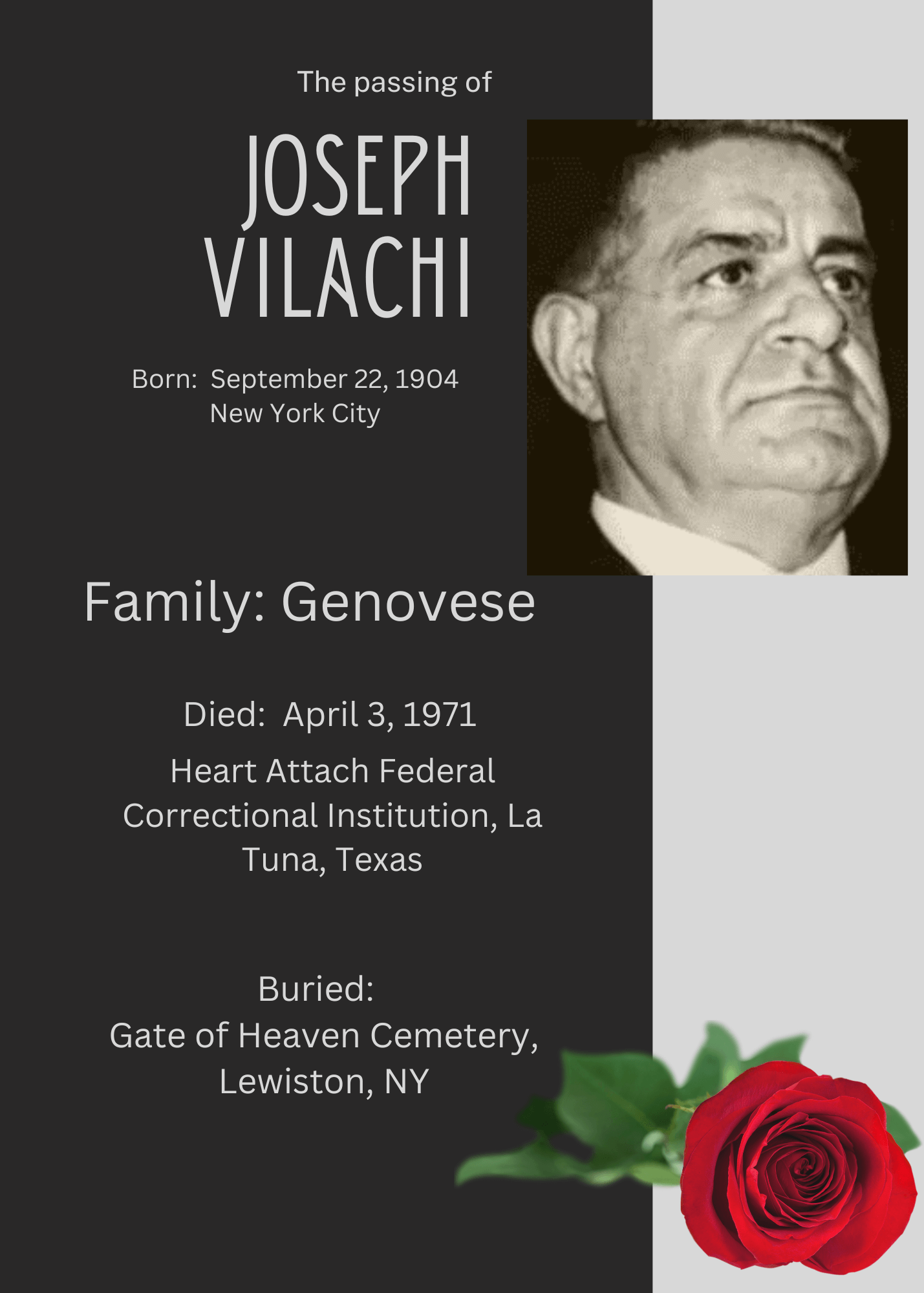
Joseph Valachi was born in 1904 in East Harlem, New York City, inside the crowded immigrant neighborhoods that helped shape early organized crime in America.
Poverty defined much of the environment. So did gangs.
Young men growing up in East Harlem often encountered criminal networks intertwined with gambling operations, theft rings, political corruption, labor racketeering, and protection schemes. Organized crime offered money, belonging, and upward mobility unavailable through legitimate work for many struggling immigrants.
Valachi entered criminal life early through small-time theft and gang activity.
He reportedly joined a burglary crew known as the “Minutemen,” specialists in rapid robberies designed to evade police response times. The work sharpened skills valuable in organized crime: discipline, silence, and loyalty.
Eventually, he moved upward into Mafia circles. That ascent changed everything.
Entering the Mafia
Valachi became associated with the organization that later evolved into the Genovese crime family under powerful figures such as Charles “Lucky” Luciano and Vito Genovese.
For Valachi, joining the Mafia carried enormous significance.
He later described initiation rituals involving blood oaths, burning saints’ cards, and pledges of absolute loyalty. Whether embellished or not, his descriptions profoundly shaped public understanding of Mafia culture for decades afterward.
The Mafia presented itself as brotherhood. Family. Honor. But beneath those rituals stood violence and fear.
Valachi learned that lesson slowly.
Life Inside Organized Crime
For years, Valachi functioned as a relatively low-to-mid-level organized crime figure involved in gambling, extortion, and criminal operations tied to the Genovese organization.
He was not a glamorous boss. Not a celebrity gangster. Not a national underworld architect like Meyer Lansky or Frank Costello. He was something more common and perhaps more revealing:
An ordinary soldier inside the Mafia system.
That perspective later made his testimony so devastating because he described organized crime not as distant mythology but as daily operational reality.
The Mafia was not movie glamour to him. It was routine life governed by paranoia.
Fear of Vito Genovese
Valachi’s downfall began partly through his deteriorating relationship with Vito Genovese.
Genovese inspired fear even among hardened gangsters. Violent, suspicious, and deeply paranoid, Genovese ruled through intimidation and ruthless enforcement of loyalty. By the late 1950s and early 1960s, federal prosecutions increasingly pressured organized crime nationwide.
Valachi eventually landed in prison on narcotics charges. So did Genovese. That proximity became dangerous.
Inside prison, Valachi reportedly became convinced Genovese suspected him of disloyalty or cooperation with authorities. In Mafia culture, suspicion alone could become a death sentence.
Then came the incident that pushed everything over the edge.
Murder in Prison
In 1962, Valachi brutally killed another inmate inside prison with a pipe. He later claimed he believed the man had been sent by Genovese to murder him. Whether true or paranoid fear hardly mattered anymore. Valachi realized he was trapped.
The Mafia wanted silence. The government wanted information. And prison walls offered no protection from organized crime retaliation.
So Valachi made the choice no Mafia member was supposed to make. He became an informant.
Breaking Omertà
Valachi’s cooperation with federal authorities shocked organized crime.
The Mafia’s code of silence—omertà—formed the foundation of its survival. Informants threatened everything because criminal organizations depend on secrecy more than violence.
Then Valachi testified publicly before the United States Senate during televised hearings in 1963.
America watched.
Valachi described the Mafia hierarchy, initiation ceremonies, terminology, organizational structure, and criminal operations in extraordinary detail. He identified leaders, explained internal rules, and confirmed the existence of a national criminal syndicate long denied publicly by many officials.
Most importantly, he used a phrase that became legendary:
“La Cosa Nostra.” Our Thing.
The term entered mainstream American culture permanently afterward.
America Discovers the Mafia
Valachi’s testimony transformed public understanding of organized crime.
Before him, many politicians and even some law enforcement leaders downplayed the Mafia’s national coordination. After him, denial became impossible.
The hearings revealed organized crime as structured enterprise rather than isolated street gangs. Families operated hierarchically. Leadership coordinated nationally. Gambling, labor racketeering, loansharking, narcotics, and political corruption interconnected across state lines.
The government suddenly possessed a roadmap. Future organized crime prosecutions relied heavily on the framework Valachi helped expose.
His testimony influenced everything that followed—from federal investigations to Hollywood depictions of the Mafia.
A Marked Man
Valachi paid heavily for cooperation.
Inside organized crime culture, informing ranked below almost every other sin. Mafia leadership despised him for violating omertà publicly and humiliating the organization before the world.
He entered protective custody while living under constant threat. Yet even outside Mafia circles, many observers viewed him ambiguously. Valachi was not a heroic reformer. He had participated in organized crime himself for decades. He became an informant largely because he feared death.
That complexity made him fascinating. And deeply noir.
Final Years and Death
Valachi spent his remaining years under government protection while his health declined.
Author Peter Maas later chronicled his story in The Valachi Papers, which further cemented Valachi’s place in Mafia history and popular culture.
Joseph Valachi died in prison in 1971. But by then, the silence had already been broken. Permanently.
The Legacy of Joseph Valachi
Joseph Valachi remains one of the most important figures in organized crime history not because he built the Mafia, but because he exposed it.
He forced America to confront the reality that organized crime operated through national systems of hierarchy, secrecy, violence, and economic infiltration far more sophisticated than most people understood previously.
Unlike flamboyant bosses such as Al Capone or disciplined rulers like Carlo Gambino, Valachi represented something more ordinary.
A soldier. A participant. A frightened insider trapped inside machinery larger than himself.
In noir terms, Joseph Valachi was the aging gangster sitting beneath hot Senate hearing lights realizing that once the code of silence breaks, everybody in the room starts looking over their shoulder.