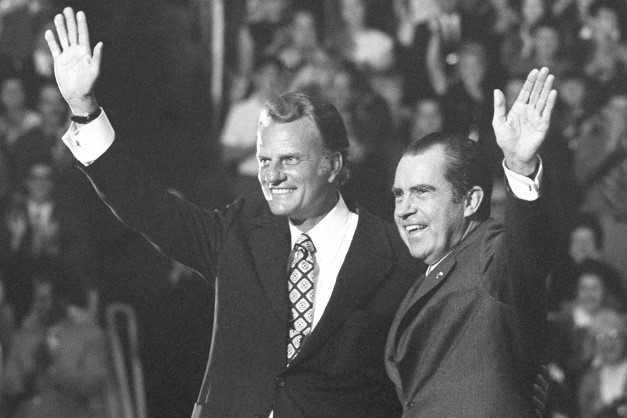
Power doesn’t just corrupt. It flatters. It seduces. It wraps itself in ceremony and access and whispers to anyone within arm’s reach: you matter because you’re here.
For Billy Graham, the most famous preacher of the 20th century, the Oval Office wasn’t just a place—it was a gravitational field. Presidents orbited him, but he orbited them right back. And when Richard Nixon entered that orbit, the collision of faith and power produced something darker than either man likely intended.
Because Nixon didn’t just crave power. He weaponized it. And Graham didn’t just seek influence—he became entangled in it.
The Preacher and the Politician
Graham built an empire on certainty. Stadium revivals, radio broadcasts, a message stripped down to salvation and urgency. He presented himself as above politics, a moral compass in a noisy world. Presidents from Harry S. Truman to Lyndon B. Johnson sought his counsel.
But Nixon was different.
Nixon saw Graham not as a spiritual advisor, but as a strategic asset—a man who could sanctify ambition, who could wrap political calculation in the language of divine purpose. Their relationship wasn’t casual. It was cultivated, deliberate, and mutually beneficial.
Graham got proximity. Nixon got legitimacy.
And in Washington, legitimacy is currency.
The Seduction of Access
There’s a moment that repeats itself throughout history: the outsider gets invited inside. The rebel gets a seat at the table. The preacher gets the private call from the President.
That moment changes people.
Graham, by most accounts, relished his access. He was no longer just preaching to the masses—he was whispering into the ear of the most powerful man in the world. The White House became less of a distant institution and more of a familiar room.
It’s here where the transformation begins—not into something openly corrupt, but something more subtle.
Compromise.
Graham insisted he wasn’t political. Yet his presence beside Nixon blurred lines that should have remained sharp. Public prayers, private conversations, visible alignment—it all fed an image of divine approval hovering over a deeply flawed administration.
Nixon understood optics. He always did.
And Graham, willingly or not, became part of the stagecraft.
Nixon’s World: Power in the Shadows
To understand the dynamic, you have to understand Nixon’s instincts. He didn’t just play politics—he operated in layers, where loyalty was transactional and enemies were everywhere.
This was a man who would later be consumed by the paranoia that fueled Watergate scandal. But long before Watergate broke, Nixon had already built a reputation for operating in the gray.
And the gray is where the underworld thrives.
While Nixon was never a mob boss, his political ecosystem occasionally brushed against figures and methods that wouldn’t feel out of place in organized crime. Campaign financing, backroom deals, shadowy intermediaries—these weren’t aberrations. They were part of the machinery.
Figures like Jimmy Hoffa, with well-documented ties to organized crime, existed within the same overlapping network of influence that defined mid-20th-century American power. Hoffa’s relationship with politics—his leverage, his enemies, his usefulness—mirrored the transactional world Nixon understood so well.
Even Nixon’s rise had benefited from political environments where the lines between legitimate influence and illicit backing weren’t always clean. Organized crime had long recognized the value of political allies—quiet ones, deniable ones, useful ones.
Nixon didn’t need to be “in the Mob” to operate in a world that occasionally echoed its logic.
And that’s the world Graham stepped into.
Faith Meets Realpolitik
The tragedy of Graham’s relationship with Nixon isn’t that he was malicious. It’s that he was human.
He believed in Nixon. Defended him. Trusted him.
That trust would prove costly.
Secret recordings from the Nixon White House—those same tapes that would later detonate the presidency—revealed a side of Nixon that stood in stark contrast to the image presented publicly. Paranoia. Resentment. Prejudice. Ruthless calculation.
And in some of those conversations, Graham himself appeared—not always as a distant observer, but as a participant in discussions that would later shock those who had viewed him as above the fray.
The revelations didn’t just tarnish Nixon. They complicated Graham.
Here was the nation’s most prominent evangelist, caught in the gravitational pull of power, saying things that didn’t align with the moral clarity he preached from the pulpit.
When the tapes became public, Graham expressed regret. Shock. A sense that he had been drawn into something he didn’t fully recognize at the time.
Maybe that’s true.
But it raises a harder question: how do you not see the darkness when you’re standing that close to it?
The Illusion of Moral Cover
Power loves moral cover. It always has.
Kings had priests. Politicians have pastors. Crime bosses have community figures who lend them a veneer of respectability.
The dynamic isn’t always explicit. Sometimes it’s just proximity. A handshake. A photograph. A shared stage.
But the effect is the same.
Graham’s presence beside Nixon sent a message, whether intended or not: that this man, this presidency, operated within a moral framework that had been quietly endorsed by one of the most trusted religious figures in America.
That kind of endorsement doesn’t just influence voters—it shapes perception. It dulls skepticism. It creates a buffer between reality and accountability.
And Nixon, ever the strategist, understood exactly how valuable that was.
Echoes of the Underworld
In the Mob, legitimacy is everything.
A boss doesn’t just need muscle—he needs respectability. Connections to politicians, judges, businessmen. The appearance of being untouchable, or at least protected.
Figures like Frank Costello cultivated relationships with politicians for exactly this reason. Costello didn’t need to run for office. He just needed access to those who did.
The relationship between power and legitimacy isn’t unique to organized crime—it’s universal. But the parallels are hard to ignore.
Nixon’s world wasn’t the Mob. But it wasn’t clean, either.
And Graham, intentionally or not, became part of the mechanism that helped maintain that illusion of legitimacy.
The Fall and the Aftermath
When Watergate finally broke, it didn’t just expose a burglary. It exposed a mindset—a willingness to bend rules, weaponize institutions, and operate above the law.
Nixon’s resignation in 1974 marked the collapse of that system.
For Graham, the fallout was quieter but no less significant. His association with Nixon became a cautionary tale, a reminder that proximity to power comes with a price.
He would later distance himself from overt political entanglements, insisting that the church should remain separate from the machinery of government. Whether that shift came from genuine reflection or reputational necessity is a matter of interpretation.
But the lesson was there, written in the wreckage.
Legacy in the Shadows
History tends to simplify figures like Graham. It remembers the crusades, the sermons, the global influence. It often smooths out the contradictions.
But the Nixon years resist that kind of polishing.
They reveal a man who, for all his spiritual authority, was not immune to the allure of power. A man who stepped into the inner circle of a deeply flawed presidency and didn’t fully grasp the cost until it was too late.
And they reveal something else, too—something less comfortable.
That the line between moral authority and political utility is thinner than we like to believe.
The Quiet Inheritance
There’s a pattern that repeats across generations: proximity to power becomes normalized. What once felt extraordinary starts to feel deserved.
Access becomes identity.
And when that happens, skepticism fades. Loyalty hardens. Doubt becomes inconvenient.
The story of Graham and Nixon isn’t just about two men. It’s about what happens when influence becomes intoxicating—when being seen in the right rooms starts to matter as much as what you stand for.
It’s about how easily conviction can blur into complicity.
Final Word
In the end, Billy Graham wasn’t a villain. And Richard Nixon wasn’t a cartoon.
One was a preacher who believed he could guide power. The other was a politician who knew how to use it.
Between them lay a dangerous illusion—that proximity equals influence, that access equals control, that standing near power somehow keeps you from being shaped by it.
History suggests the opposite.
Power doesn’t just invite you in.
It changes you once you arrive.
References
Beschloss, Michael R. Presidential Courage: Brave Leaders and How They Changed America, 1789–1989. Simon & Schuster, 2007.
Brinkley, Douglas, and Luke A. Nichter, eds. The Nixon Tapes: 1971–1972. Houghton Mifflin Harcourt, 2014.
Dallek, Robert. Nixon and Kissinger: Partners in Power. HarperCollins, 2007.
Garrow, David J. “The Christian Right and the Rise of American Conservatism.” Harvard University Press, 2013.
Graham, Billy. Just As I Am: The Autobiography of Billy Graham. HarperCollins, 1997.
Kutler, Stanley I., ed. Abuse of Power: The New Nixon Tapes. Free Press, 1997.
Lichtman, Allan J. White Protestant Nation: The Rise of the American Conservative Movement. Grove Press, 2008.
Summers, Anthony. The Arrogance of Power: The Secret World of Richard Nixon. Viking Press, 2000.
U.S. National Archives. “Watergate and the Nixon Presidential Materials.” National Archives and Records Administration.
United States Senate. Final Report of the Select Committee on Presidential Campaign Activities (Watergate Committee). U.S. Government Printing Office, 1974.